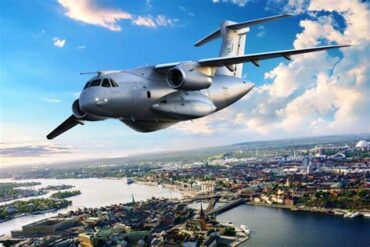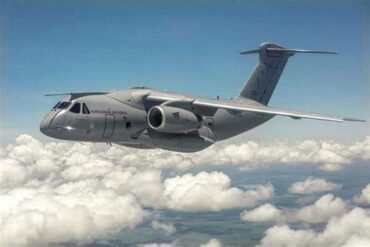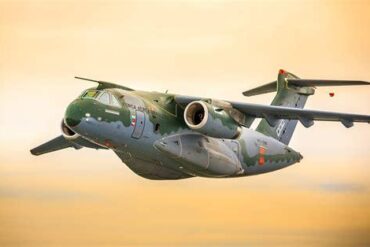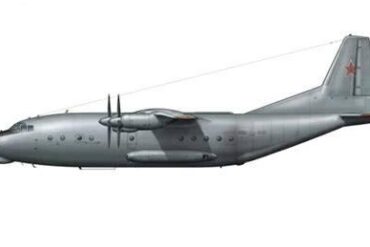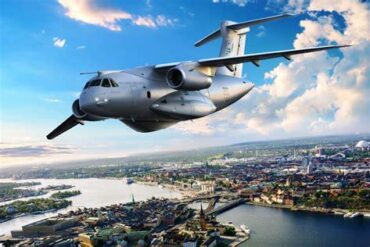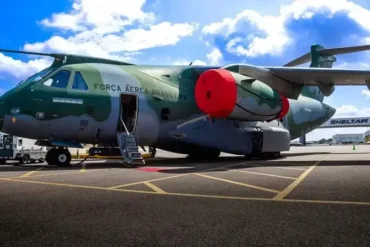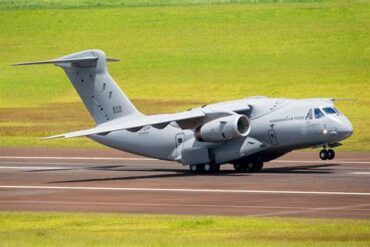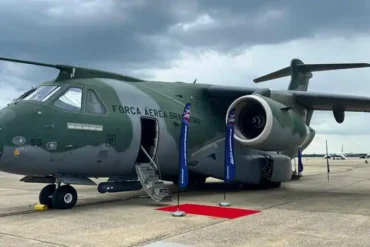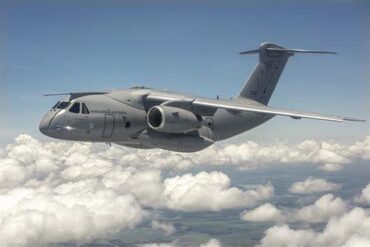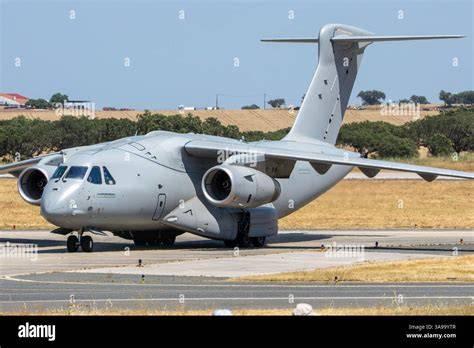
The Antonov An-178 was conceived at a moment when Ukraine’s aviation industry was trying to rebuild its position in the global transport-aircraft market. Designed as a modern medium-airlift jet, the aircraft was intended to replace aging Soviet transports while competing directly with emerging Western designs such as the Embraer C-390 Millennium. On paper, the An-178 offered the right combination of payload, speed, cargo flexibility, and military utility to become an important export aircraft.
Yet the aircraft’s story became inseparable from the political and industrial upheaval surrounding Ukraine. The collapse of the Soviet Union had already fractured Antonov’s enormous manufacturing network. Then, in 2014, Russia’s annexation of Crimea and the conflict in eastern Ukraine severed many of the remaining industrial links between the two countries. The An-178 survived that crisis only to face another devastating disruption after Russia’s full-scale invasion of Ukraine in 2022.
The result is one of aviation’s most frustrating “what if” stories. The An-178 was designed to challenge the C-390, but the aircraft never received the uninterrupted production run needed to prove itself. Meanwhile, Embraer moved from prototype development into serial production, international sales, and a rapidly expanding customer base.
Antonov’s Transport Aircraft Legacy After the Soviet Union
When the Soviet Union collapsed in December 1991, Antonov was one of the world’s largest producers of military transport aircraft. Its design bureau was based in Kyiv, while production was distributed throughout the Soviet industrial system. This arrangement had allowed Antonov to produce aircraft on a remarkable scale, but it also created a vulnerability that became obvious once the USSR disappeared.
Antonov’s portfolio included the An-26, An-32, An-72, An-74, and An-124, among many other aircraft. The company had produced more than 2,700 aircraft in the An-24/An-26 family, around 360 An-32s, approximately 200 An-72 and An-74 aircraft, and dozens of enormous An-124 transports. Its production history was even broader when the An-2 biplane and other Soviet-era programs were included.
By around 1990, Antonov was delivering roughly 170 to 200 aircraft annually. But those numbers depended on an integrated Soviet industrial network. Components, engines, production facilities, and final assembly operations were spread across several republics, including Ukraine, Russia, Uzbekistan, and Poland. Once those republics became independent states, the system that had supported Antonov’s high production rates effectively disappeared.
The problem was not simply political. The collapse of the Soviet military procurement system also destroyed much of the demand for new transports. Russia, Ukraine, and other former Soviet republics inherited large fleets of aircraft while facing severe financial constraints. International customers that had previously depended on Soviet military assistance increasingly turned toward Western suppliers.
The Long Road Back to a New Antonov Transport
Antonov survived the difficult 1990s and 2000s by becoming considerably smaller and more flexible. Instead of producing hundreds of aircraft annually, the company concentrated on aircraft modernization, maintenance, cargo operations, engineering, and niche aircraft production. New projects continued, including the An-140, An-70, An-148, and An-158.
That survival mattered because Antonov retained something few other Ukrainian aerospace organizations possessed: decades of accumulated expertise in designing and operating heavy and medium-sized transport aircraft. The company understood military cargo requirements, rough-field operations, airborne troops, oversized loads, and the practical demands of strategic and tactical airlift.
By the end of the 2000s, the market was beginning to offer another opportunity. Many Soviet-designed military transports were approaching the end of their service lives. Countries that had inherited An-12, An-26, and An-32 fleets needed replacements, while several emerging defense markets were looking for modern aircraft without necessarily committing to the largest Western airlifters.
This was the environment in which the Antonov An-178 emerged.
Antonov An-178 Development and Design
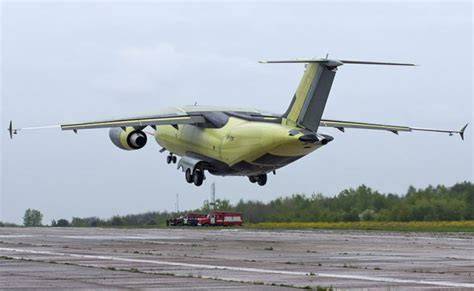
Announced in 2010, the An-178 was derived from Antonov’s An-158 regional jet. The prototype rolled out and made its first flight in 2015, giving Ukraine a modern jet-powered transport designed specifically for the medium-airlift market.
The aircraft was intended to replace several aging Soviet types, particularly the An-12, An-26, and An-32. It was also designed with international competition in mind. Antonov believed there could be a market for roughly 200 aircraft, making export sales essential to the program’s long-term viability.
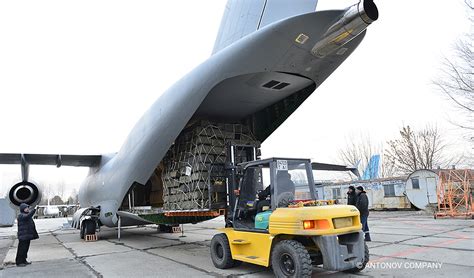
The An-178 was designed around a maximum payload of approximately 18,000 kilograms, or 39,700 pounds. It could carry up to 90 soldiers, 70 paratroopers, or a substantial military cargo load. Its two Progress D-436-148FM turbofans provided the propulsion, while the aircraft’s military transport configuration emphasized rapid loading and unloading and operational flexibility.
Its advertised ferry range was approximately 2,900 nautical miles, placing it in the same broad market as aircraft such as the C-130J and C-390. The important point was not that the An-178 was intended to dominate every category. Rather, Antonov wanted it to occupy the increasingly valuable middle ground between older turboprop transports and larger, more expensive strategic airlifters.
The An-178 Versus the Embraer C-390 Millennium
The Embraer C-390 Millennium represented one of the most serious challenges to Antonov’s ambitions. Both aircraft emerged from roughly the same period, and both targeted military customers looking for modern medium-sized jet transports.
The numbers reveal why the competition mattered. The An-178’s maximum payload was about 18,000 kilograms, while the C-390 was designed to carry approximately 26,000 kilograms. The C-390 also offered a substantially longer ferry range of around 4,410 nautical miles, compared with roughly 2,860 to 2,900 nautical miles for the An-178.
At the same time, the aircraft were not identical in every respect. The An-178 was designed to carry up to 70 paratroopers, while the C-390’s standard capacity is around 64 paratroopers. Both aircraft therefore addressed similar military missions, including troop transport, logistics, airborne operations, and humanitarian support.
The C-390’s greatest advantage, however, was not simply its specifications. It was industrial continuity. Embraer managed to turn the C-390 from a development program into an aircraft with actual production momentum. That allowed potential customers to evaluate an aircraft that was being built, delivered, supported, and progressively improved.
The An-178 never received the same opportunity.
Why 2014 Changed Everything for the An-178
The most damaging setback came in 2014, when Russia’s annexation of Crimea and the conflict in eastern Ukraine transformed the relationship between the two countries. For Antonov, the consequences were immediate because the Soviet aerospace industry had never been completely separated along modern national borders.
According to the reference material, around 60% of Antonov’s parts were imported from Russia at the time. That figure illustrates the scale of the problem. Even after more than two decades of Ukrainian independence, aircraft production still relied heavily on industrial relationships inherited from the Soviet period.
The rupture meant that Antonov could no longer depend on many Russian suppliers. Components, engines, equipment, and production processes suddenly became strategic liabilities. A modern aircraft program cannot simply replace thousands of interconnected parts overnight, especially when the manufacturer has limited production volume and limited financial resources.
For the An-178, the crisis was particularly serious because the aircraft was still transitioning from prototype development toward production. It needed customers, suppliers, financing, certification work, and a stable manufacturing system at exactly the moment when Ukraine’s aerospace industry was losing access to part of its traditional supply chain.
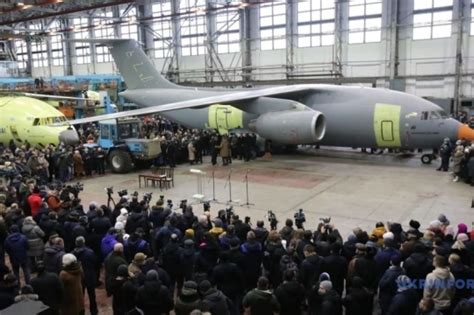
The An-178 Finally Eliminated Russian Components
Antonov did not simply abandon the program. Instead, Ukraine undertook the difficult task of removing Russian components from the An-178. The resulting An-178-100R represented a major engineering and industrial achievement because it demonstrated that the aircraft could eventually be adapted to a completely different supply base.
That process, however, consumed valuable time. Antonov needed to rebuild relationships with suppliers, redesign affected systems, qualify replacement components, and establish manufacturing capabilities that had previously depended on Russian industry.
Before the broader crisis of 2022, there were signs that the program might finally move forward. Antonov had secured interest from several potential customers, including Peru, while Ukraine itself remained interested in acquiring the aircraft. There were also expressions of interest from countries and organizations in the Middle East, Asia, and elsewhere.
In 2020, reports indicated that Antonov was assembling the fuselage for a new An-178 intended for Peru. After years of industrial disruption, the program appeared to have a possible path toward serial production.
Then came another major interruption.
Russia’s 2022 Invasion Put the Program on Ice
The full-scale Russian invasion of Ukraine in 2022 effectively ended any realistic prospect of near-term An-178 production. Antonov’s industrial facilities were directly affected by the war, while the destruction and disruption surrounding Hostomel further damaged Ukraine’s ability to manufacture large aircraft.
This was fundamentally different from a normal commercial setback. Antonov was not merely dealing with weak sales or a delayed certification program. Its country was fighting a major war, its industrial infrastructure was under attack, and its resources were increasingly directed toward national defense.
As of mid-2026, the An-178’s production record remained extraordinarily small: the original prototype that first flew in 2015 was still the only completed aircraft of the series. Orders and letters of intent that had accumulated over the years had not translated into a mature production fleet.
That is the central tragedy of the program. The aircraft did not fail because customers universally rejected its concept. It failed to receive the stable industrial environment required to become a credible mass-produced competitor.
Embraer C-390 Gained the Opportunity Antonov Lost
While Antonov’s program repeatedly encountered political and industrial obstacles, Embraer’s C-390 continued moving forward. The Brazilian aircraft manufacturer benefited from a more stable production environment and eventually established the aircraft as a serious international contender.
The C-390’s growing customer list demonstrates the importance of timing in military aviation. Defense ministries generally want aircraft that can be delivered on schedule, supported for decades, and integrated into established logistics networks. A technically promising aircraft that exists primarily as a prototype is much harder to select than one backed by an active production line.
This is where the An-178’s lost decade became particularly costly. Every year of delay gave the C-390 more time to build credibility. Potential customers that might once have evaluated the Ukrainian aircraft had increasingly strong reasons to choose a Western-produced alternative.
The C-390 also benefited from the broader shift in defense procurement among countries that once operated Soviet-designed equipment. As those nations modernized their fleets, they increasingly looked toward NATO-compatible aircraft and Western supply chains.
Poland provides a useful example of this broader transformation. Countries that once relied heavily on Soviet-era transports were increasingly purchasing Western systems, including the C-130, C-27J, and eventually the C-390.
Antonov Has Not Completely Abandoned the An-178
Despite the setbacks, the An-178 remains an important part of Antonov’s future ambitions. The company continues to focus on aircraft design and engineering, maintenance and modernization, Antonov Airlines cargo operations, and planning for eventual production.
A return to large-scale manufacturing would require far more than restarting an assembly line. Ukraine would need secure facilities, financing, suppliers, skilled workers, certification infrastructure, and reliable access to international markets. Most importantly, potential customers would need confidence that Antonov could support their aircraft over several decades.
That makes the postwar environment critical. If Ukraine eventually achieves sufficient security and attracts enough investment to rebuild its aerospace sector, Antonov could once again have an opportunity to produce the An-178-100R and potentially develop newer Western-integrated transport aircraft.
The company also retains an advantage that should not be underestimated: Russia itself has not produced a directly equivalent modern medium-sized transport in significant international quantities. Russia continues to operate and develop larger Il-76-family transports, but its own medium-airlift fleet remains heavily dependent on aging Soviet-era An-series aircraft.
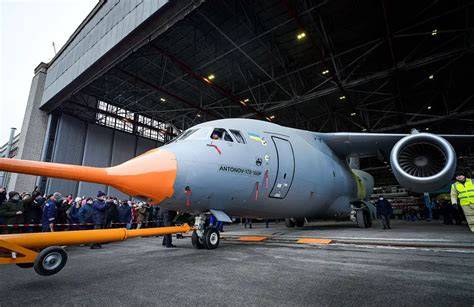
The An-178’s Unfinished Challenge to the C-390
The story of the Antonov An-178 is ultimately about more than one aircraft. It illustrates how aerospace programs depend on industrial ecosystems, geopolitical stability, financing, and timing just as much as engineering.
Antonov created a credible concept for a modern Ukrainian medium-airlift jet. The An-178 offered meaningful payload capacity, military flexibility, a rear cargo ramp, airborne troop capability, and a design philosophy rooted in decades of Antonov transport experience. It entered development at precisely the moment when many older Soviet transports were approaching retirement.
But the aircraft’s timing proved disastrous. The Soviet Union’s collapse fractured Antonov’s industrial foundation, the 2014 Russo-Ukrainian rupture destroyed critical supply-chain relationships, and the 2022 invasion prevented the program from reaching sustained production.
Meanwhile, the C-390 had the time and industrial stability needed to mature into a real competitor. That difference may ultimately define the two aircraft’s histories more than their technical specifications ever could.
The An-178 was supposed to challenge the C-390 in a market worth billions of dollars. Instead, it became a symbol of what Ukraine’s aerospace industry might have achieved under different circumstances. If Antonov eventually returns to production, the An-178 could still have a second act. But by then, the market it was designed to enter may look very different.
The most painful part of the An-178 story is that Antonov never truly got the chance to find out how good its aircraft could have been.