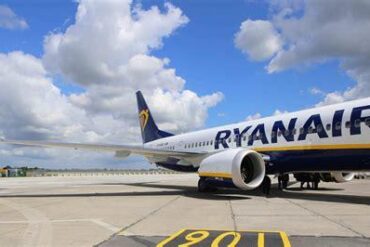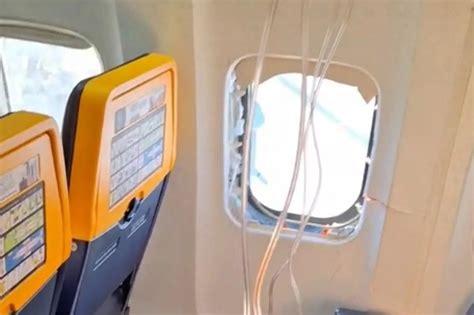
A Ryanair Boeing 737 suffered severe engine damage during the climb from Thessaloniki International Airport in Greece on July 10, 2026, in an incident that left a passenger seriously injured after part of his body was pulled through a damaged cabin window. A preliminary investigation by the National Transportation Safety Board (NTSB) has now uncovered bird remains inside the affected engine, providing investigators with important evidence as they work to establish what caused the failure.
The passenger, Serbian national Ljubisa Karović, was seated beside the window when engine components apparently struck and shattered the window during the aircraft’s climb. His head and right shoulder were pulled outside the aircraft, while his wife reportedly held onto his legs to prevent him from being completely pulled through the opening. Karović suffered serious injuries in the frightening incident aboard Ryanair Flight 1879, operated by Malta Air.
The aircraft was subsequently unable to continue its planned journey to Memmingen Airport in Germany. A replacement aircraft transported the passengers to their destination, with the disruption resulting in an approximately four-hour delay. The incident immediately raised questions about the condition of the engine, the possibility of foreign object damage, and whether previous damage may have contributed to the failure.
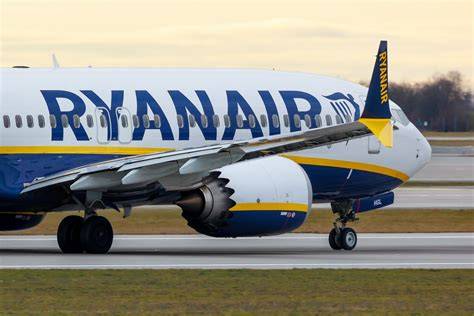
NTSB Investigation Finds Bird Remains Inside the Damaged Engine
The NTSB’s preliminary report does not establish a final cause, but investigators have confirmed that bird remains, including feathers, were recovered from several locations inside and around the affected engine. Evidence was found on the forward face of the integrated drive generator oil cooler, one of the thrust reverser blocker door drag links, and the lower section of the engine fan case near the thrust reverser split flange.
The discovery has strengthened the possibility that a bird strike played a role in the engine failure. Investigators have collected both the recovered remains and samples from the engine’s fan blades and sent them to the Smithsonian Institution’s Feather Identification Lab in Washington, DC. The laboratory examination should help determine the species involved and potentially provide additional evidence about how and when the birds entered the engine.
However, the NTSB has emphasized that the discovery of feathers does not by itself prove that a bird strike occurred during the accident flight. Investigators must determine whether the remains are associated with a fresh impact or could relate to an earlier event.
Four Previous Bird Strikes Reported on the Same Engine
The investigation has uncovered another potentially important detail. Flight crews reportedly documented four bird strikes involving the number two engine during the 12 months before the July 2026 accident. That history could become significant if investigators determine that previous impacts weakened or damaged engine components.
At the same time, the NTSB has not concluded that those earlier strikes caused the accident. The engine may have sustained damage during a previous event, while the bird remains discovered after the accident could represent either a new strike or evidence associated with earlier damage. Establishing the sequence will therefore be central to the investigation.
Ryanair’s Foreign Object Damage Theory Draws NTSB Rebuke
The findings also give new context to comments made shortly after the accident by Ryanair Group CEO Michael O’Leary. O’Leary publicly speculated that the incident appeared to involve foreign object damage to the engine during takeoff from Thessaloniki. He did not initially identify the object as a bird.
NTSB Chair Jennifer Homendy subsequently criticized the comments, stating that investigators had not reached such a determination. She also wrote directly to O’Leary over concerns that his remarks conflicted with information-disclosure rules associated with ongoing international aviation safety investigations.
Ryanair Chief Executive Eddie Wilson adopted a more cautious position. He acknowledged that the engine had suffered severe damage and that photographs existed, but said the airline would wait for the NTSB and Greek authorities to complete their work before drawing conclusions.
Engine Inspections Had Not Previously Found Cracks
The preliminary report also addresses whether maintenance history could have contributed to the accident. Investigators found cracking and 360-degree shear buckling on the exhaust case immediately behind the engine turbine rear frame, demonstrating the seriousness of the damage.
Yet available maintenance records indicate that required inspections had been performed. The engine’s fan blades underwent ultrasonic inspections on November 11, 2025, and again on May 24, 2026, just 253 flight cycles before the accident. Both inspections reportedly found no problems, including evidence of crack development.
The aircraft’s cabin safety systems also functioned as designed. According to the preliminary findings, the oxygen masks deployed properly, indicating that prescribed emergency procedures and equipment performance were not identified as contributing factors at this stage.
Bird Strike Evidence Could Reshape the Investigation
The presence of bird remains makes a bird strike an important investigative avenue, but the NTSB’s preliminary findings stop well short of declaring it the cause. Investigators still need to establish the timing of any strike, determine how it affected the engine, and explain the chain of failures that ultimately resulted in engine components damaging the passenger window.
For now, the incident illustrates how bird strikes can create complex chains of mechanical and operational consequences, particularly when an aircraft has a documented history of previous wildlife encounters. The Smithsonian laboratory’s findings, combined with engine examination and flight-data evidence, should provide a clearer picture of what happened.
The NTSB investigation remains ongoing, and the preliminary report is not a final determination of probable cause. Until investigators complete their analysis, the most significant conclusion is simply that bird remains were found in the damaged engine, adding a potentially crucial piece of evidence to one of the most unusual passenger injury incidents involving a Ryanair flight in recent years.