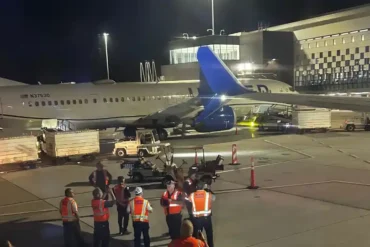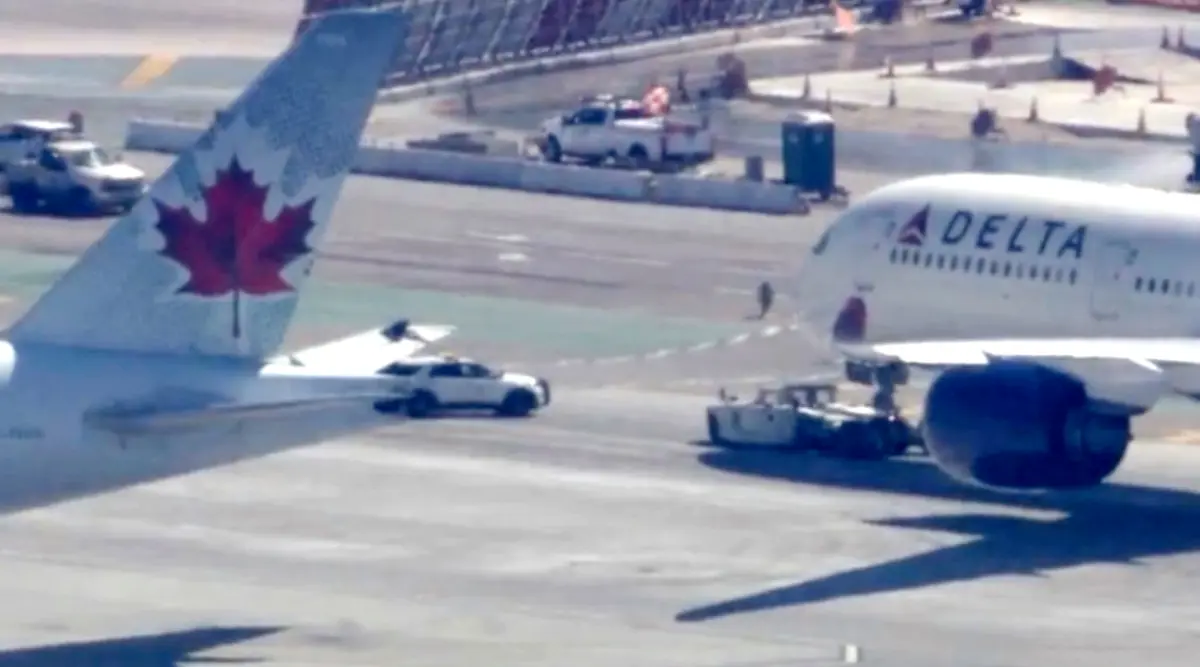
A Delta Air Lines Airbus A350-900 collided with an Air Canada Boeing 777-200LR while taxiing at Los Angeles International Airport (LAX) on Tuesday morning, leaving the A350’s left winglet wedged into the Canadian aircraft’s right horizontal stabilizer. The unusual ground collision occurred as Delta Flight DL7 prepared to depart for Tokyo Haneda, while the Air Canada 777 was being towed toward a gate after arriving from Toronto.
Despite the size of both aircraft and the visible damage caused by the impact, no injuries were reported. Delta had 275 passengers and 15 crew members aboard the A350, while the Air Canada aircraft had completed its passenger flight and was being repositioned on the ground. Both aircraft were subsequently taken out of service for detailed inspections and repairs.
The incident also prompted an investigation involving the Federal Aviation Administration (FAA), with the National Transportation Safety Board notified. Investigators now face the task of reconstructing the movements of two exceptionally large widebody aircraft operating in a busy airport environment.
Delta A350 Wingtip Strikes Air Canada Boeing 777 at LAX
The collision occurred at approximately 10:30 a.m. local time near Terminal 6 as Delta’s A350 was taxiing toward the runway for its scheduled flight to Tokyo. The aircraft, registered N512DN, had been delivered to Delta in January 2019 and was operating DL7 to Haneda Airport.
At roughly the same time, an Air Canada Boeing 777-200LR, registered C-FIVK, was being towed after arriving at LAX as Flight AC785 from Toronto Pearson International Airport. According to information released after the incident, the 777 stopped short of its intended gate.
As the Delta A350 passed the Air Canada aircraft, its left wingtip struck the 777’s right horizontal stabilizer. The impact was forceful enough to remove the A350’s winglet and leave the detached structure lodged in the tail of the Boeing 777.
Photographs from the scene showed substantial damage around the Air Canada aircraft’s horizontal stabilizer, including a large gash in the tail structure. The A350 also sustained damage around its left wingtip, although the precise extent of structural damage could only be established through inspection.
The unusual geometry of the accident made the event particularly striking. Rather than simply scraping another aircraft, the A350’s wingtip component became physically embedded in the 777’s tail, creating an immediate indication that both aircraft would require maintenance before returning to service.
ATC Recordings Capture Crew Reports After Collision
The collision was also captured through air traffic control communications, providing investigators with an important record of what the crews observed immediately afterward.
The Air Canada crew reported feeling a shudder and asked whether everything appeared normal. The Delta crew subsequently reported an apparent problem with its wingtip and indicated uncertainty about whether the controller could see the damage from their position.
The FAA later confirmed the basic sequence of events, stating that Delta Flight 7 was taxiing for departure when its left wingtip clipped the horizontal stabilizer of Air Canada Flight 785, which was being towed after stopping short of its gate.
The communications could become significant as investigators establish the exact positions of the aircraft at the moment of contact. Ground movements involving large widebody jets require substantial clearance, and the investigation will need to determine how the aircraft reached a position where their structures could overlap.
Two of LAX’s Largest Widebody Aircraft Were Involved
The collision involved two aircraft with remarkably similar wingspans. The Airbus A350-900 has a wingspan of approximately 64.75 meters, or 212 feet, while the Boeing 777-200LR measures approximately 64.8 meters, or 212 feet 7 inches across its wings.
That enormous physical footprint is particularly relevant on airport taxiways and apron areas. Even a relatively small change in position can place a wingtip or horizontal stabilizer much closer to another aircraft than may be apparent from the cockpit.
The A350 involved in the accident can accommodate up to 275 passengers in Delta’s configuration, while Air Canada’s 777-200LR aircraft can carry up to 300 passengers across three cabin classes. The aircraft therefore represent significant assets for both airlines, making the need for careful structural inspection especially important after a collision involving primary flight surfaces.
What Investigators Will Examine After the LAX Collision
The central questions will involve why the Air Canada Boeing 777 stopped short of its gate, exactly where it was positioned, and how its location interacted with the taxi path used by the Delta A350.
One passenger aboard the Delta aircraft reportedly told ABC7 News that the Air Canada aircraft began moving into the A350’s path as the Delta jet taxied away from the gate toward the runway. That account will need to be evaluated alongside aircraft tracking data, ground-control communications, tow-team procedures, airport markings and other available evidence.
Investigators will also need to determine what instructions were issued to the Delta crew and the towing team. Neither airline nor the FAA had publicly detailed those instructions in the material available at the time of the report.
Because both aircraft were moving or being repositioned in a confined airport environment, the investigation is likely to focus on the precise sequence of movements rather than simply the moment of impact. Establishing who had which clearance, where each aircraft was located, and how the crews or tow operators perceived their surroundings will be critical to understanding how the collision occurred.
Delta DL7 Continued With a Replacement A350
The damaged Delta A350 remained on the ground at LAX for inspection and repairs. Delta ultimately operated Flight DL7 to Tokyo Haneda with a replacement A350, but the departure was delayed by more than eight hours, with the flight leaving Los Angeles at approximately 6:08 p.m.
The Air Canada Boeing 777, meanwhile, had been scheduled to operate the return service to Toronto as AC786. That flight was canceled after the aircraft was removed from service.
For passengers, the incident therefore created consequences extending well beyond the initial ground contact. Although no one was injured, the damage to two widebody aircraft disrupted international schedules and required replacement aircraft, maintenance resources and additional operational planning.
The collision demonstrates how a ground incident involving two aircraft that are otherwise fully capable of long-haul international operations can quickly become a major disruption. At LAX, where large aircraft routinely maneuver through congested taxiways, gates and terminal areas, maintaining adequate separation remains essential—even when aircraft are moving at very low speeds.
The investigation will ultimately determine how the Delta A350 and Air Canada Boeing 777 came into contact and whether procedural, positioning or communication factors contributed to the collision. Until investigators complete that work, the dramatic sight of an A350 winglet lodged in the tail of a 777 offers only the visible beginning of a much more detailed reconstruction of what happened on the LAX taxiway.