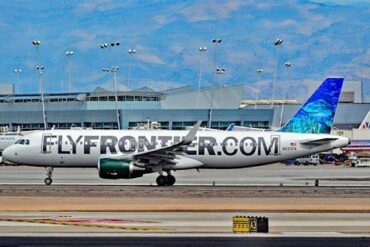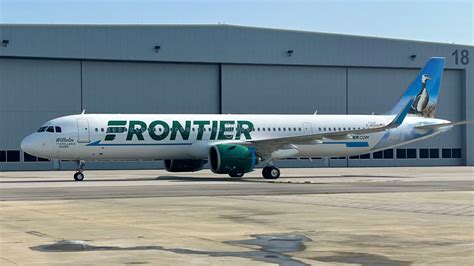
The late-night calm of Los Angeles International Airport was abruptly broken when a Frontier Airlines flight crew was forced into a split-second decision that likely prevented a serious accident. What should have been a routine taxi for departure turned into a high-stakes moment of situational awareness, as two unauthorized ground vehicles crossed directly into the aircraft’s path.
Operating an Airbus A321neo, Frontier Flight 3216 had already been delayed more than an hour before finally pushing back from the gate. The aircraft was preparing for a red-eye departure to Atlanta, a common overnight route that typically sees heavy ground congestion at one of the world’s busiest airports. But what unfolded on the taxiway exposed a vulnerability that continues to trouble aviation safety experts: ground vehicle incursions in critical movement areas.
The cockpit audio, captured through air traffic control communications, reveals a calm yet urgent exchange. The pilots, clearly shaken but composed, alerted controllers that “two trucks just cut us off,” forcing them to slam on the brakes to avoid a collision. It was a rare but chilling moment—one that highlights how even modern aviation systems still depend heavily on human vigilance.
A Near-Miss Unfolds in a Blind Spot at LAX
The incident took place in a part of the airfield that is notoriously difficult to monitor. Known within aviation circles as an “ATC non-visibility area,” this zone sits between terminal structures, limiting the line of sight for ground controllers. Despite sophisticated radar systems and surveillance technology, not every corner of a major airport is fully visible in real time.
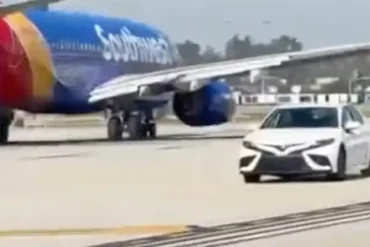
As the aircraft transitioned from taxiway Kilo toward Bravo, the unexpected happened. Two trucks entered the taxi route without clearance, cutting across the aircraft’s path. With limited time to react and no immediate warning from controllers, the pilots relied entirely on visual detection.
The braking maneuver was abrupt enough for the captain to express concern about passengers and cabin crew in the rear of the aircraft. In the audio, the pilot described the moment as “the closest I’ve ever seen,” underscoring just how narrow the margin of safety had become.
Why Air Traffic Control Didn’t See It Coming
Despite the critical nature of the event, air traffic control was initially unaware of the near-collision. When the pilots radioed in, the controller responded with a simple but concerning admission: “No.”
This wasn’t negligence—it was a limitation of infrastructure. The affected taxiway intersection lies within one of several blind spots identified in Federal Aviation Administration airport diagrams. These areas rely more heavily on pilot reporting and ground coordination than on direct visual oversight.
Controllers quickly shifted into response mode, contacting airport operations and relaying the last known position of the vehicles. The description was vague—two trucks heading eastbound, one possibly turning off—but enough to trigger a search involving airport authorities.
The Growing Risk of Ground Vehicle Incursions
This incident is not isolated. In recent years, runway and taxiway incursions involving ground vehicles have become an increasingly discussed safety concern. The complexity of modern airports, combined with high traffic volumes and multiple service providers, creates an environment where coordination errors can have immediate consequences.
Aviation professionals often point to one critical issue: the lack of mandatory transponders on all ground vehicles. Without these devices, vehicles remain invisible to both pilots’ onboard systems and certain air traffic surveillance tools.
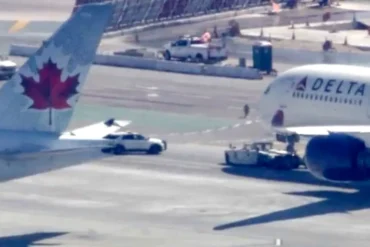
The conversation has intensified following a recent fatal accident involving an Air Canada aircraft, where preliminary findings suggested that an emergency vehicle lacked a functioning transponder. While investigations are ongoing, the parallels are difficult to ignore.
At LAX, it remains unclear whether the trucks involved in this near-miss were equipped with such systems. What is clear, however, is that the absence of real-time tracking significantly increases risk, particularly in low-visibility or high-traffic zones.
Pilot Vigilance: The Last Line of Defense
What ultimately prevented disaster was not automation or ground control—it was pilot awareness and decisive action. The ability to detect unexpected movement, assess the threat instantly, and execute a full stop under pressure is a testament to rigorous training and cockpit discipline.
Moments like this reinforce a fundamental truth in aviation: technology enhances safety, but human judgment remains irreplaceable.
The crew’s response earned praise from Frontier Airlines, which commended their “vigilance and professionalism.” While such statements are standard in corporate communications, in this case, they carry genuine weight. A delay of mere seconds—or a lapse in attention—could have resulted in a catastrophic ground collision.
What Happens Next: Investigation and Accountability
Airports like LAX are equipped with extensive surveillance systems, including high-resolution cameras covering most operational areas. While the incident occurred in a visual blind spot for controllers, it is unlikely to remain unresolved. Investigators will review footage, vehicle logs, and radio communications to determine exactly how the trucks entered the taxiway.
Responsibility could fall on multiple parties: vehicle operators, airport authorities, or procedural gaps in ground movement coordination. Regardless of the outcome, such incidents often lead to tightened protocols and renewed safety directives.
A Wake-Up Call for Aviation Safety Systems
This near-miss serves as a stark reminder that even in one of the most advanced aviation environments on the planet, risk persists in the margins. The intersection of human factors, infrastructure limitations, and technological gaps creates scenarios where seconds matter—and mistakes can escalate rapidly.
For passengers onboard Flight 3216, the event may have gone largely unnoticed beyond a sudden stop. But behind the scenes, it represents a critical data point in an ongoing effort to make aviation even safer.
The skies may be meticulously managed, but as this incident proves, the ground can be just as unpredictable.