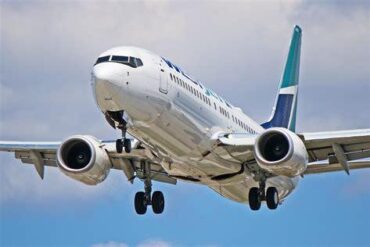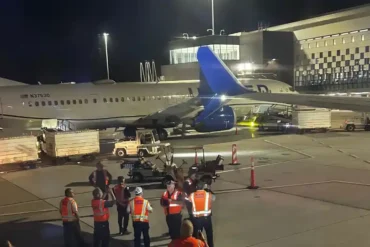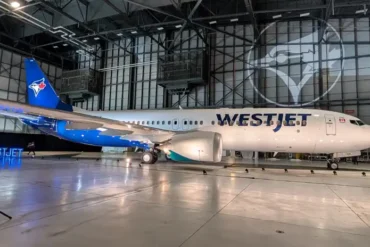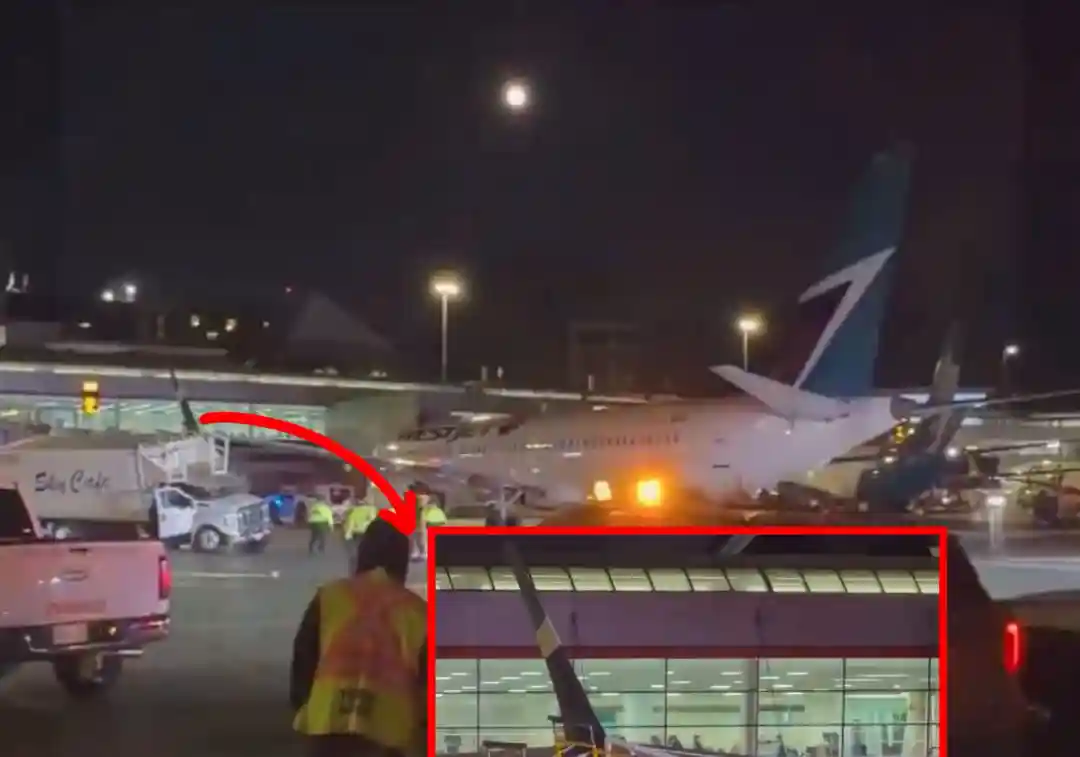
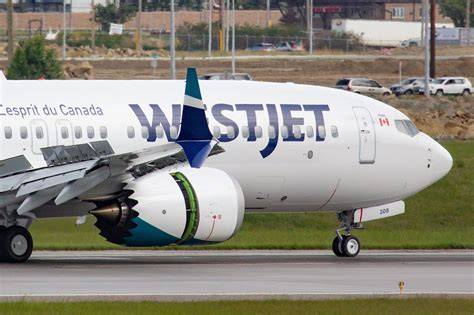
A WestJet Boeing 737 MAX 8 sustained damage at Toronto Pearson International Airport (YYZ) on Tuesday evening when its winglet struck a parked catering truck while the jet was being towed, an incident that has revived scrutiny of the ground-handling risks that quietly cost the airline industry billions of dollars every year. Nobody was injured in the collision, and no passengers or flight crew were aboard at the time, according to Global News. The aircraft, registered C-FRYV, had landed at YYZ roughly two hours earlier operating as WS2221 from Puerto Vallarta’s Licenciado Gustavo Díaz Ordaz International Airport (PVR).
Video of the aftermath spread quickly across social media, where early posts described the jet as taxiing to its gate after a completed flight. That framing was inaccurate. WestJet and Canada’s Transportation Safety Board (TSB) both confirmed the aircraft was under tow, moving without engines running and without a crew in the flight deck, a detail that materially changes how the event should be understood. The TSB said the collision occurred at approximately 8:15 PM on Tuesday, prompting airport emergency response units to be activated shortly afterward.
Addressing the incident directly, a WestJet spokesperson told Simple Flying on Wednesday that “an aircraft winglet made contact with a parked catering truck while being towed to an overnight parking pad at Toronto Pearson International Airport,” adding that “there were no guests on board, and no injuries were reported.” The statement reinforces that this was a maintenance-positioning movement rather than a revenue flight, which limits the immediate passenger impact but does not diminish the potential repair burden on a widebody-priced narrowbody asset.
The TSB confirmed the tow was unrelated to any prior or planned flight and said that while it is gathering information about the event, it did not plan to deploy investigators to the scene. That decision suggests the board currently views the occurrence as a ground-handling matter rather than one demanding a full field investigation, though the classification could shift if evidence of systemic failure emerges. The extent of the damage to C-FRYV and any subsequent operational disruption have not been officially confirmed.
Winglet Strike Highlights the Narrow Margins of Ramp Operations
The WestJet collision is a textbook example of how little clearance separates an airliner from the vehicles servicing it. Catering trucks routinely position beside the fuselage and extend hydraulic lifts to cabin doors, operating inches from wings, engine cowlings, and winglets. On a 737 MAX 8, the upward-curving winglet sits at a height and angle that is easy to misjudge from a truck cab mirror, particularly during a tow when the aircraft is moving under external control and the driver’s sightlines are already compromised. This is not WestJet’s first encounter with such equipment: in 2019, one of its aircraft was reversed into a catering truck while being pushed back from the gate at Vancouver International Airport (YVR).
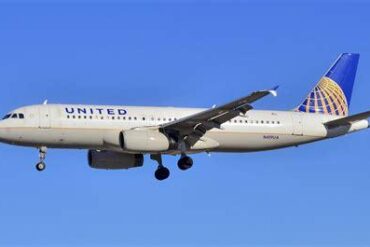
The pattern extends far beyond Canada. In May 2026, a United Airlines Airbus A320 struck at the rear fuselage at Ronald Reagan Washington National Airport (DCA) was subsequently sent for scrapping. In April 2026, a Singapore Airlines Airbus A380 suffered engine cowling damage in Singapore and required a replacement aircraft, while an unattended catering vehicle rolled into an Airbus A320 engine at Kolkata in the same month. In June 2025, a catering van struck an American Eagle Embraer E175 in Boston, injuring the driver. In March 2025, a truck pierced the fuselage of a LATAM Boeing 777-300ER in Milan, canceling the flight. December 2024 brought a catering truck overturning during a 737 towing collision at Miami, and a taxiing Boeing 737-900 clipped a truck with its wing at Sacramento in November 2024. Similar episodes struck Alaska Airlines in Seattle in September 2024, Lufthansa in Frankfurt in January 2024, Viva Aerobus in Guadalajara in March 2023, Flyadeal in Riyadh in May 2022, LOT Polish Airlines at London Heathrow in December 2021 — where a 737 MAX 8 winglet was damaged and a flight canceled — and Japan Airlines in Jakarta in February 2020.
Ground Damage Costs Billions and the Repair Bill Is Only the Beginning
Data drawn from six years of the International Standard for Business Aircraft Handling program shows that 26% of ground incidents involved contact with ground-support equipment or vehicles and 25% involved towing or pushback, with fixed objects at 15% and other aircraft at 10%. Although the dataset covers business aviation, it describes hazards that apply with equal force to commercial narrowbodies operating on tight turnaround schedules at congested hub airports. IATA’s 2025 Annual Safety Report estimates that ground damage costs the industry more than $4.5 billion annually and could reach $9.7 billion within 15 years without stronger prevention measures.
The economics of a single ramp accident are routinely underestimated. Aviation consultant Steven Bentley has estimated direct costs of around $250,000 for a typical occurrence, with indirect costs potentially reaching ten times the physical repair bill. Those indirect expenses include replacement aircraft, redeployed maintenance personnel, passenger rebooking, accommodation, and lost aircraft availability. The Singapore Airlines A380 case illustrates the cascade: substituting an aircraft delayed its Frankfurt departure by hours and ultimately forced cancellation of the return flight because of the airport’s curfew. The LATAM 777 damaged in Milan stayed out of commercial service for nearly three weeks, with costs estimated in the millions.
Online reaction to the WestJet footage carried a familiar dark humor. Comments beneath the video included “Cmon. There’s a Delta A350 around there somewhere” and “Oh my, all that delicious airplane food will be wasted.” The first quip nods to Delta Air Lines’ recent string of high-profile ground collisions, including one earlier this month that left an A350-900’s winglet wedged in the tail of an Air Canada aircraft. For WestJet, the repair bill for C-FRYV and the time the jet spends out of service remain unknown, but the incident underscores a familiar truth: the most expensive damage to an airliner often happens on the ground, at walking pace, just meters from the terminal.