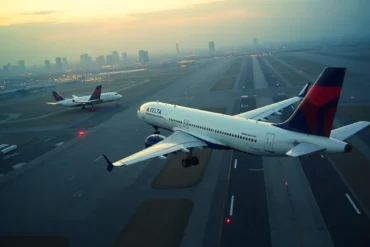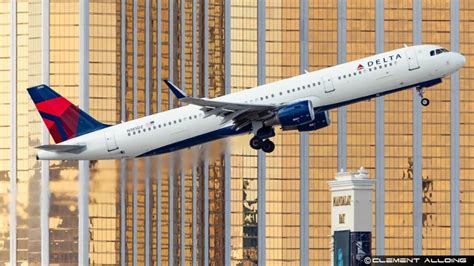
Tension crackled across Kennedy Tower frequencies on February 19, 2026, when a routine taxi instruction at New York’s John F. Kennedy International Airport (JFK) spiraled into a sharp exchange between a Delta Air Lines pilot and an air traffic controller already known in aviation circles for his uncompromising style. The incident, involving Delta Flight DL806, an Airbus A321neo bound for Las Vegas (LAS), has reignited debate about cockpit accountability, controller temperament, and the razor-thin margin between precision and pressure in one of the world’s most complex airfields.
JFK is not a forgiving place to improvise. Its taxiways braid together like circuitry on a motherboard, with aircraft streaming in from every corner of the globe. Controllers speak quickly because they must; seconds matter. Yet clarity matters just as much. In this case, both sides were technically competent. The friction came from tone.
The exchange began with what should have been routine choreography. The controller instructed Delta 806 to taxi behind a second JetBlue aircraft, turn right onto Taxiway Bravo, and hold short of Juliet en route to Runway 4L. The Delta pilot read back the clearance accurately. Moments later, however, the A321neo turned right onto Taxiway Alpha instead of Bravo.
Taxiway Alpha Instead of Bravo: A Minor Error With Major Tone
In operational terms, the mistake was not catastrophic. Aircraft were moving in the same direction on both Alpha and Bravo, and there was no immediate traffic conflict. Controllers handle far more consequential deviations daily. But aviation is a discipline of details, and taxiway assignments are not suggestions. They are instructions.
The controller’s response was immediate and sharp: “That’s crazy, hold your position.” The Delta pilot complied. The controller pointed out that the instruction had been clearly issued and correctly read back. He was right on the facts.
The pilot replied, “I made a mistake, don’t freak out on me. I make mistakes.”
That line shifted the exchange from technical correction to emotional tension. In high-stakes environments, tone becomes part of safety culture. The controller rejected the characterization, insisting no one was “crashing out” and directing the aircraft to continue via Alpha and hold short of Kilo Echo.
From a purely procedural standpoint, the situation was resolved quickly. The aircraft repositioned as instructed. No ground incursions occurred. No traffic conflicts developed. The system worked. But the radio frequency told a different story.
“Don’t Freak Out On Me”: When Professionalism Meets Pressure
Air traffic control is built on authority, brevity, and standard phraseology. The language is designed to reduce ambiguity, not escalate it. The phrase “that’s crazy” may reflect frustration, but it does not belong to standardized aviation communication. When pilots perceive emotional commentary layered onto instruction, defensiveness can creep in.
The Delta pilot’s retort—asserting human fallibility—was honest, perhaps even refreshing. Aviation culture often projects near-infallibility, yet every system is designed around the assumption that humans will err. That is why there are readbacks, cross-checks, surface movement radar, and layered redundancies.
Still, acknowledging error does not neutralize it. Taxi deviations at major hubs can become serious if compounded. Controllers, especially those who manage high-density airports like JFK daily, develop an acute sensitivity to deviations. They see patterns. They anticipate domino effects. To them, a “small” wrong turn is not small; it is the first crack in a chain that could widen.
EDCT Tension and the Phone Number Threat
After repositioning, Delta 806 reportedly waited before departure. The pilot, sensing delay, transmitted a pointed comment: were they sitting until missing their EDCT (Expect Departure Clearance Time) because the controller was angry?
That remark crossed into risky territory. Controllers guard frequency discipline fiercely. Personal commentary on active frequencies can interfere with operational clarity. The controller responded with a warning: one more irrelevant comment would result in a phone number to the tower and a supervisor.
In aviation, receiving a phone number is never symbolic. It signals a post-incident review, sometimes mandatory reporting. It can mean paperwork, internal review, and potential retraining. The warning served as a boundary marker. Shortly thereafter, Delta 806 departed without further incident.
The Reputation Factor at JFK
JFK controllers are famously direct. The airport’s complexity and relentless traffic volume reward decisiveness. But one controller in particular has developed a reputation online for his brusque style, especially in interactions that surface on publicly shared ATC audio recordings.
Experience can breed confidence. Confidence can harden into impatience. A controller who manages the same grid of pavement daily develops intimate knowledge of its flow. Pilots, by contrast, operate globally. JFK may be one of dozens of airports they encounter in a given month. Familiarity asymmetry is real.
That mismatch can create friction. The controller expects immediate spatial awareness. The pilot is integrating new taxi diagrams, signage, lighting conditions, and traffic patterns in real time. Both are professionals. Both are under pressure. The margin for misunderstanding shrinks with speed.
Human Factors in High-Performance Systems
Aviation safety science revolves around human factors—the study of how humans interact with complex systems. Stress, workload, communication style, and cognitive load all influence performance. Rapid-fire instructions increase efficiency but also elevate the risk of slips. Emotional language increases compliance urgency but may undermine collaborative tone.
The remarkable part of this episode is not that a mistake occurred. It is that the system absorbed it. The aircraft stopped. The controller corrected. Separation was maintained. Redundancies functioned.
The troubling part is cultural. Aviation depends on psychological safety—the unspoken agreement that errors will be corrected firmly but professionally. When either side perceives hostility, communication can stiffen. Defensive communication is slower communication. Slower communication in dense airspace is not ideal.
Precision, Pride, and the Sound of Authority
There is a subtle dance between authority and humility in aviation. Controllers must project command. Pilots must accept direction. Yet both are bound by shared accountability. The Delta pilot’s candid admission—“I make mistakes”—is almost philosophically aligned with aviation’s design philosophy. Systems are built assuming imperfection.
The controller’s insistence that no one was “crashing out” suggests a sensitivity to how tone is perceived. Language on frequency is not just functional; it is cultural. Every clipped syllable echoes through an ecosystem built on trust.
In the end, Delta Flight DL806 lifted off for Las Vegas only minutes later. The aircraft climbed into smooth winter sky, leaving behind nothing more tangible than a digital audio file and a wave of commentary across aviation forums.
But the exchange endures as a microcosm of modern aviation: hyper-competent professionals, dense infrastructure, relentless tempo, and human emotion threading through it all. At 30 knots on a taxiway or 500 knots at cruise, the aircraft obeys physics. The humans navigating it must manage something messier—each other.