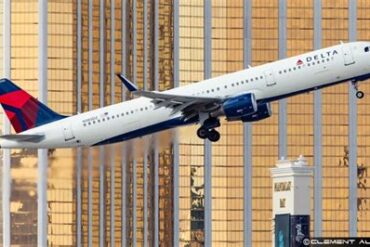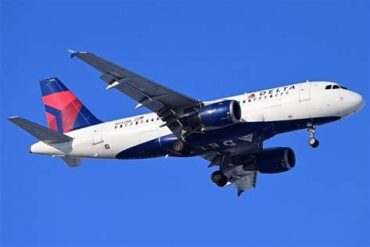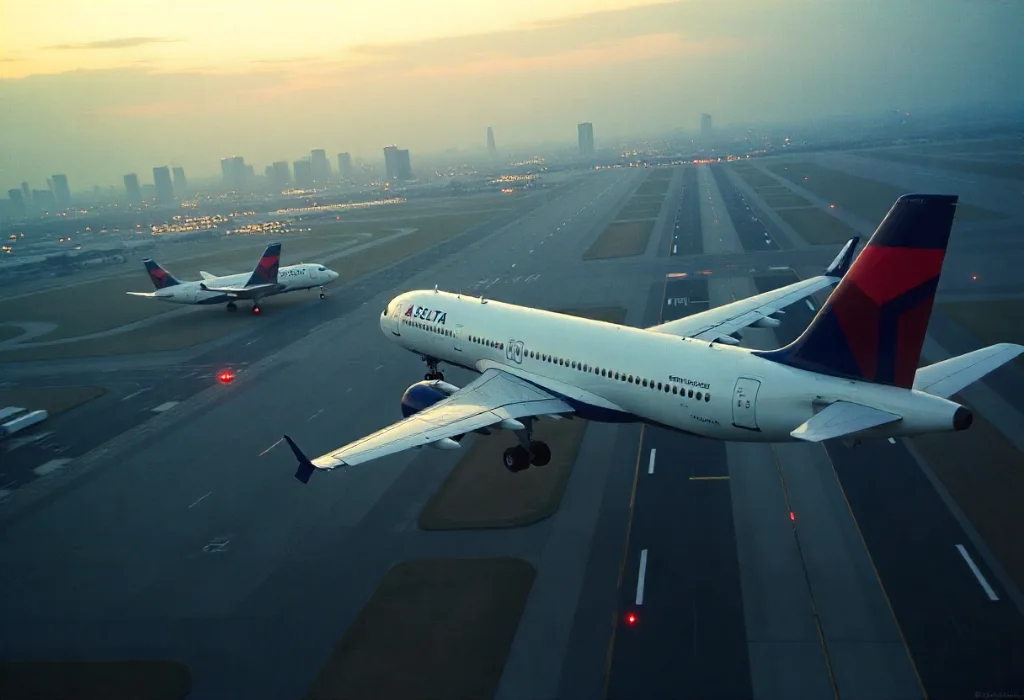
On July 21, 2025, a Delta Air Lines Boeing 767-300, operating as Flight DL938 from Los Angeles International Airport (LAX) to John F. Kennedy International Airport (JFK), encountered a serious airspace conflict during final approach that nearly resulted in a go-around maneuver. The incident has raised critical concerns over air traffic controller coordination, speed sequencing, and the safety margins in one of the busiest airspaces in the United States.
Tense Final Approach: A Breakdown of Events
As Delta 938 closed in on Runway 22L at JFK, the aircraft found itself rapidly gaining on a slower Brickyard Airlines Embraer E175, operated by Republic Airways. The final approach paths of both aircraft converged at dangerously close distances — reportedly just two nautical miles apart, well within the minimum required separation during approach sequences. This unusually tight spacing left little margin for either aircraft to safely maneuver, and Delta’s cockpit crew was forced to prepare for a potential go-around.
What compounded the problem was that JFK’s tower controller couldn’t issue a timely warning to the Delta pilots due to the compressed spacing. Both jets eventually landed without incident, but not without triggering a flurry of concern, criticism, and back-channel radio chatter among aviation professionals.
Controller Blame Game: Who Was at Fault?
Immediately after the incident, both Delta’s flight crew and the JFK tower staff voiced strong dissatisfaction with how the situation was handled. At the center of the blame was the approach controller, whose task it was to sequence and space incoming aircraft appropriately based on their type, speed, and expected arrival times.
The tower controller, using a tone laced with sarcasm and exasperation, was heard stating over frequency: “If approach had given better speeds, this wouldn’t have been so close.” This comment encapsulated the frustration of ground controllers who rely on accurate sequencing from the approach phase to keep runway traffic safe and efficient.
Pilots also chimed in, asserting that better foresight and earlier speed assignments could have prevented the situation entirely. Critics pointed out that the Embraer E175, being a regional jet, typically flies slower approach speeds compared to the wide-body Boeing 767. Not accounting for this discrepancy in velocity and handling characteristics can easily result in high-speed trailing aircraft catching up too quickly.
Why Speed Management on Final Approach Matters
Final approach is one of the most critical phases in any flight, and managing the speed differential between aircraft is fundamental to maintaining separation and avoiding mid-air conflicts. Unlike cruising altitudes where lateral and vertical separation are vast, aircraft on approach operate in tighter corridors with far less room to maneuver.
In this incident, it appears that the approach controller failed to slow down Delta 938 soon enough, or failed to provide appropriate vectoring to expand the gap between it and the preceding Embraer jet. Once inside a tight radius near the airport, options for speed control diminish, and pilots are largely locked into a fixed glidepath unless ordered to execute a go-around.
Had either aircraft encountered wind shear, required a missed approach, or suffered a mechanical glitch, the dangerously close separation could have led to a collision or other high-risk outcome.
JFK’s Crowded Skies: An Operational Challenge
John F. Kennedy International Airport is one of the most congested airports in the world, handling over 1,300 aircraft movements daily. With multiple converging runways, parallel arrivals, and intersecting taxiways, JFK presents an extraordinarily complex air traffic environment.
The New York TRACON (Terminal Radar Approach Control) is responsible for sequencing inbound aircraft from various waypoints. Their role is to ensure that traffic merges into JFK’s final approach path with enough spacing, while accounting for various approach speeds, aircraft types, and ATC handoff delays. Even minor misjudgments, such as neglecting to assign earlier speed reductions, can ripple into last-minute crises on final approach.
This incident underscores the limitations of even well-established systems when workload, fatigue, or communication breakdowns come into play. It also suggests that there may be a systemic issue with controller training or protocol enforcement within the New York airspace system.
The Human Factor and Professional Conduct
Beyond technical errors, this incident laid bare the communication breakdown and strained working relationships between different parts of the air traffic control chain. While the JFK tower and Delta pilots found common ground in their criticism of the approach controller, their post-incident chatter reveals deeper issues with professional cohesion.
Instead of a unified post-mortem focused on procedural improvement, the conversation shifted into finger-pointing and sarcasm, which does little to foster the kind of teamwork required for high-stress environments. Aviation safety experts often emphasize the importance of crew resource management (CRM) — not just in the cockpit, but across the entire air traffic system.
In this case, had the controllers and pilots followed a structured debriefing process, including formal feedback through the NASA Aviation Safety Reporting System (ASRS) or internal FAA channels, the lessons could be better captured and addressed.
Near Misses Are Warnings, Not Just Footnotes
While the aircraft landed safely and no damage occurred, the close call should not be written off as a benign mistake. The aviation industry has long relied on learning from near-misses to prevent full-blown accidents. Every incident that involves compressed separation and unexpected maneuvering on final presents a chance to revisit procedures, retrain staff, and identify blind spots in controller coordination.
At JFK, where diversity in aircraft size, pilot experience, and route complexity is extreme, the risks are magnified. In 2023, the FAA reported over 200 runway incursions and spacing violations nationwide, with the New York airspace consistently ranking among the most challenging for controllers.
Potential Solutions and Reforms
This incident may serve as a catalyst for meaningful review. A few immediate solutions could include:
- Enhanced speed sequencing protocols that take into account aircraft type and average approach speeds.
- Automation tools that alert controllers when trailing aircraft are closing too quickly on slower traffic.
- Real-time spacing visualizations on controller radar scopes to help anticipate compression zones.
- Cross-training between approach and tower controllers to promote better situational awareness.
The FAA’s NextGen Air Traffic Modernization Program has been working on integrating these features into terminal areas, but progress has been slow due to budget constraints and labor negotiations.
Conclusion: A System Under Pressure
The near-miss involving Delta Flight DL938 and a Brickyard Airlines E175 on July 21 is more than a minor blip — it is a stark illustration of the fragility of safety margins at crowded international airports like JFK. While both aircraft landed safely, the incident highlights how split-second decisions, human error, and communication lapses can quickly snowball into high-risk situations.
Rather than relying on pilot vigilance or tower improvisation, the system must be reengineered to anticipate and avoid these conflicts before they occur. That means better technology, smarter protocols, and most of all, a culture that prizes collaboration over blame. In air traffic management, as in aviation itself, safety isn’t just about landing — it’s about everything that leads up to it.