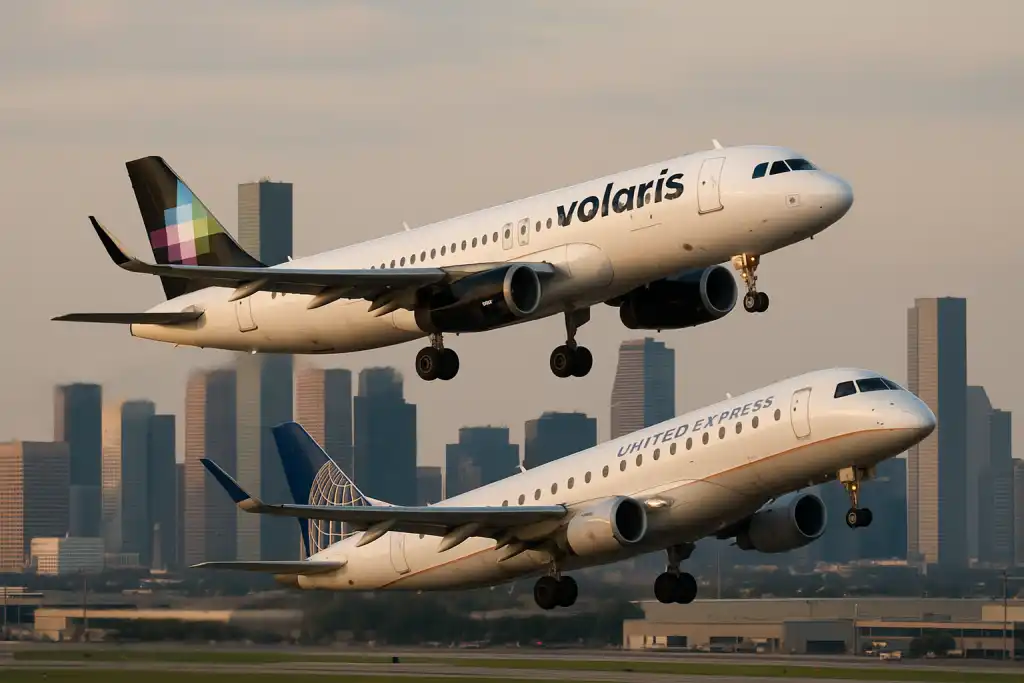
On December 18, 2025, a grave aviation incident unfolded in the skies above George Bush Intercontinental Airport (IAH) in Houston, Texas. Two commercial aircraft—a United Express Embraer ERJ-145XR and a Volaris Airbus A320neo—came within seconds of a catastrophic midair collision shortly after takeoff. The close call, triggered by an unauthorized turn by one of the jets, has alarmed aviation authorities and once again brought safety procedures into sharp focus.
Unauthorized Turn Puts Lives at Risk
According to air traffic control (ATC) recordings and flight tracking data reviewed after the event, the near-disaster was caused when the Volaris flight—en route to El Salvador—made a wrong right turn during its initial climb. This critical error placed it directly into the departure path of the United Express flight, which was ascending on its assigned route to Jackson, Mississippi.
Controllers monitoring the airspace quickly detected the unfolding conflict and issued urgent instructions to both aircraft. Simultaneously, both jets received Traffic Collision Avoidance System (TCAS) alerts, which prompted the pilots to take immediate evasive action. Thanks to rapid coordination between humans and machines, a deadly impact was narrowly avoided.
TCAS: A Last-Ditch Lifesaver
The incident underscores the irreplaceable value of TCAS, the high-stakes technology that has evolved into a cornerstone of modern aviation safety. Unlike ATC, which manages traffic from a centralized perspective, TCAS operates independently onboard the aircraft, scanning for conflicting transponder signals and offering real-time maneuvers.
- TCAS first issues a Traffic Advisory (TA), alerting pilots to nearby aircraft.
- If a collision risk escalates, it issues a Resolution Advisory (RA)—clear, concise voice commands such as “Climb! Climb!” or “Descend! Descend now!”
In this case, both jets received simultaneous RAs and followed protocol, executing precise altitude changes to avoid disaster. These split-second instructions provided critical time that ATC could not match.
Piloting During Departure: High Workload, Higher Stakes
Departure is one of the most vulnerable phases of flight. Aircraft are climbing rapidly, adjusting speeds, and juggling communications—all while flying low over densely populated areas. Any misstep, particularly an unexpected directional change, reduces reaction time to mere seconds. Experts stress that unauthorized turns during departure are among the most hazardous pilot errors in commercial aviation.
This incident fits a troubling pattern. Midair near-misses—especially involving departure or arrival corridors near busy airports—have seen a worrying uptick. According to aviation analysts, the pace of near-collisions has accelerated over the past two years in U.S. airspace, often due to human error, miscommunication, or procedural deviation.
Global Context: A Growing Concern
The Houston incident is not isolated. In a parallel case, a JetBlue A320 narrowly avoided collision with a U.S. military refueling tanker near Curaçao. Unlike in Houston, the tanker was not visible to civilian TCAS systems, making visual detection and pilot skill the only barriers to disaster.
Such events reinforce the need for layered defenses in air safety:
- Robust ATC oversight
- Automated systems like TCAS
- Adherence to standard departure/arrival procedures
- Continuous pilot training and scenario drills
FAA Investigation Underway
The Federal Aviation Administration (FAA) has launched an investigation into the Houston near-miss. Initial findings suggest the Volaris flight’s right turn was unauthorized, a critical procedural lapse that nearly triggered mass tragedy. While no injuries were reported and both planes landed safely at their destinations, the FAA’s review will likely examine:
- Pilot decision-making under departure workload
- Potential miscommunication or misinterpretation of ATC instructions
- Effectiveness of the collision avoidance response chain
Insiders suggest that corrective measures, ranging from software updates to revised pilot briefings, may follow.
Why These Incidents Matter More Than Ever
While high-profile crashes grab headlines, near-misses like this one are often more instructive. They reveal the cracks in procedural armor that, if left unaddressed, could eventually cause loss of life. Each incident becomes a case study in human-machine coordination, procedural discipline, and the fallibility of even seasoned flight crews.
What makes the Houston event particularly troubling is its location and timing. Houston is one of the busiest airspaces in the country, handling hundreds of takeoffs and landings per day. A breakdown in spatial separation at such a hub affects not only the aircraft involved but also entire corridors of coordinated air traffic.
The Path Forward: Safety Through Transparency and Technology
The industry has increasingly turned toward predictive safety models, using data analytics and AI to identify risk patterns before they manifest in real time. The FAA’s renewed focus on analyzing anomalies, radar data, and TCAS logs across the national airspace is part of a broader strategy to prevent human error from tipping into catastrophe.
Meanwhile, airlines like United and Volaris are expected to undergo internal safety reviews, which may include:
- Recurrent pilot simulator sessions focused on departure phase emergencies
- Enhanced cockpit resource management protocols
- Updated departure routing charts and procedural checklists
Conclusion: Seconds From Disaster, Lessons for a Lifetime
The December near-miss above Houston is a stark reminder that in aviation, safety is measured not just in successful landings, but in close calls that didn’t become disasters. Every evasive maneuver, every urgent ATC command, and every TCAS alert is a thread in the web of aviation safety.
While passengers onboard both jets likely remained unaware of how close they came to tragedy, regulators and airline executives will not forget. Nor should they. Each narrowly avoided accident becomes a blueprint for better vigilance, better systems, and above all, better training.
In a sky increasingly filled with commercial, military, and private aircraft, only a relentless commitment to safety will keep these steel birds from colliding above our heads. And as Houston showed, even the best systems can’t afford a single wrong turn.