The modern cabin has become a stage, and premium airline products are increasingly treated like sets for short-form video. When an influencer films himself “waking up” shirtless in Emirates Business Class, the reaction is swift, loud, and predictably polarized. Some see it as harmless performance art at 30,000 feet. Others see a line crossed in a shared space governed by unspoken rules of respect. The truth, as usual, sits uncomfortably in between.
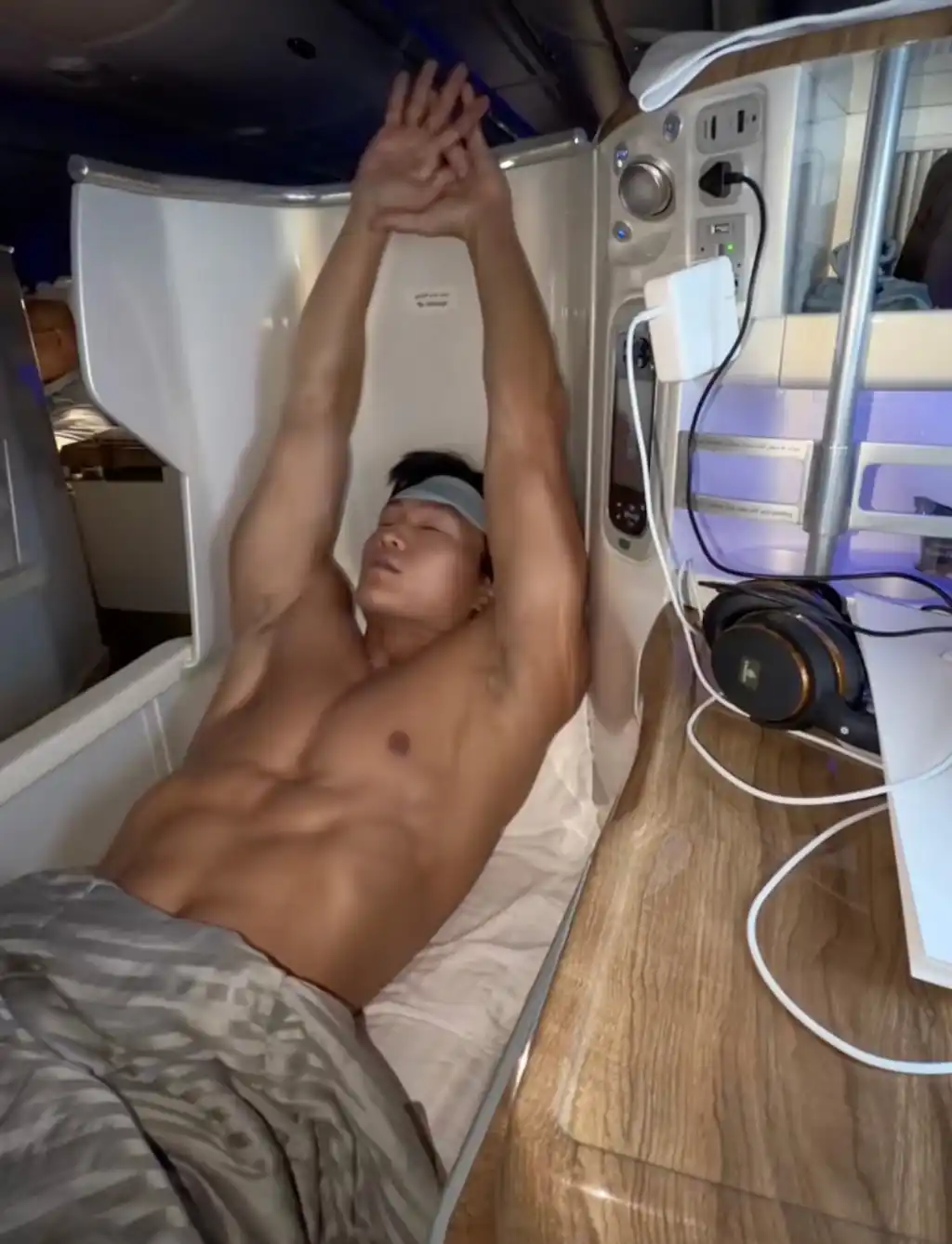
The incident unfolded aboard an Emirates Airbus A380 operating between New York JFK and Milan MXP, a route known for aspirational travelers and content creators alike. The video presents a polished morning routine: lenses in, teeth brushed, crepes ordered, movie queued. The detail that detonated the comment sections was not the routine itself, but the absence of a shirt during the “wake-up” moment, a visual choice designed to jolt attention in an algorithmic ecosystem that rewards spectacle.
Public reaction skewed heavily negative, with many viewers insisting that basic standards of dress apply regardless of cabin class. Others focused less on clothing and more on disruption, questioning whether filming in a darkened cabin intruded on fellow passengers’ comfort. The outrage, while intense, also reveals how social media has reshaped expectations of behavior in premium travel spaces.
The Video That Triggered the Backlash
The influencer, posting under the handle @jpark_fit, framed the clip as a celebration of flying horizontal in business class. The tone was upbeat, bordering on theatrical, and clearly optimized for engagement. This was not candid documentation; it was performance. The shirtless reveal functioned as a hook, a deliberate break from the polished norm of airline influencer content.
@jpark_fit The walk in never disappoints, time to eat! #emirates #jparkfit
What made the moment resonate was not indecency in any legal sense, but the collision of private behavior with a semi-public environment. Business class offers space, but not seclusion. Unlike first class suites with floor-to-ceiling doors, the A380 business cabin remains visually communal, even when passengers recline.
Airline Etiquette Versus Algorithmic Shock Value
Air travel has always relied on a fragile social contract. Shoes stay on, voices stay low, personal space is respected. Removing a shirt, even briefly, violates expectations precisely because it introduces intimacy where neutrality is preferred. In that sense, the backlash was less about skin and more about context.
Yet it is difficult to ignore the mechanics of online attention. Platforms reward novelty, not nuance. A perfectly dressed passenger quietly enjoying a lie-flat seat does not travel far. A shirtless “morning routine” does. The influencer economy thrives on these micro-transgressions, calibrated to provoke reaction without causing real harm.
Was Anyone Actually Harmed?
This is where the debate sharpens. There is no evidence that other passengers were disturbed by bright lights or obstructed aisles. No crew intervention was reported. The act, while arguably tacky, did not escalate into confrontation or safety concerns. Compared with genuinely disruptive in-flight behavior, this ranks low on the severity scale.
Critically, the video appears staged. The likelihood that the influencer slept shirtless for hours is slim; the reveal reads as a brief costume change for the camera. That distinction matters. Performance for a lens, while annoying to some, is different from sustained behavior imposed on others.
Privacy Thresholds in Premium Cabins
There are clear exceptions where shirtlessness is accepted. Onboard showers in Emirates’ A380 first class exist for that very reason. Fully enclosed suites also change the equation. When a curtain or door closes, behavior becomes invisible to others, and therefore socially neutral. Business class lacks that buffer, which is why expectations tighten.
The controversy exposes an unresolved tension: premium cabins are marketed as personal sanctuaries, yet operated as shared spaces. Influencers exploit that ambiguity, leaning into the fantasy while ignoring the communal reality.
Why This Moment Resonated Beyond Aviation Circles
The clip circulated widely because it taps into a broader cultural fatigue with performative privilege. Watching someone celebrate a luxury experience while bending social norms can feel grating, especially to viewers who see air travel as stressful rather than glamorous. The backlash, then, is as much about economic symbolism as etiquette.
Still, not all attention is condemnation. Some viewers interpreted the video as lighthearted, even self-aware. In an online landscape crowded with genuinely harmful stunts, this registered as mild mischief rather than malice.
A Low-Grade Offense in a High-Visibility Era
Stripped of outrage, the episode is best understood as a case study in attention economics. The influencer achieved visibility by flirting with impropriety, and audiences responded exactly as the system encourages them to. Airlines, meanwhile, benefit indirectly from the spotlight, their cabins framed as desirable backdrops for modern aspiration.
Sleeping shirtless in business class is not cool. Filming it for millions is certainly questionable. Yet measured against the spectrum of in-flight influencer antics, this sits near the bottom. It was awkward, calculated, and fleeting, a reminder that in the age of constant cameras, even a quiet cabin can become a stage.