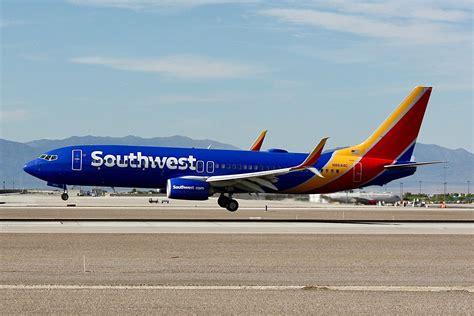
A growing controversy surrounding Southwest Airlines’ seating policy has captured public attention after a Nashville-based traveler claimed she was denied boarding unless she purchased an additional seat. The incident, which unfolded in February 2026, underscores the complexities of airline policies governing passenger space, fairness, and real-time enforcement at the gate.
Ruby Cosby, the passenger at the center of the dispute, was preparing to board a flight from Nashville to Los Angeles International Airport (LAX) when she was informed by a gate agent that she would need to purchase a second seat. The additional cost—reported at $450—became an immediate barrier. According to Cosby, she objected not only to the price but to the process itself, arguing she was not given the opportunity to demonstrate that she could comfortably fit within a single seat.
The situation escalated quickly. Unable to secure or afford the second seat on the spot, Cosby’s reservation was ultimately canceled. What might have been a routine policy enforcement instead became a flashpoint for broader questions about consistency, communication, and passenger rights in modern air travel.
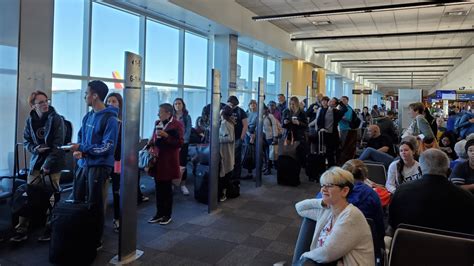
Inside Southwest’s “Customer of Size” Policy
At the core of the dispute lies Southwest’s long-standing “Customer of Size” policy, which outlines specific requirements for passengers who may need additional seating space. The rule is straightforward in principle: travelers must be able to sit in a single seat with both armrests fully lowered. If this condition cannot be met, the purchase of an additional seat is required.
Southwest has historically framed this policy as a balance between safety and passenger comfort. In many cases, the airline offers a post-flight refund for the extra seat if the flight is not fully booked, a gesture intended to reduce financial burden. However, that benefit depends heavily on availability and timing—factors that can vary dramatically at the gate.
Cosby’s experience highlights a critical tension within the policy: who decides, and when. Gate agents are often tasked with making immediate judgments based on visual assessments and flight capacity, leaving little room for negotiation or demonstration. In this case, Cosby stated she explicitly requested to test the seat but was denied the opportunity.
The Human Factor in Real-Time Enforcement
Airline policies may be written in precise language, but their enforcement often unfolds in unpredictable, high-pressure environments. Boarding gates are fast-moving spaces where decisions must be made quickly to maintain schedules. This creates a scenario where subjective judgment can carry significant consequences.
For passengers, this can feel abrupt and, at times, arbitrary. Cosby’s account suggests a lack of procedural flexibility—no trial seating, no escalation path, and no immediate alternative offered. From the airline’s perspective, however, such decisions are tied to operational efficiency and the need to avoid delays.
This gap between policy intent and passenger perception is where friction emerges. When travelers feel excluded from the decision-making process, even established rules can appear unfair or inconsistently applied.
Cabin Design Constraints and Limited Alternatives
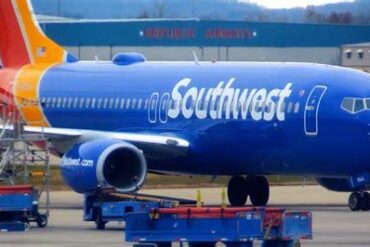
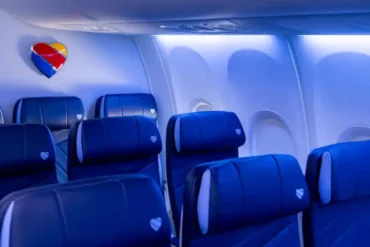
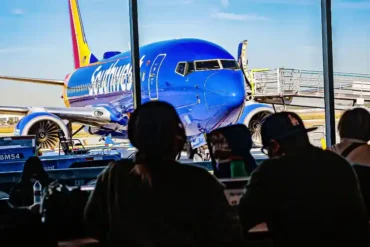
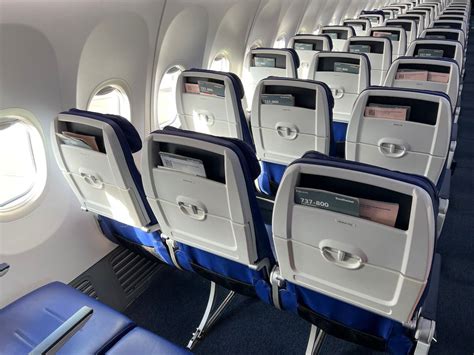
Part of the challenge stems from the physical realities of aircraft design. Southwest operates an all-Boeing 737 fleet configured in a 3-3 seating layout, with seat widths typically ranging from 17 to 17.8 inches. These dimensions are standard across much of the industry but offer limited flexibility for passengers requiring more space.
Unlike full-service carriers that provide premium economy or business-class cabins, Southwest’s single-class model leaves few alternatives. For travelers needing additional room, the only viable solution is often the purchase of an extra seat. This structural limitation places increased importance on clear communication before travel, as options at the airport are minimal.
The broader industry reflects similar constraints. Airlines have gradually optimized cabins for efficiency, often at the expense of personal space. As a result, policies addressing passenger size have become more prominent—and more scrutinized.
Assigned Seating Changes the Equation
Adding another layer to the situation is Southwest’s recent shift to assigned seating, officially implemented on January 27, 2026. This marks a significant departure from the airline’s iconic open seating model, which had defined its boarding process for decades.
Assigned seating introduces new possibilities—and new challenges. On one hand, it allows passengers to plan ahead, potentially securing additional space during booking rather than negotiating at the gate. On the other, it requires the airline to rethink how policies like the extra seat requirement are communicated and enforced.
In theory, this transition could reduce last-minute conflicts like Cosby’s. In practice, the effectiveness of assigned seating will depend on how clearly expectations are conveyed and how seamlessly accommodations can be arranged in advance.
Industry-Wide Implications and Passenger Expectations
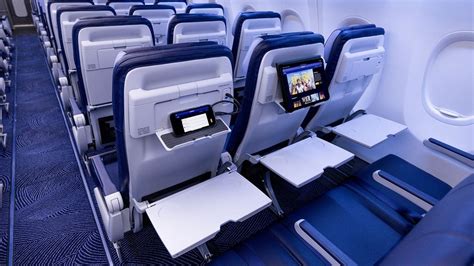
The incident arrives at a time when airlines worldwide are reassessing how to balance profitability, comfort, and inclusivity. With cabins remaining densely configured, advocacy groups have increasingly called for more transparent and standardized policies that address the needs of diverse passengers.
Different airlines take different approaches. Some require advance notice for additional seating needs, while others offer specialized seating options or flexible upgrade paths. This lack of uniformity places the burden on travelers to research policies carefully—an expectation that is not always realistic in fast-paced travel environments.
For Southwest, the challenge is particularly nuanced. The airline’s brand has long been associated with simplicity and customer-friendly practices. Incidents like this risk undermining that perception if passengers feel policies are unclear or inconsistently applied.
A Defining Moment for Policy Clarity
What happened in Nashville is more than a single dispute—it is a case study in how policy, perception, and execution intersect. The rules themselves may be established, but their real-world application can vary in ways that significantly impact passenger experience.
Clearer pre-travel communication, more transparent enforcement procedures, and flexible on-site solutions could help bridge the gap. As airlines continue evolving their seating models, the expectation is not just efficiency, but predictability and fairness.
For travelers, the lesson is equally clear: understanding airline-specific policies before arriving at the airport can prevent difficult situations. Yet the responsibility cannot rest solely on passengers. Airlines must ensure their policies are not only written clearly but also applied with consistency and empathy.
The conversation sparked by this incident is unlikely to fade quickly. As air travel continues to adapt, moments like this will shape how airlines define—and deliver—the passenger experience in the years ahead.