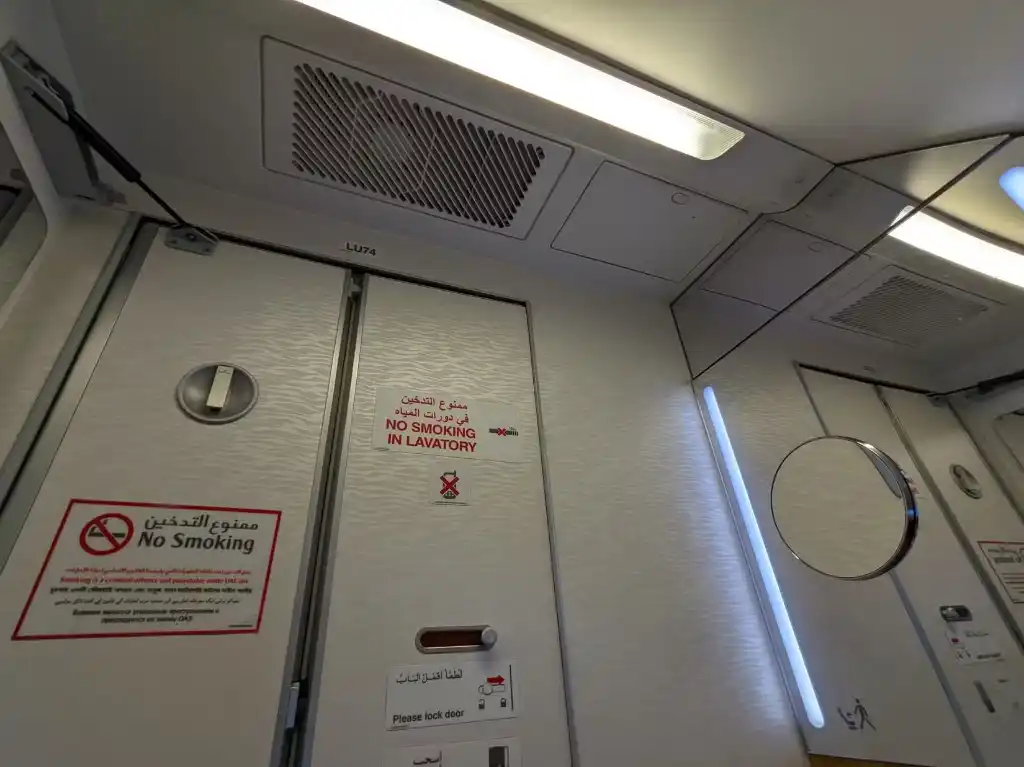
An 11-hour transcontinental flight is usually defined by quiet endurance: dimmed cabin lights, the low hum of engines, and passengers settling into the slow rhythm of long-haul travel. But on a recent commercial journey at 35,000 feet, one traveler transformed the most confined space on board into an improvised treadmill. The result was a viral moment that ignited a broader debate about in-flight etiquette, shared public space, and the limits of social media spectacle.
Dom Stroh, an Instagram fitness influencer known for unconventional endurance challenges, documented himself completing a full 5K run inside an aircraft lavatory. The video, posted as a Reel under the title “MILES High Club,” shows Stroh jogging in place for nearly an hour, carefully adjusting his stride to avoid bumping into the sink, door, and toilet in the narrow compartment. His smartwatch tracked the distance until it reached five kilometers, preserving what he described as his daily running streak.
The stunt might have been framed as personal discipline taken to creative extremes, but the response quickly moved beyond admiration for consistency. Within hours, thousands of viewers were debating whether the performance crossed a line in a tightly regulated, communal environment.
What Happened During the Midair 5K Run
According to the video timestamp and post details, the run took place on February 21 aboard a long-haul commercial aircraft. While the specific carrier was not publicly confirmed, the layout and duration suggest a widebody jet typically used for intercontinental travel, such as an Airbus A350 or similar aircraft equipped with multiple economy-class lavatories.
Stroh remained inside a single lavatory for approximately one hour, jogging in place to accumulate the necessary distance recorded by his fitness tracker. The footage shows him maneuvering cautiously in the cramped setting, at times bracing himself against minor cabin movement. The door remained closed throughout the challenge.
The controversy centered not on any explicit violation of aviation law but on practical considerations. On most long-haul aircraft, economy cabins share between four and six lavatories among hundreds of passengers. Occupying one unit for an extended period can create bottlenecks, particularly during peak times after meal service or before landing. Passengers waiting in line may have little context for why a restroom is unavailable beyond assuming routine use.
Aviation commentators noted that while extended lavatory occupancy is not automatically prohibited, it can attract attention from cabin crew. In today’s security-focused aviation climate, unusual patterns of behavior in confined areas can prompt precautionary checks, even if the activity itself is not inherently dangerous.
Where Fitness Culture Collides With Flight Etiquette
Airlines frequently encourage light movement during long-haul travel. Passengers are advised to stand, stretch, and occasionally walk the aisles to promote circulation and reduce the risk of deep vein thrombosis. However, those recommendations involve brief, low-impact activity performed in open cabin spaces — not sustained cardio exercise inside service areas designed for short-term use.
Aircraft lavatories are compact by design. Typically measuring just a few square feet, they are engineered for efficiency and sanitation, not athletic exertion. Surfaces are high-touch, and the environment can shift suddenly due to turbulence. Even minor cabin bumps can alter balance, increasing the risk of injury in a confined setting.
Beyond safety and hygiene concerns, critics framed the incident as emblematic of a larger cultural shift. Social media challenges often reward novelty and spectacle, particularly in unusual environments. Commercial aircraft, however, are not private studios. They are shared spaces governed by federal regulations and operational protocols.
While Stroh’s supporters argued that the act was harmless and even entertaining, detractors emphasized the collective nature of air travel. In an environment where personal space is already limited, courtesy becomes a silent but essential contract between passengers.
The Rise of Viral Lavatory Stunts at 35,000 Feet
The lavatory 5K is not an isolated case. Over the past several years, aircraft bathrooms have repeatedly appeared in viral videos that test the boundaries of appropriateness.
In 2023, a TikTok user filmed himself cooking shrimp in an airplane lavatory sink using a portable immersion heater. The footage showed seafood and instant mashed potatoes being prepared in a space intended exclusively for sanitation. The reaction was swift and overwhelmingly critical, with viewers highlighting both hygiene violations and potential electrical risks.
An earlier incident in 2020 featured a passenger appearing to grill a steak inside an aircraft restroom using a small heating device. Although later described as staged, the clip raised alarm due to the presence of heat sources in a pressurized cabin. Aircraft lavatories are equipped with smoke detectors and built-in fire suppression systems precisely because onboard fires represent one of aviation’s most serious hazards.
These episodes underscore a pattern: content creators increasingly treat aircraft lavatories as novel backdrops for personal branding. What may appear as isolated creativity can accumulate into a broader operational concern for airlines tasked with maintaining order, safety, and passenger comfort simultaneously.
Aviation Safety and the Unwritten Rules of Shared Space
Commercial aviation operates on a layered system of formal regulations and informal social norms. Federal aviation authorities outline clear safety requirements, but the smooth functioning of a flight also depends heavily on cooperative behavior among passengers.
Extended lavatory use falls into a gray zone. It is not inherently illegal to remain inside for an hour. However, cabin crew are trained to monitor unusual behavior, particularly when it involves enclosed areas. In certain contexts, prolonged occupancy could trigger welfare checks to ensure a passenger is not ill or engaging in prohibited activity.
At cruising altitude, small actions can have disproportionate consequences. A blocked lavatory may delay other passengers, increase cabin movement as people search for alternatives, and create tension in already crowded aisles. The aircraft environment magnifies minor inconveniences because options are limited until landing.
Stroh’s video did not indicate confrontation with crew or passengers, and there is no public record of formal disciplinary action. Nevertheless, the online backlash reflects a growing sensitivity toward performative acts in shared transportation spaces.
The Thin Line Between Discipline and Disruption
The cultural symbolism of the “Miles High Club” title added another layer of intrigue. Traditionally associated with a different kind of midair activity, the phrase repurposed here for athletic achievement amplified the viral appeal. It also highlighted the tension between personal branding and communal responsibility.
Endurance culture often celebrates extreme consistency — never missing a workout, never breaking a streak. Yet commercial aviation is built around collective logistics. Hundreds of strangers temporarily share oxygen, facilities, and infrastructure inside a pressurized aluminum tube crossing oceans.
The midair 5K may ultimately fade from trending feeds, but it leaves behind a sharper conversation about boundaries. In an age where nearly any moment can become content, the definition of appropriate behavior in public — especially in highly regulated environments — is being renegotiated in real time.
Air travel has always required compromise. Passengers accept cramped seats, recycled air, and limited privacy in exchange for speed and global connectivity. The unspoken agreement is mutual respect within those constraints. When personal challenges intersect with shared infrastructure, even a solitary jog in place can ripple outward into a broader debate about how far self-expression should travel at 35,000 feet.