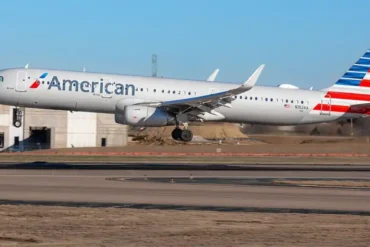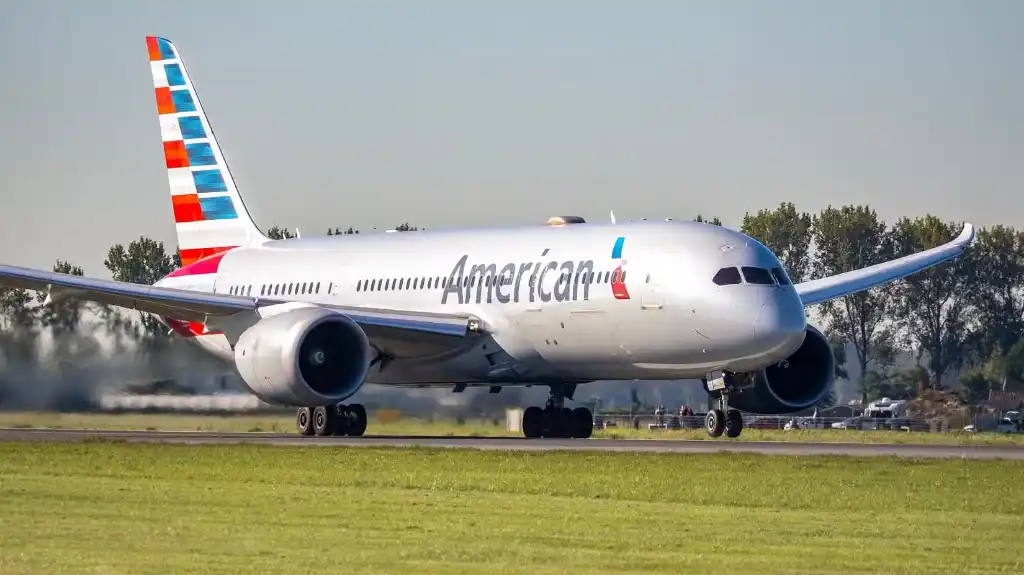
An American Airlines ground crew member was reportedly hospitalized in critical condition after being struck by a Boeing 787 Dreamliner during taxi operations at Dallas/Fort Worth International Airport (DFW). Early reports circulating through aviation insider JonNYC’s X account show disturbing footage of the incident, prompting renewed scrutiny over ramp safety procedures at one of the nation’s busiest hubs.
Disturbing Ramp Incident Involving American Airlines 787
The available video, widely shared across social media, shows the widebody aircraft taxiing toward its assigned gate following arrival in Dallas. As the Dreamliner advanced, a wing walker—a ground worker tasked with visually guiding and protecting the aircraft’s wingtips—unexpectedly moved across the aircraft’s path. Moments later, the individual appeared to walk directly into proximity with the aircraft’s forward engine and was struck in a sudden, traumatic moment.
Airport sources state the employee was immediately transported to a hospital and remains in intensive care. Witnesses on the ramp can be heard reacting in shock, underscoring the severity of the collision and the chaotic scene that followed.
What Wing Walkers Do And Why This Incident Is So Unusual
Wing walkers serve as an essential human buffer between a moving aircraft and surrounding ground equipment, personnel, or structures. Their primary responsibility is to ensure safe clearance of the aircraft’s wings—particularly critical for large aircraft such as the Boeing 787, whose sweeping composite wings demand vigilant monitoring.
Standard protocol dictates that wing walkers maintain a safe distance from engines during taxi, standing outside the well-defined exclusion zones where engine thrust and suction remain dangerous even at low power. The early footage raises immediate questions because the ground crew member appears to step into a restricted area ahead of the aircraft. The reason for this movement remains unclear.
Eyewitness Accounts And Industry Reaction
Aviation commentator Gary Leff from View From The Wing noted that while incidents involving engine ingestion or aircraft strikes are rare, they are tragically not unheard of in high-risk ramp environments. He emphasized that strict safety zones exist precisely to prevent these types of accidents.
Social media users expressed alarm at the footage, with several questioning situational awareness, ramp workload conditions, or possible miscommunication between team members—a reminder that even well-regulated procedures can falter under real-world pressure.
American Airlines Yet To Release A Detailed Statement
Simple Flying and other outlets have requested official comment from American Airlines, though the carrier has not yet released further information about the employee’s condition or the internal investigation reportedly underway. Typically, such incidents trigger a multi-layered review involving airline safety teams, airport authorities, and federal regulators.
Context: American Airlines’ Heavy Presence At DFW
Dallas/Fort Worth International Airport is American Airlines’ most significant operational hub. With six terminals and 224 gates, DFW handles millions of passengers annually and manages some of the airline’s highest-density traffic flows. Between March 2024 and February 2025, American held more than 66% of the airport’s market share, accounting for nearly 48 million passengers.
Such massive throughput requires a vast ground workforce operating in tightly choreographed routines. Wing walkers, tow teams, marshallers, and ramp agents all play critical roles in ensuring safe aircraft movement. The scale and complexity of the operation highlight the razor-thin margins for error.
Ongoing Investigation And Industry Concerns
Ramp safety has already been a point of focus in recent years, with several high-profile incidents involving ground crew injuries across major U.S. airports. While speculation is discouraged until official findings are released, the footage suggests potential lapses in positioning or communication at the critical moment the 787 approached the gate.
Regulators and industry partners will likely review:
- The situational awareness and assigned role of the injured worker.
- Whether standard marshalling and wing-walking procedures were followed.
- Communication protocols between ramp agents and cockpit crew.
- Environmental or operational conditions that may have influenced movement on the apron.
As investigators work to piece together what happened in the moments leading up to the collision, the aviation community continues to hope for the ground crew member’s full recovery. For now, the incident serves as a stark reminder of the hazards that persist in the high-energy, fast-moving environment beneath the wings of modern aircraft.