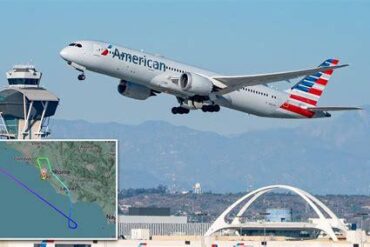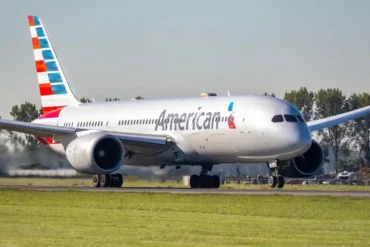
American Airlines found itself in an embarrassing operational mishap on June 2, when a scheduled transatlantic flight from Philadelphia International Airport (PHL) to Naples International Airport (NAP) was forced to divert mid-air due to a critical miscalculation. The Boeing 787-9 Dreamliner, a larger widebody aircraft not typically used for this route, was unwelcome at its intended destination — prompting a redirection to Rome’s Leonardo da Vinci Fiumicino Airport (FCO).
The aircraft in question, registered N837AN, was operating Flight AA780 and departed PHL at 19:42 local time, about 30 minutes behind schedule. While it cruised at 26,000 feet over Italy, nearing its descent into Naples, the jet abruptly changed course at approximately 09:08 local time, skipping any holding pattern and proceeding directly to Rome, where it safely touched down at 09:42.
The Mismatch: When Aircraft Size Meets Airport Limitations
American Airlines has successfully operated seasonal flights between Philadelphia and Naples using the Boeing 787-8, a smaller member of the Dreamliner family, since it launched the route. However, June 2 marked a deviation from standard protocol as the airline deployed a 787-9 — a move that proved incompatible with Naples’ airport specifications.
Despite both the 787-8 and 787-9 having the same wingspan of 197.3 feet (60.1 meters) — qualifying them under ICAO code 4E — the distinction that mattered was in fire and rescue classification. Naples is classified as an ICAO RFFS Category 8 airfield, suitable for aircraft like the 787-8, which measures 183 feet 5 inches (55.9 meters). The 787-9, with a longer fuselage of 203 feet 5 inches (62 meters), falls under RFFS Category 9 — exceeding the limits of Naples’ operational readiness for fire and rescue contingencies.
Operational Oversight or Route Planning Blunder?
Aviation insiders and analysts have begun questioning how such a basic infrastructure mismatch went unnoticed during pre-flight operations. Given the high regulatory standards in international aviation — especially on transatlantic routes — deploying an aircraft to an airport unable to legally accept it reflects poorly on American Airlines’ dispatch and operations teams. It raises further concerns over interdepartmental communication and route validation protocols within the carrier.
Sources noted that Flightradar24 data had shown consistent use of the 787-8 since the May 5 relaunch of the Philadelphia-Naples service. Additionally, American’s new route from Chicago O’Hare (AA180), which started on May 6, also exclusively operated with the smaller Dreamliner. The deviation on June 2, therefore, was a clear departure from standard equipment practice.
Passenger Disruption and Legal Implications
For passengers, the diversion added unexpected complexity. Those expecting to land in Naples — often a gateway to southern Italy’s Amalfi Coast and other tourist hubs — instead found themselves over 140 miles north in Rome. Despite the relatively short distance, commercial connectivity between the two cities is limited, especially on short notice.

ITA Airways, Italy’s flag carrier, had only four departures between Rome and Naples on June 3, with three occurring post-10:00 AM. American Airlines, as a non-European Union carrier, is not obligated under EU Regulation 261/2004, meaning affected travelers may not be entitled to the same levels of financial compensation they would receive from a European airline.
Without a guaranteed rebooking service, many likely had to self-arrange ground transport or wait hours for a connection, turning a streamlined transatlantic journey into a logistical headache. For a route that has historically maintained an 89% load factor during its seasonal peak, according to Cirium Diio Mi citing U.S. DOT data, the incident could shake traveler confidence if not properly addressed.
Aircraft’s Return and Aftermath
Following the diversion, the 787-9 was repositioned back to the United States. It operated Flight AA111 from Rome to Chicago O’Hare (ORD) on June 3, touching down around 14:50 local time. The quick redeployment hints at the airline’s urgency to restore schedule stability and reposition the aircraft for long-haul use.
While American Airlines has not released an official statement on the incident, aviation forums and enthusiasts tracking the flight — notably user JonNYC on BlueSky — were among the first to raise questions and point to the discrepancy in aircraft categorization and airport compatibility.
Bigger Picture: Infrastructure Gaps in Secondary European Airports
This event shines a spotlight on the limitations of Europe’s secondary airports, many of which have eagerly welcomed seasonal transatlantic services but lack infrastructure for larger widebody aircraft. With carriers increasingly pursuing point-to-point models instead of routing everything through traditional hubs like Heathrow or Frankfurt, airports like Naples (NAP), Bologna (BLQ), and Palermo (PMO) find themselves under pressure to upgrade facilities.
The 787-9, A350-900, and 777-200ER are now standard tools for intercontinental services, and airports that cannot accept Category 9 aircraft may face restrictions in route development or lose airline interest altogether. Naples, a growing Mediterranean tourism hub, may need to reassess its infrastructure if it hopes to attract a wider portfolio of long-haul operators.
Lessons Learned: Operational Discipline in Aircraft Assignment
For American Airlines, the incident will likely trigger a review of operational assignment protocols, especially on international routes involving infrastructure-sensitive destinations. It also underscores the critical need for interdepartmental communication between flight planning, dispatch, operations, and fleet management teams.
Assigning aircraft based solely on capacity or availability — without a matching infrastructure check — can result in high-cost, brand-damaging reroutes, especially when affecting high-yield leisure markets during summer peak season.
Moreover, airlines must also balance equipment standardization with flexibility, ensuring that substitutions remain within the certified operational parameters of destination airports. While newer aircraft like the Dreamliner family offer immense flexibility, not all runways are created equal, and adherence to compatibility documentation is non-negotiable.

Conclusion: A Wake-Up Call Amid Transatlantic Expansion
American Airlines’ Naples diversion is more than a footnote — it’s a cautionary tale in modern aviation planning. As airlines ramp up services to non-traditional European destinations, they must pay closer attention to ground capabilities, aircraft compatibility, and contingency planning.
The rise in transatlantic interest in cities like Naples reflects evolving traveler demand, but sustainable growth in this segment will only come if airline ambition is matched by operational precision. In a competitive global market where customer loyalty is easily lost, such oversights can prove costly — both in dollars and reputation.
Ultimately, the diversion from Naples to Rome may have lasted only a few hours in time — but its implications could reverberate through airline boardrooms and airport planning meetings for far longer.