Airbus released its 2026-2045 Global Market Forecast in London in July, and buried inside a document about trillion-dollar demand sat an argument about aircraft size that runs directly against the direction the narrowbody market has travelled for two decades. Manufacturers and airlines have spent twenty years pushing upward. More than 70% of the A320 family backlog now sits on the A321neo and the A321XLR, the stretched variants that carriers have been told will unlock transatlantic flying on single-aisle economics. Against that backdrop, Airbus devoted a full section of its forecast to the smallest aircraft it builds and made a case that the A220, not the largest narrowbody in its catalogue, is the machine that will reshape where people can actually fly.
The claim is not modest. Airbus says the A220 has already created more than 400 new routes across North America, Europe, and Africa, meaning city pairs that had no scheduled service at all until an operator put the type on them. It then goes further, identifying more than 2,200 additional unserved city pairs that it considers suitable for the aircraft. Joost van der Heijden, the manufacturer’s Head of Marketing for Commercial Aircraft, described the type as “the ultimate network builder,” a phrase that sounds like marketing until it is set against the route data underneath it. The A220-100 seats 108 to 133 passengers and the A220-300 seats 130 to 160, placing the family firmly below the A320neo and above most regional jets. That position in the market, unglamorous and slightly awkward for years, is precisely the point of the argument.
The 400-Route Number That Does The Heavy Lifting
No figure in the forecast works harder for the A220 programme than the 400-route count. Airbus describes those sectors as routes that were unserved before the A220 allowed them to operate, and it repeated the number in London with evident intent. Leeham News reported the same figure from the presentation, framing the 400 as thin sectors the aircraft could potentially unlock across those three regions. The distinction matters more than it first appears. Routes transferred from one aircraft type to another, which is what a straightforward regional jet replacement produces, do not change a network; they simply change the equipment flying it. New routes change the map.
Van der Heijden put the case plainly during the presentation. “By providing the right aircraft that can open these new routes, and clearly, the A220 is the ultimate network builder, in that already more than 400 new routes unserved before are being created with the A220 allowing them to operate,” he said. The emphasis Airbus places on the count reflects what the manufacturer is really arguing about the aircraft’s role. An A220 that displaces an older regional jet is a fleet decision. An A220 that opens Riga to Tenerife is a market decision, and it is the second kind that supports a 2,200-route sales pitch.
The gap the A220 occupies is one the rest of the narrowbody market has deliberately vacated. Airbus describes the type as capable of US transcontinental operations, Europe to the Middle East and Central Asia, and trans-Asia flying, a range envelope that regional equipment simply cannot match. The route argument rests on that combination: enough range to reach genuinely distant destinations, and few enough seats to fill on routes that cannot support a larger aircraft. Neither half works without the other, which is why regional jets and mainline narrowbodies have both historically failed on this particular shape of route.
Riga To Tenerife And The Anatomy Of A Long-Thin Route
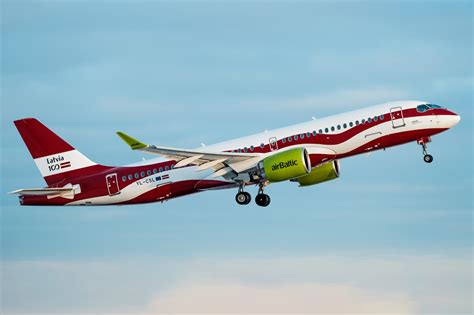
Airbus named two specific routes in its forecast as examples of what the A220 unlocks. The first is Riga to Tenerife, flown by airBaltic between Riga International Airport (RIX) in Latvia and the Canary Islands. Simple Flying reported the sector at more than 2,700 miles, or 4,345 kilometres, nonstop, describing it as evidence of the type’s versatility in linking far-flung destinations while burning significantly less fuel per seat. airBaltic is the A220-300 launch operator and has ordered 90 of the type, which makes it both the most committed customer and the most useful case study.
The second example is Melbourne to Alice Springs, linking Melbourne Airport (MEL) to Alice Springs Airport (ASP) in Australia’s Northern Territory. Airbus listed both routes together, stating that sectors such as Riga-Tenerife or Melbourne-Alice Springs “can be already efficiently served by aircraft like the A220.” Neither is a business corridor. Both connect an origin city to a destination people travel to for leisure, and in both cases the distance is substantial relative to the traffic the route generates.
That combination is what the industry means by long and thin, and it is historically the hardest shape of route to serve profitably. A larger narrowbody brings trip costs the route cannot cover, so the aircraft flies half empty and the airline eventually retreats. Regional equipment cannot reach the destination at all, so the route never opens in the first place. Airbus chose these two examples deliberately, because they show the A220 functioning as leisure network infrastructure rather than as the regional replacement the aircraft is more commonly described as being. Tenerife is not a hub. Alice Springs is not a business market. Both became reachable because an aircraft with the right capacity and the right range finally existed.

Inside The 2,200 Unserved City Pairs Airbus Has Mapped
The 400 routes already flying are the proof point. The number Airbus wants airlines to focus on is 2,200, its count of currently unserved city pairs suited to the A220’s capacity and range. Van der Heijden broke the figure down during the London presentation. “In North America, also a potential for 800 more new city pairs with the A220, 600-plus in Europe and the Middle East/North Africa, for a total of more than 2,200 currently unserved routes that will become suitable for the A220 in the coming years,” he stated. Airbus separately identifies strong potential in Asia-Pacific, which accounts for the balance of the total.
The geographic spread matters as much as the headline number. North America and Asia-Pacific are structurally different markets: the former is built around a mature, consolidated hub network where connecting traffic has been optimised for decades, while the latter is growing rapidly in secondary cities that have never had meaningful direct service. That Airbus sees comparable A220 potential in both suggests the opportunity is not specific to one type of network or one regulatory environment. It is a function of where people increasingly live, not of where airlines have historically flown.
Treating 2,200 unserved routes as a forecast requires caution. These are routes Airbus has calculated the A220 could operate, not routes any airline has committed to opening or demonstrated demand for. The figure is a sales argument as much as an analysis, and it assumes airlines will choose to decentralise rather than concentrate traffic through existing hubs, a strategic bet many carriers resist because it complicates fleet commonality and undermines connecting revenue. What gives the number weight is the 400 routes that have already opened, which is a record rather than a projection. Airbus is not asking airlines to believe a model; it is asking them to extrapolate from routes that exist.
The Demographics Rewriting Where Demand Sits
The route-opening argument rests on a demographic one. Airbus forecasts that the number of smaller urban centres will grow at a significantly faster pace than larger ones over the next twenty years, reflecting shifting urban populations. The Global Market Forecast counts medium and small cities above 250,000 people rising from 2,251 today to 2,857 by 2045, an increase of 606, while megacities above 10 million grow only from 33 to 37. Urbanisation is continuing, but it is happening fastest in places that have never had direct air service, and that is the fact the A220’s business case is built on.
The route data already reflects the shift. The number of city pairs served by scheduled airlines grew from 17,800 in 2005 to 28,000 in 2025, and Airbus reports that 55% of all city pairs in 2025 were routes that had not existed twenty years earlier. Antonio Da Costa, Airbus Head of Market Analysis and Forecast, told the London presentation that an additional 532 airports now have scheduled airline service that were not on the global route network in 2005, pointing to Sucre, Daocheng in China, and the Vietnamese resort destination of Thanh Hoa as examples.

Those trends together describe the market Airbus is selling into. A world where small and medium cities multiply faster than megacities produces more city pairs generating real but modest demand, and modest demand over meaningful distance is the shape that defeats both regional jets and larger narrowbodies. Airbus frames this as networks decentralising, with connectivity expanding beyond trunk routes toward smaller and medium city pairs. The A220 is simply the tool that makes the arithmetic work on routes that previously could not survive a spreadsheet.
Qantas, The 717 Replacement And The 137-Seat Configuration
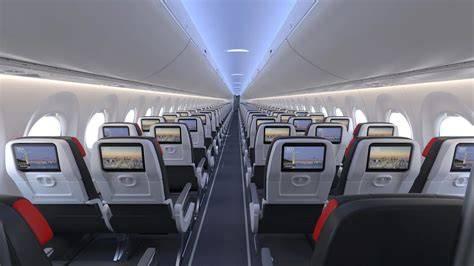
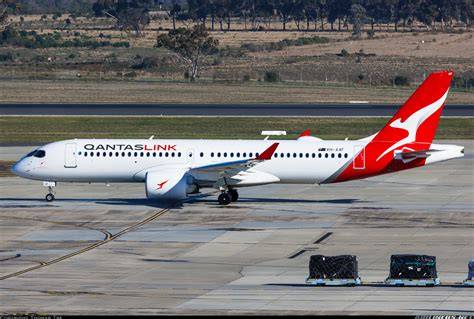
Qantas offers the clearest operator case for the argument Airbus is making, and it is where the 137-seat figure central to this story comes from. QantasLink configures the A220-300 with 137 seats, comprising 10 Business and 127 Economy, including 20 Qantas Economy Plus seats in a 2-3 layout. The aircraft is replacing Boeing 717s across the carrier’s domestic and regional network, and the airline has 29 on firm order, with 12 delivered as of August 2026. Qantas reports the A220 carries up to 25% more passengers than the 717 while burning 25% less fuel and producing 25% fewer CO2 emissions per seat, a triple gain that explains why the type was chosen over a straightforward like-for-like replacement.
Range is what changes the network. Qantas describes the A220 as having almost double the range of the 717 at over 6,000 kilometres, which it says allows the aircraft to fly between any two cities in Australia. The airline is using it to connect smaller capitals including Canberra and Hobart to its hubs in Brisbane, Melbourne, and Sydney, and expects it to open new domestic and short-haul international routes as more aircraft arrive. That is the long-thin leisure network thesis applied to a single country: an aircraft small enough to fill on routes that could not support a 737, with the legs to reach destinations the 717 could not. For a continent where leisure demand is dispersed across vast distances and population centres outside the eastern seaboard are small, the match is unusually exact.
Production Scale And The 1,800 Routes Still Waiting
The programme behind the argument has scaled accordingly. A220 family orders passed 1,000 in May 2026 when AirAsia placed a record order for 150 A220-300s, becoming the first customer for a 160-seat configuration. Total orders stood at 1,110 as of August 2026, with 542 aircraft delivered and 538 in service across 25 operators. Delta is the largest operator at 93 aircraft. The global fleet has flown more than 2.17 million flights carrying over 240 million passengers to 540 destinations, and the type holds more than 55% market share in its category.
Those numbers explain why Airbus can credibly make a network argument rather than a product argument. The 400 routes Airbus counts came out of that fleet, and each one is a demonstrated case where the aircraft changed a market rather than merely serving one. The remaining 1,800 depend on how fast the next several hundred aircraft arrive, and that is a production question as much as a commercial one. Every additional airframe delivered adds another operator that can test the long-thin thesis on its own network, and every route that works becomes evidence for the next sales campaign.
What Airbus is really selling with the A220 is not a regional jet replacement or a smaller A320. It is a licence to fly places that previously could not be flown, at a seat count that makes the maths close, over distances that make the destination worth reaching. The 137-seat QantasLink configuration and the 2,700-mile airBaltic sector to Tenerife are two expressions of the same idea, separated by a hemisphere and joined by an aircraft size the rest of the market spent two decades ignoring. Airbus’ forecast argues that the smallest aircraft it builds will end up carrying more of the industry’s growth than its size suggests, and after 400 routes, the burden of proof has shifted.