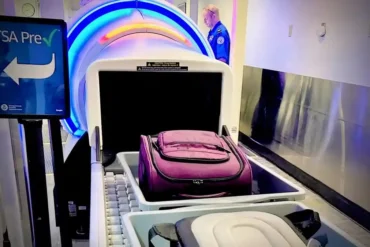
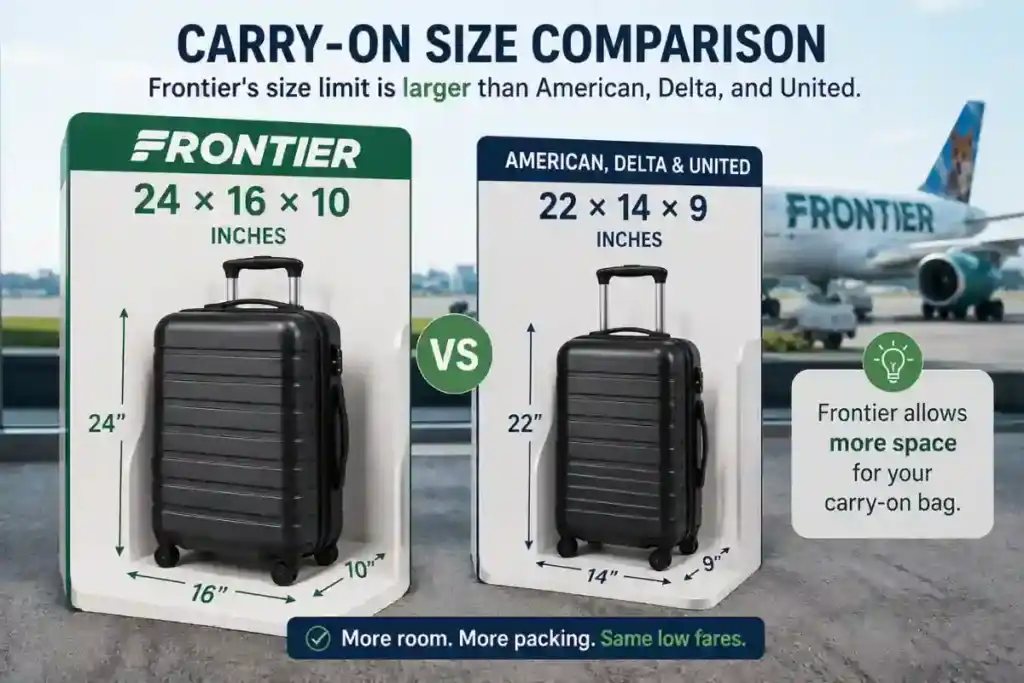
Air travelers who deliberately bought the biggest cabin bag their airline would let them bring are running into an unfamiliar obstacle, and it has nothing to do with a gate agent’s tape measure. Frontier Airlines and Southwest Airlines both publish a carry-on limit of 24 by 16 by 10 inches — roughly 61 by 41 by 25 centimeters — including handles, wheels, and straps. The Transportation Security Administration is meanwhile installing computed tomography scanners whose tunnel openings measure approximately 24.5 inches wide by 16.5 inches high. A maximum-size bag therefore fits on paper and nowhere near comfortably in practice, because the two dimensions that matter at the scanner mouth leave about half an inch of combined tolerance.
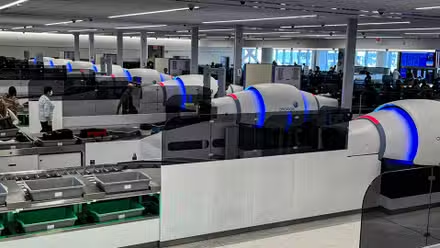
That figure is the entire story in miniature. It is not a rule change, not a fee change, and not a warning that the 24-inch carry-on is being retired. It is a collision between a baggage policy written for cabin overhead bins and a piece of federal screening hardware engineered around detection performance. The TSA had installed 1,162 CT units across 296 airports by July 6, 2026, which means the tight geometry is no longer a curiosity confined to a handful of test lanes. The agency has publicly acknowledged that not every larger carry-on will clear the tunnel and advises travelers to check oversized items with their airline when the machine will not take them. What emerges is a real gap between the size a carrier permits and the equipment actually standing between the passenger and the gate.
The 24-Inch Allowance Is Still Fully Valid
Nothing in the TSA CT scanner rollout rewrites either airline’s published baggage policy. Frontier’s carry-on standard permits a bag up to 24 inches high, 16 inches wide, and 10 inches deep, and the measurement explicitly includes handles, wheels, and straps, with a 35-pound (15.8-kilogram) maximum. Southwest lists the identical 24-by-16-by-10-inch limit and counts wheels, handles, and attachments in exactly the same way. Neither carrier has announced a reduction tied to the arrival of new checkpoint machines, and neither is obligated to. The TSA does not set cabin baggage allowances for commercial airlines; its authority covers what may pass through a security checkpoint, not what may be stowed overhead. The federal agency is therefore not quietly replacing two decades of airline policy with a new national measurement.
The geometry is where the nuance lives. A rectangular 24-by-16-by-10-inch bag can be rotated so that its 24-inch side travels through the 24.5-inch-wide opening while its 16-inch side passes through the 16.5-inch-high opening, leaving the 10-inch depth to run through the machine’s interior. A case built and packed to precisely those figures has theoretical clearance in both directions.
The difficulty is the word exactly. Real luggage is not a machined block of aluminum. Soft-shell cases compress in one direction and bulge in another, and expandable models change shape the moment they are filled. A traveler who is scrupulously inside the airline’s nominal dimensions can still present a profile that is far less cooperative at the checkpoint. Manufacturers also describe their products inconsistently, so a number on a product page may say nothing useful about how far a corner guard, a telescoping handle, or a wheel housing protrudes beyond the nominal envelope.
CT Scanners Bring a Different Physical Constraint
The new machines exist because CT technology meaningfully improves security screening, not because anyone set out to create a stricter carry-on standard. Conventional two-dimensional X-ray systems flatten a bag into a single projected image; CT scanners build three-dimensional images that let officers rotate the contents mentally and inspect them from multiple angles. The TSA credits the technology with stronger explosives detection, and its airport guidance notes that passengers in CT lanes can leave laptops and other large electronics inside their bags. Travel-size liquids can likewise stay packed in CT lanes, subject to the screening rules in force at that airport.
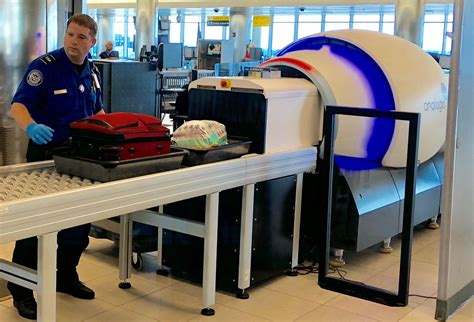
That upgrade carries a different equipment footprint. The CT tunnel is smaller than the openings on many legacy systems, a mechanical reality rather than a baggage rule. The TSA has described the narrower tunnel in its own materials and warned that larger carry-ons may not fit. For the great majority of travelers the change is invisible. The widely used carry-on benchmark of 22 by 14 by 9 inches — about 56 by 35.5 by 22.8 centimeters — leaves substantial breathing room inside the opening, which is precisely why most passengers will never notice the difference. The exposed group is narrow and specific: travelers who deliberately shop for luggage at the extreme edge of what their airline allows, especially when that bag has flexible walls or hardware that sticks out past the shell.
Overstuffed Bags Are Where the Margin Disappears
The greatest risk is not a suitcase that is formally oversized. It is a bag that meets its published dimensions when empty or gently packed and then changes shape the moment it is zipped shut under pressure. Expansion zippers, exterior compartments, wheels, telescoping handles, and soft construction all alter the profile that actually faces the scanner. The CT tunnel does not read the marketing dimensions printed on a luggage box or the specification sheet on a retailer’s website. It presents a fixed physical opening, and the bag either enters it or it does not.
Construction therefore matters more than any single measurement. A hard-shell case with carefully contained dimensions is far more likely to hold its shape through a week of packing than an expandable soft-shell roller stuffed with clothing. Even a modest bulge consumes most of the available slack when only half an inch separates the nominal bag dimension from the tunnel wall. A traveler can be fully compliant with an airline’s written rule and still present a shape that is genuinely difficult to feed into a particular machine, which is the precise failure mode that turns a routine security stop into an argument about a checked bag fee.
The practical response is to measure the bag in its actual travel condition rather than trusting its advertised size. Handles, wheels, and attachments belong in that measurement because both Frontier and Southwest include them in their limits. An expandable section packed to capacity produces a different object from the one measured the night before a trip. Hard-shell and soft-shell luggage also behave differently at the lane: a rigid case cannot be compressed to negotiate a tight opening, while a soft case can sometimes be reshaped on the spot but is far more prone to bulging in the first place. Neither construction is automatically superior, and the deciding factor is simply whether the packed case keeps a predictable profile inside the scanner’s opening.
A Scanner Rejection Can Quietly Become a Baggage Fee
When a bag will not pass through a CT scanner, the TSA’s response does not automatically mean the passenger has broken an airline’s baggage policy. Officers can fall back on manual screening or direct the traveler toward another lane capable of handling the item, and the agency has said officers can assist travelers with larger items or special needs. The TSA has also advised passengers carrying larger bags to consider checking them with the airline before reaching security when the machine will not cooperate.
The operational concern is time. A traveler redirected to another screening lane can lose precious minutes during a busy departure bank, and the clock is unforgiving for anyone with a tight connection. If the bag has to be checked, the sequence is punishing: leave the secure area, return to the airline counter, pay any applicable fee, obtain a bag tag, and clear security a second time. Southwest instructs passengers whose carry-ons are too large to check them at the ticket counter before proceeding to the departure gate, while Frontier notes that oversized carry-ons can incur additional charges when the problem is discovered at the airport. A bag that was perfectly legal for the cabin can end up generating a fee the passenger never anticipated.
What follows is an unusual split in enforcement. An airline can deem a bag acceptable for the cabin while TSA equipment determines that the same bag cannot be screened through a particular lane. The two standards govern different parts of the same journey, yet the passenger feels them as one continuous requirement.
Rollout Makes Airport-Specific Planning Less Useful
The issue is increasingly hard to dismiss as an isolated airport quirk. More than 1,000 new CT scanners are already operating at nearly 300 airports, so the deployment has moved well beyond a handful of trial locations even though equipment still varies between checkpoints and terminals. The rollout followed years of testing and a substantial federal investment in checkpoint CT technology, and it continues to expand.
That variation means passengers cannot assume every security lane will handle a maximum-size carry-on the same way. A bag that clears one checkpoint may meet a different machine at the next airport, and a passenger redirected away from a CT lane may still find an alternative screening option that accepts the case without drama. Travelers connecting through multiple airports have more opportunities to encounter the newer equipment, which makes airport-specific advice less useful than knowing the packed dimensions of the bag in hand.
For Frontier and Southwest, the longer-term question is not whether either airline must immediately shrink its allowance. Their 24-by-16-by-10-inch policies remain perfectly usable within the stated limits, and there is no indication that either carrier intends to abandon them. The more relevant question is whether passengers continue to perceive the full allowance as practical when airport screening infrastructure provides so little tolerance for deviation from those numbers.
The Real Limit Is Becoming a Three-Way Equation
The emerging carry-on problem is less about a brand-new federal baggage rule than about three systems designed around three different requirements. Frontier and Southwest define what a passenger may bring into the cabin. Luggage manufacturers build cases to those dimensions. The TSA must move those cases through machines engineered primarily around security performance. None of the three is malfunctioning, but their boundaries do not align cleanly.
For travelers, the safest response is refreshingly unglamorous. Treat the airline’s maximum as an upper boundary rather than a target. A rigid bag slightly below the published limit offers more practical tolerance than an expandable case packed to its full advertised capacity, and a bag measured with wheels and handles included will rarely produce a surprise at the lane.
As the CT rollout continues, luggage makers have a clear commercial incentive to design future carry-ons around the physical realities of modern checkpoints rather than maximizing whatever dimensions an individual airline permits. That could eventually produce a new de facto carry-on standard without a single formal change to airline baggage policies. Airlines may also face pressure to explain more clearly how their maximum dimensions interact with screening equipment, particularly when a compliant bag can still trigger a fee at the checkpoint. The 24-inch suitcase is not disappearing from the market or from either carrier’s rulebook, but the margin for packing it to the absolute limit is shrinking fast, and the passengers who feel that squeeze first will be the ones who bought the largest bag their airline said they could bring.