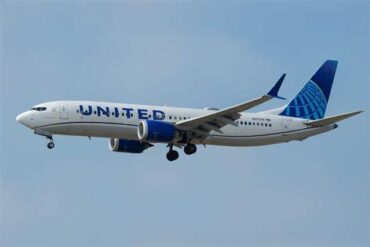
United Airlines has quietly turned the Boeing 737 MAX into one of the most consequential long-distance tools in its network, and nowhere is that clearer than in the eleven nonstop services that now stretch the narrowbody beyond 3,300 miles. From the fjords of Alaska to the pilgrimage trails of Galicia, the MAX 8 has been entrusted with missions that would once have demanded a widebody, a fuel stop, or simply no route at all. The result is a portfolio of flights that reads less like a domestic narrowbody schedule and more like a map of calculated risk, one in which United bets that modest capacity, disciplined frequency and a distinctive destination can together justify a thinner market than legacy thinking would allow.
How The 737 MAX 8 Unlocked United’s Longest Narrowbody Missions
At the centre of this strategy sits an unglamorous but decisive fact of engineering. United’s eleven longest MAX routes all use the Boeing 737 MAX 8, the smaller of the two MAX variants in the carrier’s fleet, precisely because it carries a meaningful range advantage over the larger MAX 9. Boeing advertises a maximum range of 3,500 nautical miles for the MAX 8, equivalent to roughly 4,028 miles, against 3,300 nautical miles for the MAX 9. That extra two hundred nautical miles is not a marketing footnote; it is the difference between serving Anchorage from Newark and leaving the route to a twin-aisle.
The fleet logic reinforces the point. United ended 2025 with 243 aircraft of the type, split between 123 MAX 8s and 120 MAX 9s, and its July 2026 plan projected 323 by year-end, an increase of 80 aircraft or 33%, averaging more than six new MAX deliveries each month. Because the MAX 9 offers more seats but less reach, United can pair aircraft to mission with unusual precision: the MAX 9 absorbs dense trunk routes where capacity matters most, while the MAX 8 roams further into markets where frequency, not volume, carries the day.
The passenger experience reflects that same trade-off honestly. United’s standard MAX 8 cabin seats 166 passengers across three cabins: 16 United First recliner seats, 54 Economy Plus seats and 96 standard Economy seats. There is no lie-flat Polaris business class, which makes the aircraft a less premium proposition on transatlantic flying than United’s widebodies or its incoming Airbus A321XLR. In compensation, travellers get 13-inch entertainment screens in First Class and 10-inch screens in Economy, alongside Bluetooth connectivity, USB charging and larger overhead bins that soften the edges of a long narrowbody haul.
Ranking The 11 Longest United 737 MAX Routes Of 2026
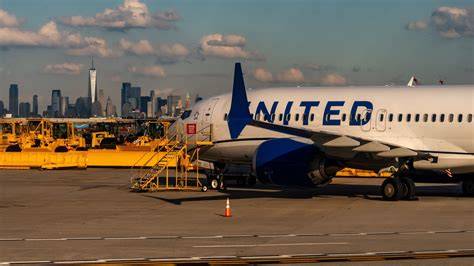
The top of the list belongs to Alaska. United’s longest scheduled MAX route in 2026 connects Newark Liberty International Airport (EWR) with Anchorage International Airport (ANC), covering 3,369 miles (5,422 km). Washington Dulles International Airport (IAD) to Anchorage follows almost immediately behind at 3,356 miles (5,401 km), a gap of just thirteen miles that underscores how deliberately United has built its Alaska corridor from two separate East Coast hubs. Third place crosses the Atlantic: Newark to Santiago de Compostela at 3,310 miles (5,327 km), a route with no meaningful precedent in United’s history.
| Rank | Route | Distance |
|---|---|---|
| 1 | Newark – Anchorage | 3,369 mi (5,422 km) |
| 2 | Washington Dulles – Anchorage | 3,356 mi (5,401 km) |
| 3 | Newark – Santiago de Compostela | 3,310 mi (5,327 km) |
| 4 | Houston – Anchorage | 3,265 mi (5,255 km) |
| 5 | Newark – Glasgow | 3,229 mi (5,196 km) |
| 6 | Newark – Funchal, Madeira | 3,178 mi (5,115 km) |
| 7 | San Francisco – San José, Costa Rica | 3,039 mi (4,891 km) |
| 8 | San Francisco – Liberia, Costa Rica | 2,946 mi (4,741 km) |
| 9 | Chicago O’Hare – Reykjavík | 2,944 mi (4,738 km) |
| 10 | Houston – Georgetown, Guyana | 2,901 mi (4,669 km) |
| 11 | Chicago O’Hare – Anchorage | 2,846 mi (4,580 km) |
The composition of that table is revealing. Four of the eleven routes are domestic, linking the contiguous United States with Alaska from Newark, Washington Dulles, Houston and Chicago O’Hare, while four more cross the Atlantic, reaching Glasgow, Santiago de Compostela, Madeira and Reykjavík. The remainder stretch south into Costa Rica and Guyana from San Francisco and Houston. In other words, the MAX 8 is not a niche solution confined to one region; it is a flexible instrument that United applies wherever a market is too thin for a widebody yet too distant for comfortably conventional narrowbody economics.
Newark To Glasgow And Santiago: Europe’s Improving Demand Story
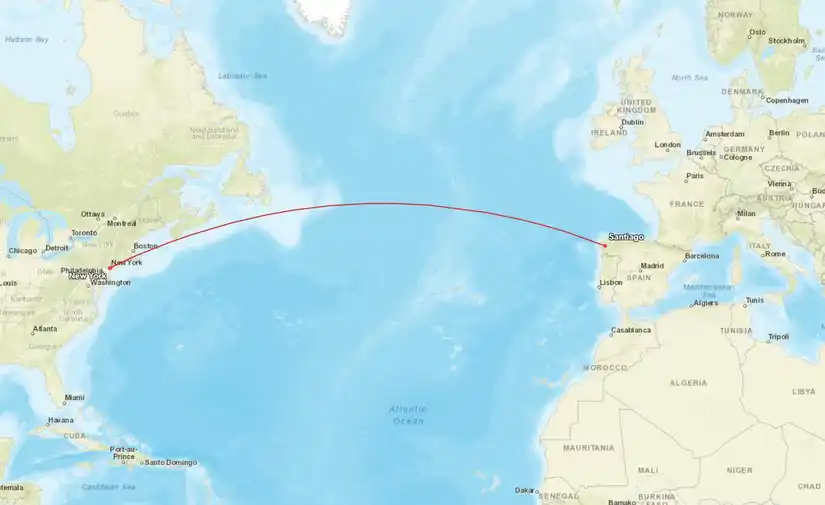
Two of these services were bolted onto United’s transatlantic schedule in May 2026, and both arrived with genuine novelty. Daily nonstop flights between Newark and Glasgow International Airport (GLA) resumed on May 8, restoring a transatlantic link last operated by a Boeing 757-200 in 2019. Three-times-weekly service to Santiago de Compostela Airport (SCQ) began on May 27, marking the first nonstop connection between the United States and the Spanish pilgrimage destination. Both formed part of a wider European expansion that also introduced Bari and Split, deepening United’s habit of marketing distinctive destinations that sit well beyond the familiar gateways of London and Paris.
The early returns were sobering. Bureau of Transportation Statistics data showed Santiago performing worst, recording 58% in its abbreviated opening month and 64% in June. Glasgow carried 4,977 round-trip passengers in May for a load factor of just 64%, improving modestly to 69% in June. By peak summer, however, the picture brightened considerably.
| Route | May 2026 | June 2026 | July 2026 |
|---|---|---|---|
| Newark – Glasgow | 64% | 69% | 74% |
| Newark – Santiago de Compostela | 58% | 64% | 81% |
Santiago’s climb past 80% in July vindicates the patience United showed in launching a route with no direct comparable, while Glasgow’s 74% still hovered under three-quarters full. That gap matters because Newark to Edinburgh Airport (EDI) operated at a 91% load factor across July, raising legitimate questions about how much depth exists for two nonstop New York-area services to Scotland in the same season. United’s response has been characteristically pragmatic rather than defensive: the carrier extended the seasonal Glasgow service by a month, running it through to the end of October, and has already confirmed the route will return for the 2027 summer season. A weak start, in this reading, is survivable precisely because the MAX 8’s modest capacity makes thin-market experimentation affordable in a way a widebody deployment never could be.
United’s MAX Fleet Growth And The Coming 737 MAX 10
The commitment behind these routes extends far beyond the eleven longest missions. United’s fleet plan shows steady quarterly additions: from 243 aircraft at the end of 2025 to 268 in Q1 2026, 283 in Q2, and forecasts of 303 in Q3 and 323 in Q4, growth of 20 to 25 aircraft per quarter. All of this flows from years of investment under the United Next modernisation programme, which exists to retire ageing airframes, raise average seats per departure and lift operating efficiency across the network.
Beyond the current build sits a substantial delivery pipeline. United holds 230 outstanding firm commitments, comprising 63 MAX 9s and 167 MAX 10s. The MAX 9 orders conclude by the end of next year, with 40 aircraft arriving in the second half of 2026 and a further 23 in 2027. The MAX 10 begins its United career in 2027, when the first 20 are projected to arrive pending Federal Aviation Administration certification, which is now expected within weeks after years of safety concerns and manufacturing delays. A further 147 MAX 10s follow after 2027.
| Aircraft Type | H2 2026 | 2027 | After 2027 | Total |
|---|---|---|---|---|
| Boeing 737 MAX 9 | 40 | 23 | — | 63 |
| Boeing 737 MAX 10 | — | 20 | 147 | 167 |
| Total | 40 | 43 | 147 | 230 |
The net effect is that United will eventually become the world’s second-largest MAX operator with more than 500 aircraft of the type. That places it behind Southwest Airlines, which holds firm orders for nearly 800 MAX aircraft plus 138 options, and comfortably ahead of Ryanair’s firm-order trajectory of 360 aircraft. For a carrier that once treated the 737 as a short-haul workhorse, the transformation is complete: the MAX family is now the backbone of United’s long-term growth strategy, and the eleven routes that stretch past 3,300 miles are simply its most visible expression.