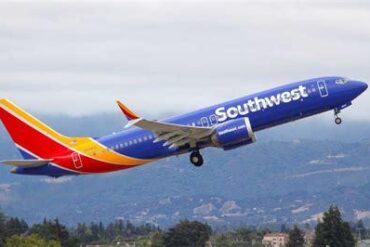
United Airlines has quietly turned the Boeing 737 MAX into one of the most versatile long-distance tools in its fleet. Rather than reserving every far-flung city pair for a widebody, the Chicago-based Star Alliance carrier assigns the MAX to some of its most geographically ambitious nonstop services, stretching from the Pacific coast of Costa Rica to the northeastern coast of South America. These are not marginal experiments — they are carefully calibrated deployments where range, fuel efficiency, and seat capacity intersect at a point that widebodies simply cannot match. The following breakdown, drawn from January 2027 schedule data compiled by the aviation analytics firm Cirium, maps the carrier’s farthest MAX sectors and explains why each one matters.
Why United Airlines Leans On The 737 MAX For Long Nonstop Missions
The economics of a long, thin route are unforgiving. Put a 250-seat widebody on a market that only fills 160 seats, and the route bleeds money. Put 160 seats on a market that fills exactly 160, and the route prints profit. The 737 MAX sits precisely in that sweet spot for United, which operates 304 of the type across its MAX 8 and MAX 9 variants, with 167 MAX 10s still on order alongside 43 additional MAX 9s. That scale allows United to spread relatively long, narrow sectors across multiple hubs and still maintain a coherent fleet plan.
Range is the second pillar. The MAX 8 and MAX 9 comfortably cover stage lengths that once demanded a 757, and United’s winter network uses that capability to bypass traditional connecting gateways. A passenger bound for Costa Rica from Northern California no longer needs to route through Houston or Dallas; the aircraft flies the segment nonstop, arrives with fuel reserves intact, and returns the same day. That single change transforms a connection-heavy market into a point-to-point product that competes directly with any carrier offering a one-stop itinerary. United has long positioned itself as a carrier that connects distant destinations without defaulting to widebody aircraft, and the MAX is the instrument that makes that positioning real.
A Network That Ignores Conventional Geography
What stands out about United’s longest MAX routes is their geographical variety. They connect the continental United States with Central America, the Caribbean, Alaska, Hawaii, and South America, and they also link major transcontinental city pairs that have nothing to do with the tropics. Denver sends the MAX to Puerto Rico and the Dominican Republic. Houston sends it to Guyana. Chicago sends it to Alaska. Los Angeles sends it to Kauai. Each route reflects a distinct revenue driver — leisure demand in one market, energy-industry travel in another, and business demand on the longest domestic legs.
This dispersion is deliberate. United’s hub structure gives it five different launch points for long MAX service, so the airline can attack several distinct demand pools at once rather than concentrating aircraft on a single corridor. Denver’s central position serves inland cities that would otherwise need two connections to reach the Caribbean. Houston’s Texas hub funnels traffic toward northern South America. Chicago’s O’Hare reaches Alaska more efficiently than any coastal gateway. San Francisco, meanwhile, anchors the entire western long-haul strategy, and it does so with the two longest MAX sectors in the network.

San Francisco To San José: The Longest MAX Route At 3,309 Miles
The single longest Boeing 737 MAX service in United’s January 2027 schedule links San Francisco International Airport with Juan Santamaría International Airport in San José, Costa Rica, spanning 3,309 miles. The reference data records the figure in imperial terms and separately cites 3,039 miles (4,890 kilometers) elsewhere in the same schedule set, a discrepancy worth noting when reading distance tables, but the ranking itself is unambiguous: the Costa Rican capital sector tops the list. The flight consumes the better part of eight hours, placing it firmly in territory once reserved for widebody equipment.
San José serves as Costa Rica’s principal international gateway, feeding the capital region, the densely populated Central Valley, and onward road connections to Pacific beach towns and cloud-forest destinations. United’s decision to fly this market nonstop from Northern California strips out an entire connection and turns a full travel day into a single boarding. San Francisco’s own role amplifies the value: the airport funnels passengers from across the West Coast and offers onward links to Asia and Oceania, so the Costa Rica flight functions both as a standalone leisure product and as a component of a much larger connecting lattice. Business travelers, families visiting relatives, and vacationers all draw from the same aircraft.
San Francisco To Liberia: Guanacaste Tourism Without A Widebody
At 2,946 miles, United’s San Francisco to Liberia Guanacaste Airport service ranks second and demonstrates a subtler point about network design. Costa Rica is not a single market. San José and Liberia serve vastly different traveler intentions, and United exploits that distinction by assigning the MAX to both. Liberia sits closer to the Pacific resort corridor of Guanacaste, where travelers arrive to check into beachfront properties and never set foot in the capital. A direct flight to Liberia saves those passengers several hours of ground transportation, which matters enormously when a vacation is measured in nights rather than days.
The MAX makes this possible because it carries enough range to reach northwestern Costa Rica from the Bay Area while keeping seat counts aligned with leisure demand that swells in the northern winter and thins in the shoulder season. A widebody would offer more seats than the market consistently absorbs; a smaller regional jet could not make the journey at all. United’s pairing of San José and Liberia from the same California gateway gives travelers a genuine choice of arrival points and locks in two distinct leisure segments with a single deployment pattern.
Houston To Georgetown: The South American Outlier At 2,901 Miles
Houston George Bush Intercontinental to Georgetown’s Cheddi Jagan International Airport in Guyana stretches 2,901 miles and represents the network’s most geographically distinctive international MAX service. Guyana has become a meaningful aviation market in its own right, propelled by tourism, family visits, commerce, and the country’s expanding offshore energy industry. That last factor drives a steady flow of business traffic that fills premium cabins and sustains nonstop service well beyond what leisure demand alone would support.
Georgetown’s location on South America’s northern Atlantic coast gives the route a rare profile in United’s system: a long, narrowbody overwater sector to a single-gateway destination in a market with limited competition from the US Gulf Coast. The MAX’s operating economics allow United to offer the nonstop without committing a widebody, and Houston’s hub position lets passengers from dozens of US cities reach Guyana with exactly one transfer. Booking demand outside the energy sector remains resilient, anchored by diaspora traffic and a growing inbound tourism trade.
Chicago To Anchorage And Denver To San Juan: Long Domestic And Caribbean Legs
Chicago O’Hare to Ted Stevens Anchorage International Airport covers 2,846 miles, connecting the Midwest directly with Alaska’s largest city. Anchorage functions as the launching point for the state’s outdoor destinations, and the route serves tourism, business, and visiting-friends-and-relatives demand in roughly equal measure. The nonstop spares Midwestern travelers a coastal connection and positions O’Hare as a genuinely competitive Alaska gateway rather than a secondary option behind Seattle. Seasonality shapes the service, with summer drawing outdoor travelers and the winter months carrying a steadier mix of business and family traffic.
Denver to San Juan’s Luis Muñoz Marín International Airport runs 2,732 miles and pulls together two entirely different demand profiles in a single market. San Juan combines beaches, a historic colonial core, and a strong tourism economy with a large diaspora. Denver’s central location then acts as a collection point, gathering passengers from dozens of inland cities that have no nonstop Caribbean option of their own. The MAX delivers enough range to make the flight routine while keeping capacity proportionate to a route that peaks hard during holiday periods. United can add rotations when demand spikes without the commitment a widebody would impose.

Los Angeles To San José And Liberia: A Second West Coast Costa Rican Strategy
Los Angeles International Airport to San José spans 2,721 miles, and Los Angeles to Liberia stretches 2,627 miles. Together they prove that United can serve the same foreign destination from more than one US gateway, and that the MAX is flexible enough to make duplication economically sound. Southern California travelers no longer need to fly north to San Francisco or connect through a Texas hub to reach Costa Rica — a direct departure removes an entire scheduling constraint and makes a weekend trip to the tropics plausible.
The Liberia service illustrates the winter leisure dynamic especially well. Demand concentrates in the peak northern season, when travelers from the Los Angeles basin seek warm-weather escapes, and both Costa Rican destinations benefit from that pattern. Offering the capital region and the Guanacaste resort coast from the same Los Angeles hub gives travelers a choice that hinges on ground transportation and holiday planning rather than flight availability. United’s ability to place MAX capacity at both gates reflects the aircraft’s role as a capacity-matching instrument rather than a one-size-fits-all long-haul solution.
Los Angeles To Lihue: The Hawaii MAX Mission
Los Angeles to Lihue Airport on Kauai covers 2,615 miles and places a Hawaiian island service among United’s longer MAX sectors. Lihue opens access to Kauai’s beaches, coastal cliffs, and outdoor attractions, and Los Angeles provides the connecting feed that funnels passengers from across the US into a single California departure. Overwater operations carry their own discipline. Hawaii missions require careful attention to fuel requirements, weather patterns, and diversion options, and the MAX’s performance margin on a 2,615-mile segment leaves room for the reserves that ETOPS planning demands.
The route also illustrates the competitive logic of point-to-point flying. Travelers who once routed through Honolulu or a mainland widebody hub can now fly direct, and United captures that demand with an aircraft whose seat count matches the market’s peak and off-peak volumes far more closely than a larger airframe would. Kauai’s finite inventory of resort capacity means the market cannot absorb unlimited seats, making right-sized equipment essential.
Denver To Punta Cana And A Summer Atlantic Footnote
Denver to Punta Cana International Airport covers 2,609 miles, linking the Rocky Mountain hub with one of the Caribbean’s most prominent resort destinations. Travelers seeking to escape the cold gain a nonstop option that removes a transfer at an eastern hub, and that advantage becomes decisive during the busy holiday periods when demand for direct leisure service surges. Punta Cana’s resort-oriented profile means the route responds to holiday calendars rather than corporate schedules, which suits a seasonal MAX deployment perfectly.
The MAX’s reach extends beyond winter, too. During the summer months, United deploys the same aircraft across the Atlantic to destinations including Glasgow and Santiago de Compostela, sectors that would rank among the carrier’s longest MAX missions if they were flown in January. Those seasonal Atlantic assignments reveal the underlying flexibility that makes the winter list possible: an aircraft that can handle Central America in one season and Europe in another is an aircraft United can keep productively employed year-round.
Boston To San Francisco And A Brief Look At The Short End
Boston Logan to San Francisco spans 2,704 miles, the longest purely domestic MAX sector in the ranking. It connects commercial, educational, and technology hubs that sustain premium demand year-round, and it demonstrates that the MAX can replace a widebody transcontinental aircraft without sacrificing connectivity. Scheduling discipline matters on sectors this long, because aircraft spend hours in the air and delays ripple through subsequent rotations, but the fuel efficiency of the MAX offsets much of that exposure.
Contrast that with the network’s shortest MAX assignments. Houston to San Antonio covers just 191 miles, San Francisco to Reno 192 miles, and Newark to Boston 200 miles. Los Angeles to Fresno reaches 209 miles, Newark to Washington Dulles 213 miles, Houston to Dallas/Fort Worth 224 miles, and Los Angeles to Las Vegas 236 miles. These puddle jumps prove the MAX is not confined to long missions; turnaround discipline, demand alignment, and fleet utilization determine which sectors it flies on any given day. The common thread across both ends of the spectrum is capacity matching — the same judgment that puts a MAX on a 191-mile hop also justifies it on a 3,309-mile haul.
What The Winter 2027 MAX Map Signals About United’s Strategy
United’s longest 737 MAX routes reveal a carrier that treats range as a tool for market creation rather than a niche capability. Costa Rica receives service from three separate gateways in this ranking, Guyana gains a nonstop from the Gulf Coast, Alaska and Hawaii join the long-sector roster, and Caribbean leisure markets draw steady capacity from a mountain hub. Every one of those placements reflects a deliberate reading of demand against aircraft size, and the schedule remains subject to change as departure dates approach. Aircraft assignments shift, frequencies adjust, and seasonal demand patterns evolve.
Yet the underlying trend is clear. The 737 MAX has moved from a 737-800 replacement into a genuine long-distance strategist, and United has built a winter network that exploits every mile of that range. As the MAX 10 order enters service, the airline will gain even more flexibility over these distant city pairs, extending the logic that already links San Francisco to San José and Houston to Georgetown. The narrowbody, once confined to regional work, now anchors the edges of the network.