When WestJet filed its summer schedule with four weekly departures bound for Cardiff International Airport (CWL), the reaction across the aviation community was a mixture of curiosity and disbelief. Calgary’s hometown carrier had spent years building a reputation for connecting Canadian cities to secondary international airports that legacy competitors treated as afterthoughts, yet Wales represented something altogether more exotic. On May 22, the airline launched flights between Toronto Pearson International Airport (YYZ) and Cardiff, operating every Monday, Wednesday, Friday, and Saturday aboard the Boeing 737 MAX 8. The aircraft, configured with 12 premium seats and 162 economy seats, departed Toronto at 10:10 PM and touched down in Wales at 10:15 AM the following morning, while the return leg left Cardiff at 11:35 AM and arrived in Toronto at 2:30 PM. Those timings were engineered with intent: overnight westbound-to-eastbound positioning allows business travellers to sleep through the Atlantic crossing and land ready for a full working day in Cardiff, Bristol, or the Welsh Valleys.
The service carried genuine historical weight. Cardiff had endured an 18-year absence of nonstop Canadian flights, a drought stretching back to 2008, when the defunct Zoom Airlines linked the Welsh capital to Toronto and ran a Vancouver service via Belfast. Before that, Air Transat served Toronto until 2004. In the intervening years, Welsh travellers bound for North America funneled through London Heathrow, Bristol, and Manchester, surrendering hours to motorway congestion and connection risk. Cardiff Airport framed the launch as a generator of “new opportunities for tourism, trade, investment and cultural exchange,” and the first season, which closed on September 12, appears to have justified the fanfare. Cirium schedule data indicates the route will return on May 21, 2027, a signal that WestJet sees something worth defending.
A Small Airport With a Long History of False Starts
Cardiff’s struggle to sustain long-haul flying is not a story about inadequate runways or terminal capacity. It is a story about catchment economics. The airport sits within a few hours’ drive of some of the most densely connected hubs on earth, and passengers in South Wales have spent decades demonstrating a willingness to drive past their local terminal if the fare, frequency, or destination warrants it. That gravitational pull toward Heathrow and Manchester has repeatedly strangled ambitious Welsh long-haul experiments before they could mature.
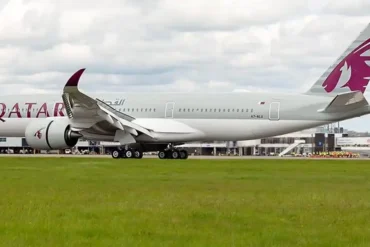
The cautionary tale is Qatar Airways. In May 2018, the Doha-based flag carrier launched flights between Hamad International Airport (DOH) and Cardiff, operating up to five weekly frequencies with the Boeing 787-8. The service was widely read as a triumph of Welsh industrial policy as much as commercial logic. Multiple reports at the time suggested the Welsh Government and Cardiff Airport expended considerable effort to attract the Gulf carrier through financial incentives, with roughly $1.3 million (£1 million) reportedly handed over to market Wales internationally. The route did not survive COVID-19, ending in 2020 and never returning. Whether it would have endured on pure passenger demand remains an open and uncomfortable question for anyone now championing transatlantic service from CWL.
The Financial Arithmetic Behind Four Weekly Flights
It is unclear whether WestJet receives comparable incentives for the Toronto route. The airline has not disclosed any public subsidy arrangement, and the fact that flights are already scheduled to return next summer implies an internal case exists. The available evidence is mixed but not discouraging. UK Civil Aviation Authority data covering the period through July 2026 shows WestJet carried 10,033 passengers between May and July at a load factor of 73%. That figure sits below the threshold most airlines regard as comfortable for long-haul narrowbody operations, though it is respectable for a brand-new seasonal route still building brand recognition in an unfamiliar market.
What the CAA data cannot reveal is the average fare required to fill those seats. WestJet’s booking platform currently lists one-way fares from Toronto to Cardiff at roughly $318 (£240) for next summer, a price point that suggests the airline is buying market share rather than harvesting premium yields. On a 3,435-mile sector flown by a single-aisle jet, the margin between profit and loss is measured in tens of dollars per seat, and a 73% load factor at leisure-oriented fares leaves limited room for error.
Why WestJet Is Retreating Elsewhere While Advancing in Wales
The sharpest insight into WestJet’s Cardiff commitment comes from examining what it is abandoning. The airline reinstated Toronto to Glasgow International Airport (GLA) in May, having last served Scotland’s largest city in 2022, and simultaneously launched Halifax Stanfield International Airport (YHZ) services to Copenhagen Airport (CPH) and Madrid Barajas Airport (MAD). All three routes are now being dropped. The Glasgow decision reflects straightforward consolidation: WestJet already operates seasonal flights to Edinburgh from Toronto, Halifax, and Calgary, and lower yields on the Glasgow pairing made a two-airport Scottish strategy indefensible. Copenhagen and Madrid collapsed under a different problem, with Simple Flying reporting that more than 60% of passengers on both routes were connecting traffic, a mix that starves an airline of the ancillary and fare-premium revenue that point-to-point demand delivers.
Cardiff, by contrast, offers WestJet something those markets could not: a monopoly. No carrier competes on Toronto–Cardiff, so every passenger choosing a nonstop flight has no alternative but to book with WestJet. Glasgow, Copenhagen, and Madrid all sit within fiercely contested European airspace where incumbents can undercut a challenger at will. WestJet’s single-aisle fleet, deployed strategically against thin, uncontested city pairs that cannot justify widebody economics, is precisely the tool for a market like this. The airline’s seven Boeing 787-9 Dreamliners remain reserved for denser long-haul missions, leaving the 737 MAX 8 to probe opportunities larger carriers ignore.
The Strategic Case for Betting on Wales
WestJet’s willingness to return to Cardiff while retreating from Copenhagen and Madrid reveals a coherent philosophy rather than a contradiction. The airline is not chasing volume; it is chasing route exclusivity and the pricing power that comes with it. Wales offers a diaspora market, a growing inbound tourism sector anchored by Cardiff Castle, the Brecon Beacons, and the Pembrokeshire coast, and a business community that has lacked direct North American connectivity for nearly two decades. Toronto Pearson, meanwhile, functions as a hub gateway feeding onward traffic across Canada and into the United States, giving the route a reach far beyond point-to-point demand.
The unknowns remain substantial. A 73% load factor must climb, average fares must hold above discount thresholds, and the route must prove it can survive outside the peak summer window when Welsh holiday demand evaporates. Yet the scheduled May 21, 2027 return is itself the most eloquent statement WestJet could make. In an industry where airlines quietly delete underperforming routes from the following year’s schedule, recommitting to the UK’s 19th-busiest airport while cutting three higher-profile European destinations suggests Calgary has run the numbers and concluded that Wales, of all places, is worth the gamble.