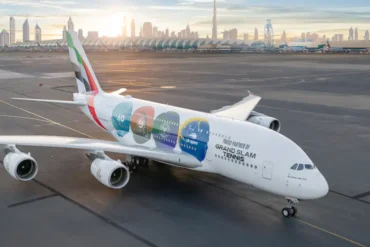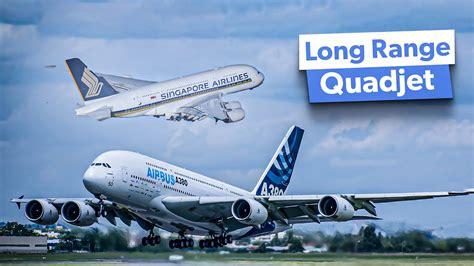
The Airbus A380 was never designed to be subtle. It was built to dominate skies, redefine long-haul travel, and carry entire micro-cities across continents without stopping. When it entered commercial service, it didn’t just raise expectations—it rewrote them. At the heart of its legend lies one key question: how far can the Airbus A380 actually fly without refueling?
The answer is both precise and fascinating. In a standard four-class configuration carrying around 545 passengers, the A380 boasts a range of approximately 8,000 nautical miles (14,800 kilometers). Under certain conditions—depending on engine type, payload, and operational strategy—that figure can stretch closer to 8,200 nautical miles (15,200 kilometers). Those numbers aren’t just impressive; they unlock nonstop connections between some of the most distant city pairs on Earth.
This capability isn’t theoretical. Airlines have consistently used the A380 to operate ultra-long-haul routes linking global megahubs, often keeping the aircraft airborne for well over 14 hours at a time. It’s a feat that combines engineering brilliance with operational precision—and it’s exactly what made the A380 the undisputed king of long-haul, high-capacity aviation.
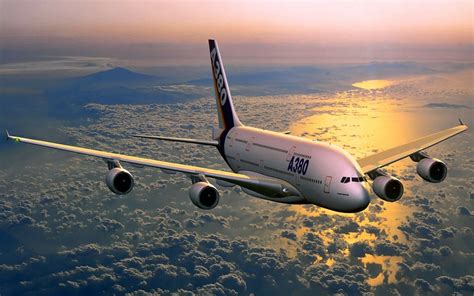
The True Nonstop Range of the Airbus A380
Understanding the A380’s range requires context. Aircraft performance is never static; it shifts depending on weight, weather, routing, and even air traffic control constraints. Still, Airbus’ official data provides a reliable benchmark: 8,000 nautical miles under typical long-haul operating conditions.
That range allows the aircraft to connect cities separated by vast oceans and multiple time zones without the need for refueling stops. Routes such as London to Singapore, Dubai to Los Angeles, and Sydney to Dallas/Fort Worth fall comfortably within its operational envelope. These are not just long flights—they are endurance tests of both machine and human coordination.
What’s particularly striking is how the A380 balances this range with its enormous passenger capacity. Unlike smaller long-haul jets that trade seating for distance, the A380 manages to carry hundreds more passengers while still covering similar ground. This dual capability is what made it so attractive to airlines operating hub-and-spoke networks, where maximizing passenger throughput between major hubs was critical.
However, there’s a catch—and it’s one rooted in physics. The more passengers, cargo, and baggage loaded onboard, the shorter the maximum achievable range. Every additional kilogram demands more lift, more thrust, and ultimately more fuel burn. That’s why airlines carefully plan payloads and fuel loads to optimize each route.
Engineering Brilliance: What Enables the A380’s Range
The A380’s extraordinary range isn’t the result of a single innovation—it’s the product of multiple engineering breakthroughs working in harmony. At its core, the aircraft was designed to be both massive and efficient, a combination that sounds contradictory but was executed with remarkable precision.
Roughly 25% of the A380’s structure is made from advanced composite materials, significantly reducing weight without compromising structural integrity. This lighter airframe translates directly into lower fuel consumption, especially during critical phases like climb and cruise.
Fuel storage is another defining factor. The aircraft carries an astonishing 320,000 liters (84,535 US gallons) of fuel, distributed across 11 tanks, primarily located in the wings. But this isn’t just about quantity—it’s about intelligent management. Sophisticated onboard systems continuously redistribute fuel during flight to maintain the optimal center of gravity, enhancing both stability and aerodynamic efficiency.
Even the aircraft’s flight profile is tailored for efficiency. Pilots typically operate the A380 at a cruising speed of around Mach 0.85, slightly below its maximum capability. This deliberate choice reduces aerodynamic drag and fuel burn, extending the aircraft’s range. Similarly, the A380 is known for its relatively gentle climb rate, a strategy that conserves fuel during ascent.
All these elements—lightweight materials, advanced aerodynamics, intelligent fuel systems, and optimized flight operations—combine to create an aircraft capable of traveling extraordinary distances without refueling.
Fuel Consumption: The Trade-Off Behind Long Range
Covering 8,000 nautical miles doesn’t come cheap. Over the course of a full-range flight, the A380 consumes approximately 320,000 liters of fuel. That figure might sound staggering, but when distributed across more than 500 passengers, the fuel burn per seat becomes surprisingly competitive.
This is where the A380’s economic logic comes into play. Its design prioritizes cost per seat mile, not absolute fuel efficiency. When fully loaded, it can outperform smaller widebody aircraft in terms of operating cost efficiency. But when seats go empty, that advantage quickly erodes.
Airlines that succeeded with the A380—most notably those operating major global hubs—understood this dynamic. They deployed the aircraft on routes with consistently high demand, ensuring that its massive capacity translated into maximum revenue.
A380 vs Boeing 747: A Battle of Giants
Before the A380, the Boeing 747 reigned supreme as the world’s most iconic long-haul aircraft. Comparing the two is inevitable—and revealing.
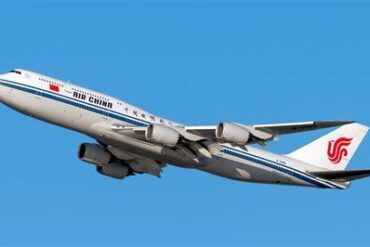
The latest passenger variant, the Boeing 747-8 Intercontinental, offers a range of roughly 8,000 nautical miles, placing it in the same league as the A380. However, the A380 edges ahead in overall passenger capacity, giving it a distinct advantage on high-density routes.
Earlier versions of the 747 tell a different story. The original 747-100, introduced in 1970, had a range of just 5,300 nautical miles, while later variants gradually extended that figure. Even so, the A380 represents a generational leap in both efficiency and capability.
One of the most fascinating moments in aviation history came when a modified 747-400 completed an ultra-long-haul flight from London to Sydney, covering nearly 17,000 kilometers in over 20 hours. While impressive, such flights required specialized fuel and conditions—whereas the A380 achieves its range routinely under standard operations.
Powering the Giant: Engines That Make It Possible
An aircraft as large as the A380 demands extraordinary power. To get airborne at its maximum takeoff weight of 575,000 kilograms (1.268 million pounds), it relies on four high-thrust engines, each producing around 70,000 to 75,000 pounds of thrust.
Airlines can choose between two engine types: the Rolls-Royce Trent 900 and the Engine Alliance GP7200. Both are engineering marvels, designed to deliver immense power while maintaining fuel efficiency over long distances.
Together, these engines generate a combined thrust of approximately 300,000 pounds, enough to propel the double-deck giant across continents and oceans. That’s comparable to the combined output of multiple smaller aircraft—a reminder of the sheer scale involved.
Despite their power, these engines are optimized for efficiency. High bypass ratios, advanced materials, and precision engineering allow them to deliver sustained performance without excessive fuel consumption. Subtle differences between the two engine types influence range and efficiency, but both enable the A380 to achieve its remarkable capabilities.
How Modern Aircraft Have Surpassed the A380’s Range
As dominant as the A380 once was, aviation doesn’t stand still. New-generation aircraft have redefined what’s possible, often surpassing the A380 in range while using fewer engines and less fuel.
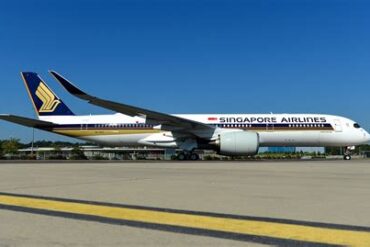
The Airbus A350-900 can fly up to 8,500 nautical miles, while the A350-1000 extends that to 9,000 nautical miles. The ultra-long-range A350-900ULR pushes boundaries even further, reaching an astonishing 9,700 nautical miles, making it the longest-range commercial aircraft currently in service.
Meanwhile, Boeing’s upcoming 777X family promises similar capabilities. The 777-8 is expected to achieve a range of 8,745 nautical miles, surpassing the A380 while carrying fewer passengers more efficiently.
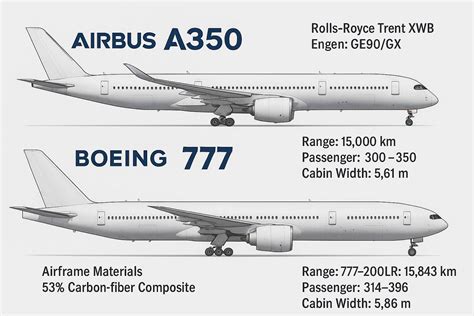
These aircraft embody a different philosophy. Instead of maximizing capacity, they focus on point-to-point travel, allowing airlines to connect smaller cities directly without relying on massive hub airports. This shift has fundamentally changed long-haul travel dynamics.
The Strategic Role of Range in the A380’s Legacy
The A380’s range wasn’t just a technical achievement—it was a strategic tool. It enabled airlines to funnel massive numbers of passengers through key hubs, creating highly efficient long-haul networks. Routes that once required multiple stops became seamless, transforming the passenger experience.
Yet, that same strategy also limited its flexibility. The aircraft’s size required specialized infrastructure, and its economics depended heavily on consistently high demand. As travel patterns evolved and airlines prioritized flexibility, smaller long-range jets became more attractive.
Still, the A380’s ability to fly 8,000 nautical miles without refueling remains a defining feature. It represents a pinnacle of engineering—a moment when aviation pushed the boundaries of size, capacity, and distance all at once.
Final Thoughts: A Range That Defined an Era
The Airbus A380 didn’t just fly far—it flew far with purpose. Its range enabled global connectivity on an unprecedented scale, linking continents with unmatched capacity and comfort. Even as newer aircraft surpass it in efficiency and flexibility, the A380’s capabilities remain extraordinary.
In an industry driven by constant innovation, the A380 stands as a bold statement: bigger can be better—if the conditions are right. And when it comes to long-haul range combined with sheer passenger volume, few aircraft have ever come close to matching what this giant achieved.