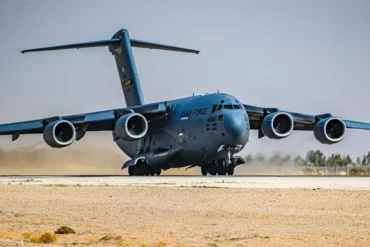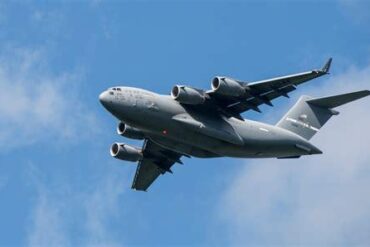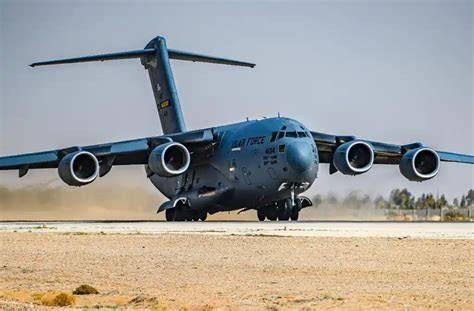
The United States remains, by an enormous margin, the world’s foremost expeditionary military power, projecting force through a sprawling constellation of bases across the Middle East, Europe, and the Western Pacific. Most of the tonnage sustaining those outposts travels by sea, but strategic airlift is what turns a distant runway into a functioning military base, delivering the time-sensitive components, munitions, and personnel that ships cannot schedule around. That dependence exposes an awkward gap in the American industrial base. Russia still builds the Il-76, China produces the Y-20, and Europe assembles the A400M Atlas, yet the United States has not produced a single strategic airlifter in more than eleven years, not since the last C-17 Globemaster III rolled out of Boeing’s Long Beach facility in 2015. The C-130J Hercules remains in production, but it is a tactical airlifter built for a fundamentally different mission, with a narrower fuselage, shorter legs, and far less capacity for outsized cargo like tanks, helicopters, and Patriot batteries.
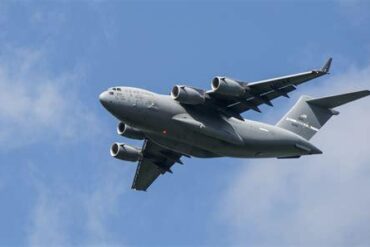
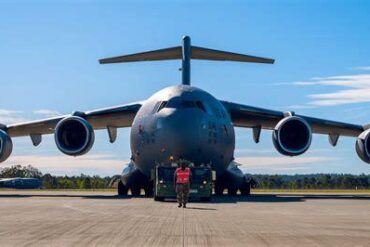
That anomaly has now become a policy problem. Reports have circulated since at least mid-2025 that Boeing is quietly exploring whether the C-17 line could be resurrected, and the conversation has since migrated from industry rumor into the language of congressional mandates. Operators who fly the aircraft, from Australia to the United Kingdom, have reportedly been “encouraged” by early contacts with Boeing about a potential restart, a signal that demand may exist beyond the Pentagon’s own inventory. What began as speculation about exports to an unnamed foreign buyer has returned to the aircraft’s original and most important customer, the U.S. Air Force, which owns the overwhelming majority of the 279 Globemasters ever built.
Renewed Interest In Restarting C-17 Production
The most concrete evidence of renewed momentum arrived through the legislative process rather than a corporate announcement. Congress recently directed the U.S. Air Force to prepare a formal briefing on the feasibility of acquiring new Globemaster IIIs, an instruction that reframes a once-unthinkable question as a matter of active planning. The Air Force’s C-17 fleet is critical for U.S. power projection globally, and the House Committee on Armed Services has now put the service on a deadline: a briefing is due no later than March 1, 2027, covering the status of tooling, supplier base viability, workforce availability, potential reconstitution costs, an estimated timeline for reestablishing production, and a projected delivery date for the first aircraft. The committee’s request extends further, into cost estimates for restarting the line, per-aircraft procurement costs, options for service life extension programs, and modernization of the existing fleet.
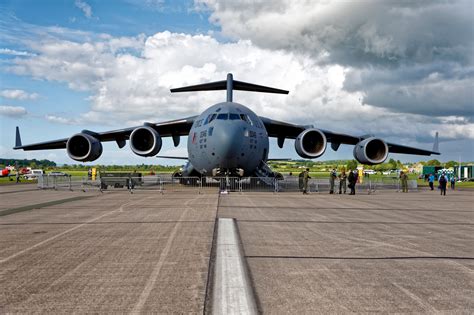
The numbers behind the fleet help explain the urgency. Boeing delivered 223 aircraft to the U.S. Air Force, with the service accepting its final new airframe in 2013, and the remaining 56 went to export customers. Those overseas operators form a remarkably committed community: Australia flies 8, Canada 5, India 11, Kuwait 2, Qatar 8, the United Arab Emirates 8, the United Kingdom 8, and the NATO Strategic Airlift Capability consortium 3. Saudi Arabia was among the interested buyers whose orders never materialized before the line closed, and the fact that the final production aircraft went to export customers rather than the Pentagon underscores how demand outlasted the production decision. For allies facing their own airlift shortfalls, a reopened line would be the only path to a new strategic airlifter with interoperability baked in from the start.
US Concern Over Its Existing Fleet
Operational tempo is the second front in this argument. Recent contingencies, including Operation Epic Fury, have placed a large amount of strain on the C-17 fleet, and the committee’s report explicitly warns that future operational demands may place additional strain on the existing fleet. The deeper worry is structural: can a fleet of roughly 222 airframes, many of them already well past their original design benchmarks for fatigue life, be sustained until 2075? That date is not arbitrary; it is the year the Air Force’s current planning assumes the C-17 will finally leave service. Each airframe carries a finite reserve of structural life, and every contingency consumes a share of it. The committee’s concern is not abstract accounting but the prospect of a capability gap opening in the 2040s and 2050s, precisely when the Air Force expects to be fighting for airlift capacity it cannot replace.
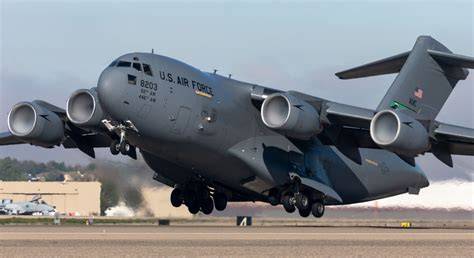
The committee has therefore widened its inquiry beyond the binary question of restart or not. It asks whether service life extension programs can buy the fleet more years, whether existing aircraft can be modernized with new defensive systems and communications gear, and whether alternative approaches could relieve some strain. Among the alternatives floated are procuring commercial cargo aircraft and expanding the Civil Reserve Air Fleet, the mechanism that lets the military draw on airlines’ freighters in a crisis. International participation in a restart is also on the table, an acknowledgment that a production line needs enough orders to make economic sense and that allied demand could be the difference between a viable case and a dead one.
Potential Alternative Aircraft
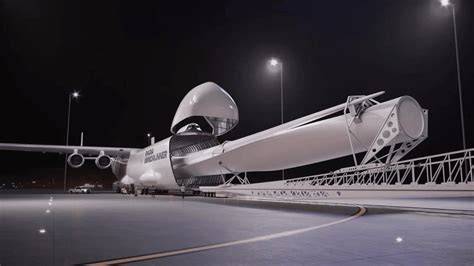
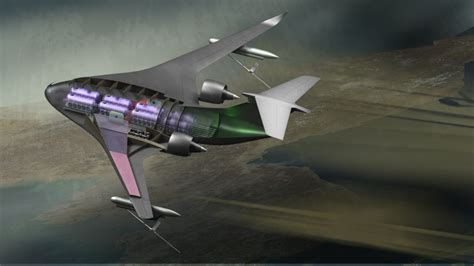
No other American airlifter exists that could simply take the C-17’s place, but several aircraft could relieve parts of the burden. The Airbus A400M Atlas occupies the strategic-tactical niche, and the upcoming A350F freighter offers commercial efficiency, though serious consideration by the Pentagon seems unlikely given the long-standing priority on American aircraft programs. More interesting is Radia’s Windrunner, a proposed giant with a cargo volume roughly ten times that of a Boeing 777 and the ability to land on unpaved strips. It is an extraordinary machine, but it is also deeply niche, optimized for outsized cargo such as wind turbine blades, and unsuited to routine military logistics. Another option is the blended-wing-body concept from JetZero, developed with Northrop Grumman, which remains on track for a full-sized demonstrator flight in 2027; the Air Force’s current interest in that aircraft centers on refueling rather than airlift.
The commercial option is more mundane but more realistic. The committee says it is interested in purchasing commercial cargo aircraft, and realistically the candidates narrow to a variant of the Boeing 767 or the larger upcoming 777-8F, alongside the outgoing 777F. Whether the Air Force would consider second-hand 747-8F freighters remains unclear, though the market for those aircraft exists. None of these substitutes matches the C-17’s combination of heavy payload, short-field performance, and the ability to operate from austere, semi-prepared runways, which is precisely why the service kept buying C-17s long after commercial freighters became cheaper per ton-mile.
Next Generation Airlift Aircraft
The restart debate cannot be separated from the Air Force’s long-term airlift strategy, currently embodied in the Next Generation Airlifter program. NGAL is intended to develop a single aircraft family that eventually replaces both the C-5M Super Galaxy and the C-17A Globemaster III, and it remains in an early stage, pre-Analysis of Alternatives, though it is being accelerated in Fiscal 2027. The current plan calls for the first production aircraft as early as Fiscal 2038 with initial operational capability in Fiscal 2041, timelines that look optimistic given the historical record of major acquisition programs and that depend entirely on stable funding and uninterrupted development. The program envisions acquiring around 274 aircraft on a one-for-one basis, with early baseline requirements from Requests for Information specifying a wingspan of less than 223 feet and the ability to carry a minimum payload of 160,000 pounds over at least 2,500 nautical miles unrefueled. Under the current plan, NGAL would fully replace the Super Galaxy fleet by 2045 and the Globemaster III fleet by 2075.
If NGAL proceeds as planned and the C-17 returns to production, the two aircraft could conceivably be built concurrently, a strange but not unprecedented overlap. History offers a rough guide to the difficulty of the restart itself: comparable cases suggest Boeing may need three to five years to bring the C-17 line back to life, a timeline that would consume a meaningful fraction of the window before NGAL’s first deliveries. That interval is the crux of the feasibility question, because a restart that takes five years and delivers aircraft only at the far end of that window may fail to bridge the gap it was meant to close.
The Cost Of Restarting C-17 Production
The best available study of the economics remains a RAND Corporation analysis published more than a decade ago, now badly dated but still the only serious public estimate. RAND examined restarting production of the C-17A and also explored an updated variant, the C-17B. Its figures put the cost of restarting C-17A production at $2.1 billion to $2.7 billion in 2011 dollars, with a new C-17B version at $4.6 billion to $6.4 billion and a more advanced C-17FE at $6.2 billion to $7 billion. Cumulative U.S. inflation since 2011 stands at about 49%, though inflation in specialized aerospace production may run unevenly, and any modern estimate would need to account for years of further price growth in titanium, forgings, and skilled labor.
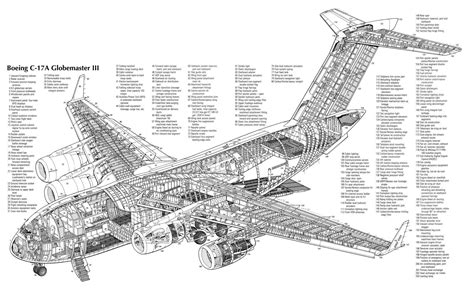
The hard part is rarely the money alone. Restarting a cold production line is an exercise in industrial archaeology: tooling is lost, engineers move on, and supply chains shrivel as small suppliers exit the business or are absorbed by competitors. A restart must reconstruct a vendor base for thousands of components, recertify processes, and rebuild a workforce that has not built the aircraft in over a decade. Per-aircraft costs depend heavily on order quantity, since fixed restart costs must be spread across however many airframes are ultimately bought, and they depend on capability. Future C-17Bs would likely cost more than original C-17As because aircraft are expected to be more capable and networked; transport aircraft are no longer simply a box that flies. Airbus’s vision of its A400M operating inside future networked kill chains and deploying drones points to where the market is heading, and any new-build C-17 would need to arrive with modern defensive systems, open-architecture mission systems, and the ability to integrate with autonomous systems.
The ‘Last Mile’ & Pushing Strategic Airlifters Back
A third strand of the debate concerns survivability. The Air Force and Marine Corps have grown increasingly concerned about large, unstealthy aircraft like the C-17 in future high-end conflicts, and both services are exploring alternative programs for “last mile” cargo transport using runway-independent aircraft, STOVL designs, and various forms of cargo drones. As adversary capabilities grow, the last mile can stretch to hundreds of nautical miles, and the threat is not hypothetical: airbases are becoming vulnerable, and aircraft like China’s J-20 and the upcoming J-36 can threaten airlifters at increasingly greater ranges. The C-17 was designed to operate from austere forward airbases, but that design assumption may no longer be sufficient when the enemy can reach those airbases with precision weapons.
The emerging division of labor is worth stating plainly. Strategic transport aircraft can be expected to safely lift cargo and troops from the U.S. mainland to Hawaii and possibly to Guam, but operating beyond Guam could become increasingly problematic in a high-end conflict. Air Force-focused programs such as Silent Arrow CLS-300 and Next Generation Airlift – Last Tactical Leg, alongside Marine Corps-focused solutions like R66 TURBINETRUCK and Piasecki KARGO, point toward a future in which the C-17’s replacement is not one aircraft but a layered system. Solutions range from wing-in-ground-effect ekranoplans to MALE drones, and a common feature is that these aircraft are typically autonomous and often electric or hybrid-electric. The C-17, the C-5M, the C-130J, and even the CV-22 are all expected to remain vital to sustaining expeditionary capability deep into the century, but they will increasingly hand off the final and most dangerous leg to smaller, cheaper, and more expendable platforms.
That layering is precisely what makes a C-17 restart plausible rather than nostalgic. The case rests on a fleet that must survive to 2075, a congressional mandate with a March 1, 2027 deadline, an allied customer base that includes Australia, Canada, India, Kuwait, Qatar, the UAE, the UK, and the NATO consortium, and a gap in the industrial base that no commercial freighter, European airlifter, or experimental blended-wing design can close on its own. Whether Boeing can reconstruct a line it dismantled eleven years ago, at a cost that a skeptical Congress will accept, and in time to matter before NGAL arrives, is now the central question in American strategic airlift.