The Boeing 747 has slipped from the world’s premier long-haul workhorse into a rare, almost archival experience, and that scarcity has quietly transformed how travellers evaluate a business class seat. Where a dozen carriers once competed on routes that crossed every ocean, a passenger-configured 747 in 2026 departs from only a handful of hubs, and each of those operators has shaped its premium cabin around a very different philosophy. Some built their reputation on the sheer intimacy of the upper deck, others on a seat architecture engineered for privacy, and at least one still flies a cabin designed for a market that no longer exists. Understanding which of those offerings genuinely delivers the most space, and where a traveller can still reserve it, requires looking past a single width measurement and into the geometry of the aircraft itself.
Production of the type ended with 1,574 examples completed across every variant, and the first prototype, the City of Everett, now rests permanently at The Museum of Flight in Seattle. The first commercial delivery went to Pan American World Airways on 12 December 1969, an aircraft registered N733PA that was later re-registered 5N-THG, withdrawn from use, and stored at San Bernardino International Airport before being scrapped by late 1993. Retirements had already begun early, with American Airlines shedding the type in 1974 because the super jumbo did not fit its route strategy at the time. What followed was a decades-long migration toward twin-engine efficiency, and the economics became impossible to ignore once the Boeing 777-300ER arrived: the most modern 747-400 and 747-8 variants burn roughly 8.83 to 12 tonnes of fuel per hour, while the 777-300ER consumes about 7.35 to 7.5 tonnes on a comparable mission. Four engines, in other words, now cost real money.
Where Passenger 747s Still Fly In 2026
Four carriers have made the maths work for regularly scheduled passenger services. Lufthansa fields 25 aircraft, Air China operates 9, Korean Air flies 4, and Rossiya Airlines keeps 6 in service. Beyond that quartet, the type survives only in cargo and charter roles, which means the search for a spacious business class seat on a 747 is effectively a search across four hubs: Frankfurt Airport (FRA) for Lufthansa, Beijing Capital Airport (PEK) for Air China, Seoul Incheon International Airport (ICN) for Korean Air, and Moscow Sheremetyevo International Airport (SVO) for Rossiya. Each airline builds its schedule around its own base, so route planning comes before seat selection rather than after it.
Geography also shapes who can realistically reach these cabins. South Korean passport holders arguably enjoy the widest access, since Passport Index confirms visa-free entry to Germany, China, Russia and South Korea itself, covering all four strongholds without paperwork. For everyone else, the practical question becomes which hub is reachable on a sensible itinerary, and only then which seat on that aircraft deserves the booking.
Why The Upper Deck Delivers Space That Seat Specs Miss
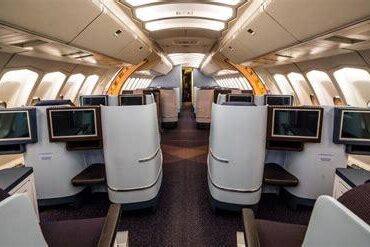
The 747’s hump is the most misunderstood premium real estate in commercial aviation. Because it sits physically apart from the main deck and stacks vertically above another premium segment, cabin crew effectively manage a self-contained wing of the aircraft rather than a long cross-section of a single-aisle cabin. That separation produces a psychological spaciousness no twin-engine widebody can replicate, even when the individual seat measures identically. Density in the hump is correspondingly low, so the ratio of passengers to crew and passengers to lavatories shifts decisively in the traveller’s favour, and the cabin feels closer to a private lounge than a commercial cabin.
Frankfurt: Lufthansa’s Bay Of Plenty
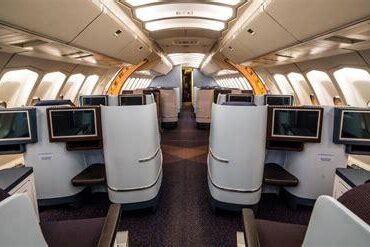
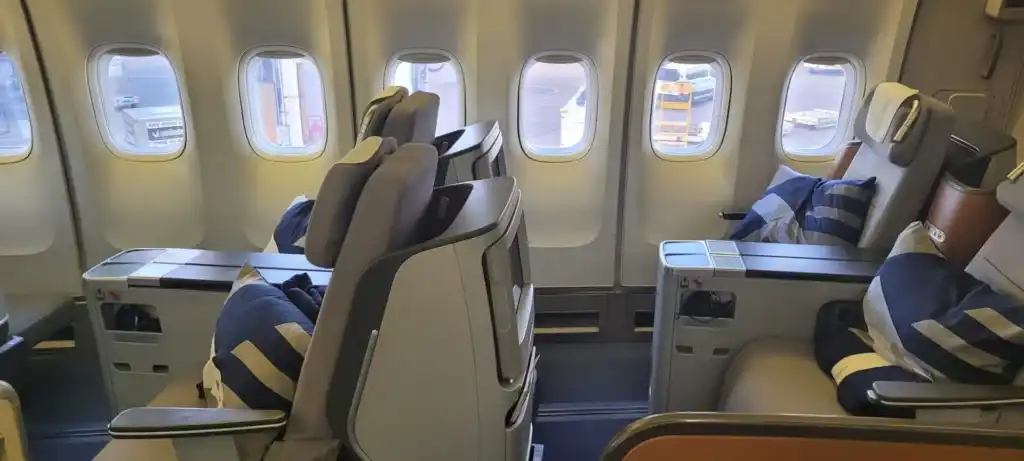
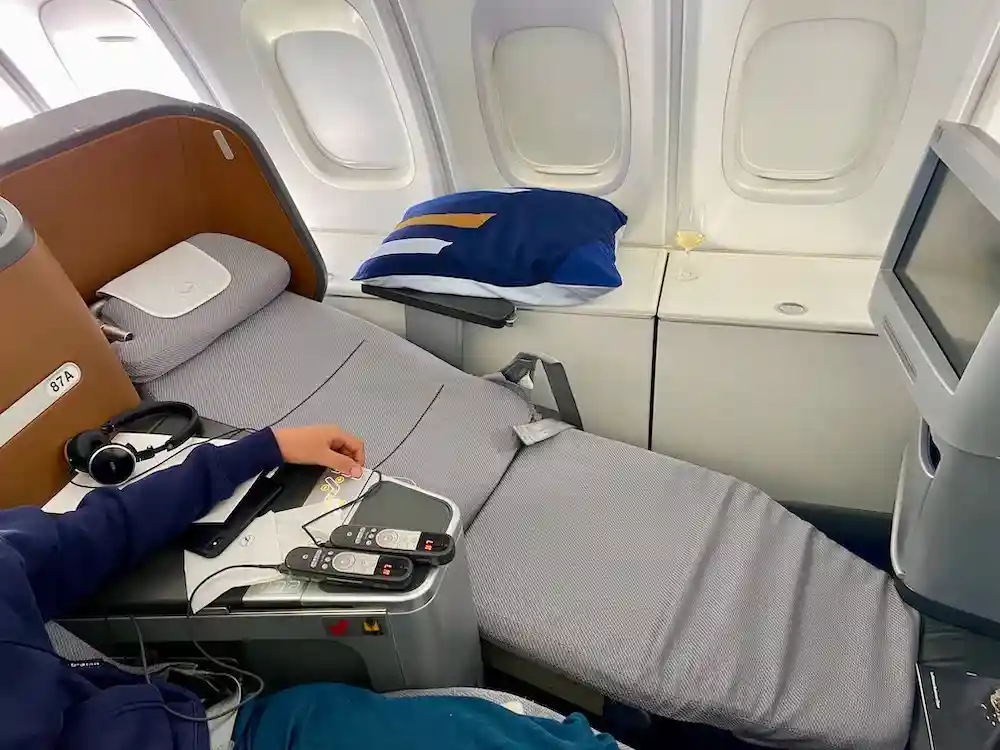
On any given day the apron at Frankfurt reads like a museum exhibit of Boeing widebody history, and no airline has committed more heavily to keeping the passenger 747 alive than Lufthansa, which flies both the -400 and the newer -8 from its primary hub. That commitment makes FRA the easiest place on earth to find a passenger 747 and the destination with the greatest number of daily business class seats aboard the type. On the 747-8, Lufthansa configures either 80 or 92 business class seats across the main and upper decks, publishing a seat roughly 20 inches (51 cm) wide with a fully flat bed approaching 78 inches (198 cm) long.
Those figures no longer lead the industry, and Lufthansa’s genuine advantage lies elsewhere. Most of its aircraft carry just 32 passengers in the hump, an intimate environment that feels removed from the rest of the jet. The carrier therefore offers the most spacious cabin environment rather than the most spacious individual seat, which is a meaningful distinction for anyone weighing privacy against raw dimensions. Travellers who value the sensation of occupying the Queen of the Skies will find nothing comparable; travellers who want the widest, most modern seat will need to look east.
Seoul: Korean Air’s Apex Suite Sets The Benchmark
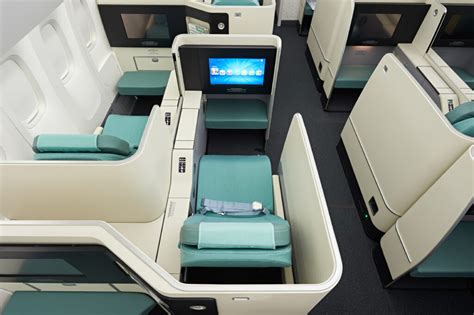
If the objective is the most spacious business class seat still bookable on a passenger 747, Incheon is the place to be. Korean Air’s remaining 747-8 Intercontinentals carry 48 Prestige Class seats across the main and upper decks in the highly regarded Apex Suite, with a published width of approximately 21 inches (53 cm) and a fully flat bed measuring roughly 75 inches (191 cm). Korean Air achieves that within a 368-seat aircraft, so the denser configuration does not come at the expense of cabin size.
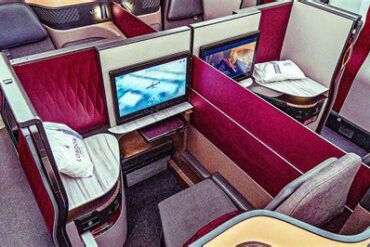
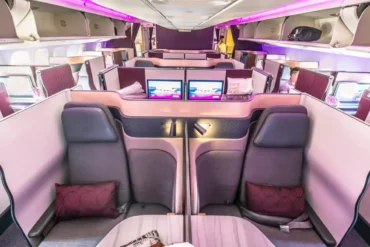
The architecture matters more than the numbers. The Apex Suite places a large side console between many passengers and the aisle, generating a sense of personal floor space that exceeds what a simple width measurement implies, and it delivers direct aisle access and strong privacy in a way that older staggered layouts cannot. For travellers specifically chasing the most modern premium experience available on a Boeing 747 in 2026, Korean Air remains hard to beat.
Beijing: Air China’s Space Through Cabin Geography
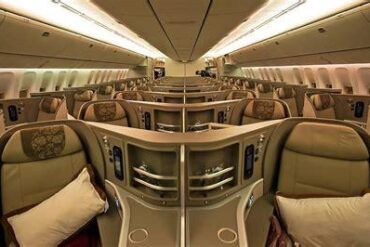
Air China takes a noticeably different approach, using the aircraft’s unique geometry rather than seat innovation to create exclusivity. Its 747-8 business class occupies the upper deck and parts of the distinctive forward fuselage, with seats roughly 21 inches (53 cm) wide and fully flat beds, broadly similar to Korean Air’s offering. The experience nevertheless varies considerably by seat selection, because the nose section narrows toward the cockpit and forms a smaller, more private compartment than the main cabin.
Upstairs, just 30 business class seats occupy the hump, making it one of the lowest-density premium environments available on the open market. That configuration confirms that dimensions alone cannot crown a single best 747 premium seat: Air China’s cabin is more intimate than either Korean Air’s or Lufthansa’s, and fewer seats translate into service that can be more tailored and curated for each business class passenger.
Moscow: Rossiya As The Wild Card
Rossiya represents the most unusual way to fly business class on a 747 today. Operating former Transaero aircraft, the St Petersburg-based carrier maintains one of the last substantial passenger 747 fleets outside the major global network carriers, and its cabins were designed for a different market environment and reflect an earlier era of premium travel. Because Russia is vast, the 747 is deployed on key domestic routes from SVO rather than on long-haul prestige services, consistently linking Moscow with economic centres such as Sochi International Airport (AER). Rossiya publishes no seat dimensions, so the cabin’s appeal rests on rarity rather than measurable space.
The long-term test for Rossiya, and arguably for the passenger 747 itself, is not whether travellers enjoy the aircraft but whether sufficient economic justification remains for four-engine passenger operations when twins achieve similar range on far less fuel. That calculation has already removed dozens of passenger 747 fleets worldwide, and Rossiya must additionally absorb the burden of a deteriorating 747-400 supply chain alongside international sanctions imposed over the war in Ukraine.
Matching The Right Seat To The Right Traveller
| Airline | Aircraft | Business Class Type | Published Strength |
|---|---|---|---|
| Korean Air | 747-8I | Apex Suite | Direct aisle access, strong privacy |
| Lufthansa | 747-8 / 747-400 | Lufthansa Business Class | Upper deck exclusivity |
| Air China | 747-8I | Flat-bed business class | Low-density premium cabin footprint |
| Rossiya | 747-400 | Legacy business cabin | Rare passenger 747 experience |
Choosing among them comes down to what a traveller means by space. Korean Air wins on the individual seat, pairing a 21-inch width with an Apex Suite console that manufactures usable personal territory and direct aisle access. Lufthansa wins on cabin atmosphere, trading a slightly narrower seat for a 32-passenger hump that feels like a private compartment. Air China splits the difference, matching Korean Air’s width while delivering the lowest seat count upstairs and a narrowing nose cabin that adds genuine seclusion. Rossiya offers neither refinement nor published comfort metrics, but it provides something no other carrier can sell: a passenger 747 experience that has already vanished almost everywhere else.
Book early and choose the upper deck whenever the option appears, because those seats are the first to go on the routes where the type survives, and confirm the operating aircraft at the time of booking since schedule substitutions remain common near the end of a fleet’s life. For a cabin that defined an era of air travel, the remaining inventory is finite, and the most spacious seats on the Queen of the Skies now reward travellers who plan with unusual precision.