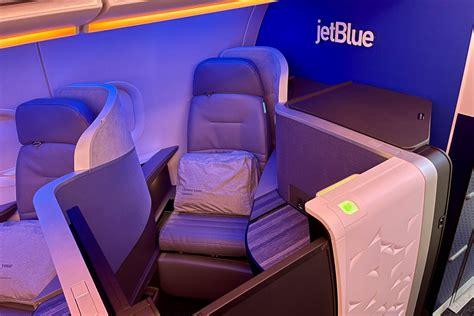
JetBlue Mint did not become a cult favorite by accident. It earned its reputation by quietly rewriting what US business class could feel like, long before the legacy carriers realized passengers were paying attention. In a market long dominated by incremental upgrades and inconsistent experiences, Mint arrived with a sharper idea: premium travel should feel intentional, humane, and modern rather than ceremonial. Flyers noticed. Then they talked. And the chorus has only grown louder.
Unlike American, Delta, or United, JetBlue does not rely on global alliances or sprawling hubs to sell its premium cabin. It relies on the experience itself. Mint is not positioned as aspirational luxury; it is designed as practical excellence, tuned for real travelers who value privacy, sleep quality, food, and reliability over brand mythology. That distinction matters, because it explains why frequent flyers—especially those who actually pay for business class—keep ranking Mint at or near the top.
By 2025, that sentiment crystallized into measurable validation. The J.D. Power North America Airline Satisfaction Study ranked JetBlue Mint as the best first/business class cabin in the region, a remarkable result for an airline that still describes itself as a challenger brand. Rankings vary, methodologies differ, but one pattern is hard to ignore: Mint is consistently excellent, and consistency is the rarest currency in premium air travel.
JetBlue Mint’s Unusual Position in the US Market
JetBlue occupies an odd but powerful niche. It sits alongside Alaska Airlines and Hawaiian Airlines as a carrier offering a genuine long-haul lie-flat business class without being a global legacy airline. The difference is strategic aggression. Alaska and Hawaiian largely avoid direct confrontation with the Big Three on their most profitable routes. JetBlue does the opposite.
Mint was built to attack the strongest markets in US aviation: transcontinental routes like New York–Los Angeles and New York–San Francisco, and later the fiercely competitive transatlantic corridors linking the US East Coast to Europe. These are routes where business travelers notice details, where corporate contracts are fought over seat-by-seat, and where mediocre premium products get exposed quickly.
This direct confrontation forced JetBlue to overdeliver. Matching legacy carriers would not be enough. Mint had to be better—clearly, tangibly better—or the strategy would collapse. That pressure shaped every design choice, from seat architecture to service philosophy, and it shows in the finished product.
What JetBlue Mint Actually Is — And What It Is Not
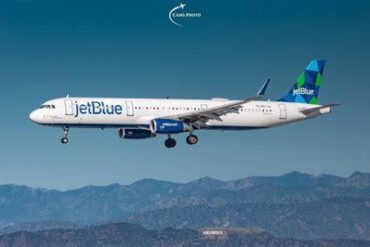
Mint is not a dressed-up domestic first class seat. It is a true lie-flat business class, comparable in intent to Delta One, United Polaris, and American Flagship Business. From the beginning, JetBlue resisted the temptation to blur categories. Mint debuted in 2014 on Airbus A321 aircraft flying from New York JFK to the West Coast, offering something unheard of at the time: a fully flat bed, modern entertainment, elevated food, and genuine privacy on a narrowbody jet.
That launch alone reset expectations. Over the following decade, JetBlue expanded Mint across select domestic routes, the Caribbean, and eventually Europe. The fleet evolved with it. Today, Mint appears in three main configurations: the original Mint on A321-200 aircraft, and the newer Mint Suites on A321neo and A321LR jets, with the forthcoming A321XLR set to continue the trend.
Each generation reflects a different era of premium travel design, but all of them share a core philosophy: maximize personal space, reduce friction, and eliminate unnecessary compromises.
Why the Original Mint Still Feels Special
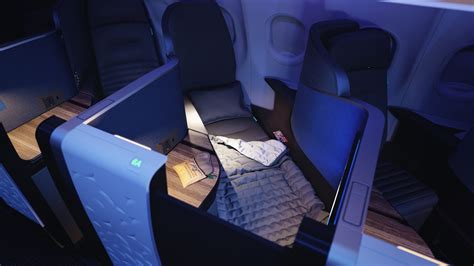
On paper, the original Mint seat should feel dated. It is based on the Thompson Vantage, a design now more than a decade old and widely used elsewhere, including on Delta’s Boeing 767 fleet. In many cabins, that seat feels tired. In Mint, it does not.
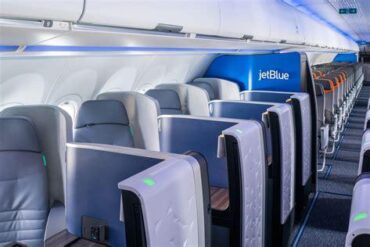
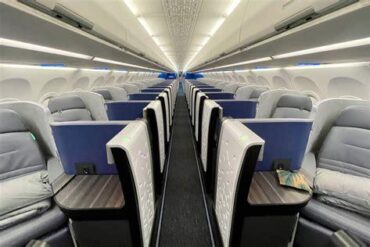
JetBlue customized the Vantage aggressively. Privacy partitions are higher than standard, creating a cocooned feel uncommon on narrowbody aircraft. Screen sizes remain competitive even by today’s standards, and the cabin layout avoids the claustrophobic sensation that plagues many older business class products.
The defining feature, however, is the quartet of throne seats. These single seats, created by the alternating Vantage layout, offer direct aisle access, no seatmate, and expansive side consoles. JetBlue went further by adding sliding privacy doors, making Mint the first airline in the world to introduce business class doors in 2014—years before Qatar Airways, Delta, or anyone else followed suit.
That innovation still matters. On transcontinental routes, Mint often competes against Collins Aerospace Diamond seats flown by Delta and United on Boeing 757s, and against American’s A321T configuration. Those products lack true privacy and feel visibly older. American’s Flagship First offers something better, but at a significantly higher price point. Mint delivers a premium experience without demanding a premium surcharge, and flyers respond accordingly.
Mint Suites and the Leap Forward on the A321neo and A321LR
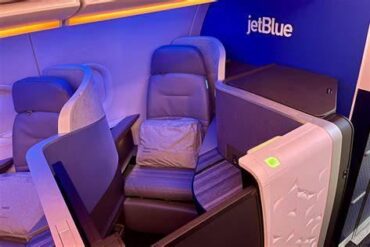
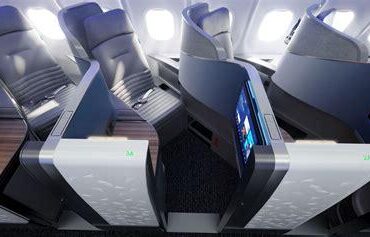
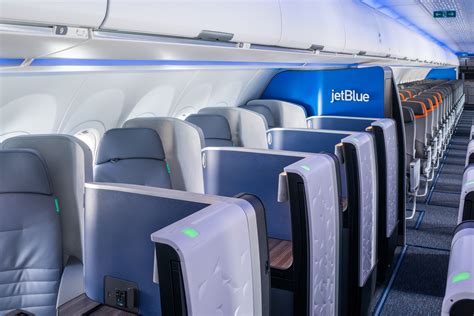
The second-generation Mint Suites mark a decisive evolution rather than a refresh. Based on the Thompson VantageSOLO, these seats feature direct aisle access for every passenger, full-height privacy doors, and a two-abreast layout that feels improbably spacious for a narrowbody jet.
Earlier herringbone designs were infamous for their flaws. Seats angled toward the aisle sacrificed privacy and made window views awkward. The VantageSOLO corrects those issues through smarter geometry. The suite walls angle inward, improving sightlines to the window while shielding passengers from aisle traffic. Even with the door open, the seat feels private; with the door closed, it rivals many widebody business class suites.
Storage is meaningfully improved, bed length is generous, and the overall ergonomics favor long-haul comfort rather than short-hop convenience. Against Delta’s and United’s Collins Diamond seats, Mint Suites are decisively superior. Against American’s newest A321XLR business class, they are competitive enough that preference often comes down to service rather than hardware.
Narrowbody Does Not Mean Inferior on Long-Haul Flights
JetBlue’s transatlantic strategy unsettled the industry because it challenged a long-held assumption: that serious long-haul business class requires a widebody aircraft. Mint’s deployment on the Airbus A321LR proved that assumption outdated.
Mint now operates across the Atlantic to London, Paris, Amsterdam, Dublin, Edinburgh, Barcelona, Madrid, and Milan, sometimes as the only narrowbody on the route. Skeptics expected compromises. What they found was a cabin that delivered everything business travelers actually care about: privacy, sleep quality, a long flat bed, and quiet efficiency.
Legacy carriers often deploy widebodies with inconsistent seat generations. United still lacks privacy doors across much of its fleet. Delta’s best Delta One Suites are concentrated on A350s and A330-900s, while older aircraft lag behind. American’s door-equipped business class appears on only a subset of jets. Mint, by contrast, offers a predictable experience, and predictability is priceless when booking premium travel.
Mint Studio and the Art of Going One Step Further
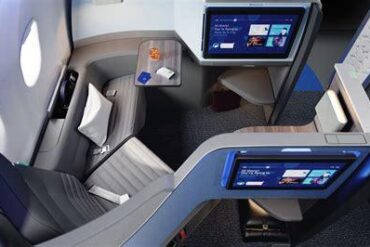
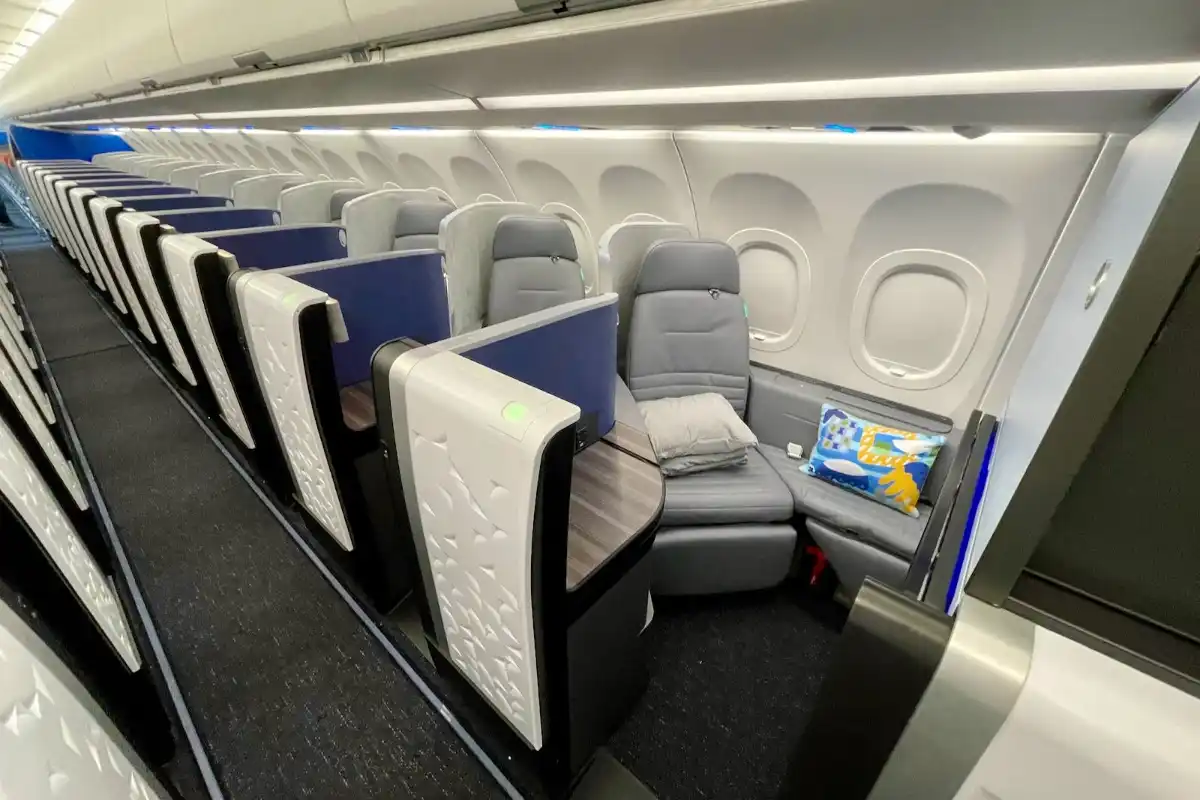
JetBlue’s Mint Studio represents a rare moment of US airline creativity. Positioned in the front row, this seat adds a larger screen and a substantial buddy seat, allowing a second person to join for dining or conversation. It is not merely a bigger chair; it is a flexible social space, something US airlines historically avoid.
For a time, Mint Studio stood uncontested as the best seat offered by a US carrier. American has since introduced a comparable product on select Boeing 787 aircraft, but Mint Studio remains more widely available and better integrated into the overall cabin experience. It feels intentional rather than experimental, and passengers sense that confidence immediately.
The Soft Product Advantage That Seals the Deal
Seats attract attention. Service earns loyalty. This is where Mint quietly pulls ahead.
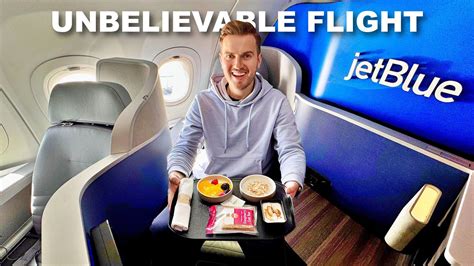
JetBlue has offered free high-speed Wi-Fi to all passengers for over a decade, without loyalty hoops or paywalls. In-flight entertainment is robust and intuitive. More importantly, Mint catering consistently outperforms domestic competitors. Meals emphasize freshness and variety rather than reheated theatrics, and the beverage program includes thoughtful touches like properly made lattes and cappuccinos, not just coffee-flavored gestures.
Service culture matters, too. While any airline can deliver a great crew on a good day, Mint’s baseline is higher. Crews tend to take pride in the product, and that pride translates into attentiveness without stiffness. On legacy carriers, business class service can feel wildly inconsistent depending on route and crew. Mint’s relative consistency makes it feel calmer, more reliable, and more respectful of the passenger’s time.
Consistency Over Prestige: Why Flyers Keep Choosing Mint
JetBlue Mint does not trade on heritage. It trades on execution. Even as the airline navigates financial pressures and operational challenges, the core Mint experience remains intact. Some cost-cutting has occurred, including staffing adjustments on transatlantic routes, but the fundamentals—seat quality, privacy, food, connectivity—remain strong.
For frequent flyers, that reliability outweighs branding. Mint rarely surprises, and when it does, the surprise is usually positive. In a premium market where expectations are high and tolerance for disappointment is low, that steadiness explains why so many travelers keep saying the same thing: JetBlue Mint feels like the best business class in the United States.
Not because it is flashy. Not because it is exclusive. But because it understands what business class is supposed to do—deliver rest, dignity, and a sense that someone actually thought about the person in the seat.