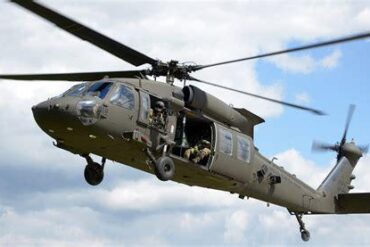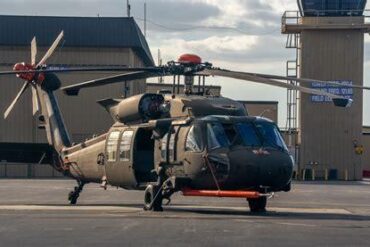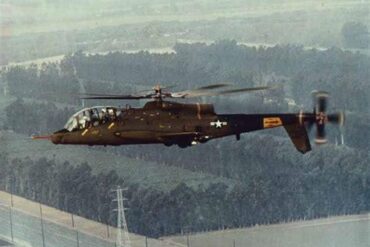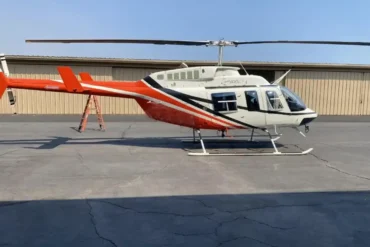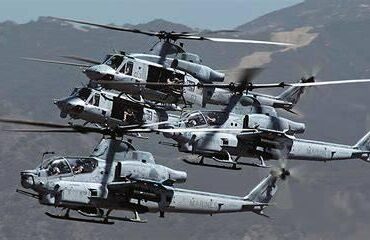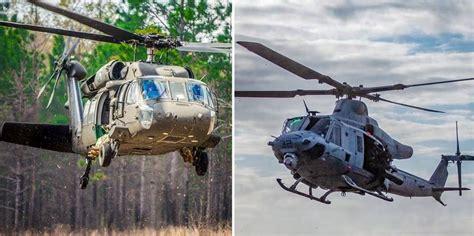
The Sikorsky UH-60 Black Hawk and the Bell UH-1 Huey represent two distinct eras of American rotary-wing aviation, yet both remain in active service today, often flying side by side in the same theaters of operation. Both are classified as utility helicopters, both have served in every branch of the U.S. military at some point, and both have earned reputations as rugged, adaptable workhorses. But beneath that shared designation lies a fundamental divergence in design philosophy, propulsion, cabin architecture, and battlefield role that explains why the Army chose one to replace the other and why the Marine Corps chose to keep flying an upgraded version of the older airframe years after the Black Hawk entered service. Understanding the Black Hawk vs. Huey distinction requires looking past the labels and examining how each machine was engineered to solve a different problem.
Engine Architecture and Powerplant Differences
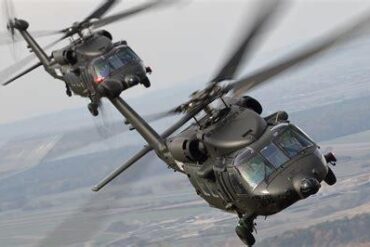
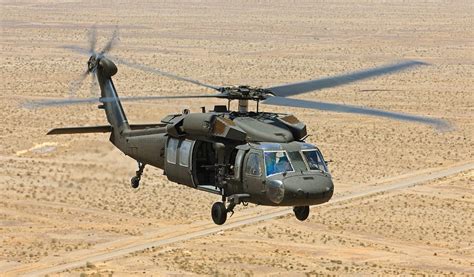
The most immediate mechanical distinction is the powerplant. The Black Hawk carries two General Electric T700 turboshaft engines, a pairing that gives it substantial margin for lifting troops, sling loads, and external fuel tanks even in hot, high-altitude environments where helicopter performance typically degrades. That twin-engine redundancy was a deliberate design requirement, allowing the aircraft to remain controllable and continue to a safe landing after a single engine failure. The Air Force’s UH-1N Huey, by contrast, uses two Pratt & Whitney T400-CP-400 turboshaft engines, a powerplant arrangement that reflects its role as a light-lift platform rather than a medium-lift assault transport. The T400’s combined output is modest compared with the T700 pair, and that gap in available power directly shapes what each helicopter can physically carry, how far it can fly with a full cabin, and how comfortably it performs when conditions turn unfavorable.
Cabin Capacity, Configuration, and Mission Flexibility
Capacity figures tell a story that raw engine specs only hint at. When configured for passengers, the Huey seats up to 13 people, though that number shifts with fuel load, temperature, and density altitude. Remove the seats and its cabin can accommodate up to six medical stretchers or a comparable volume of cargo, a layout that made the Huey a natural platform for medical evacuation, disaster response, and search-and-rescue support. The Black Hawk’s cabin is considerably larger and is deliberately designed as a modular space, configurable for personnel transport, equipment hauling, external sling loads, auxiliary fuel tanks, and integrated sensor packages. That flexibility to reconfigure the same airframe across dozens of mission profiles is what cemented its reputation as one of the Army’s most versatile aircraft.
Development History and the Handoff of the Utility Role
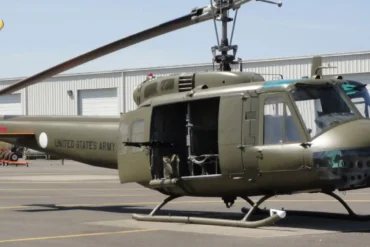
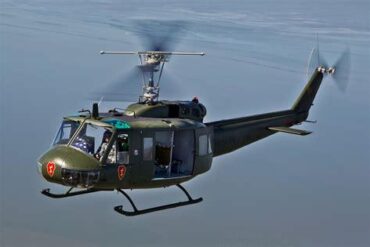
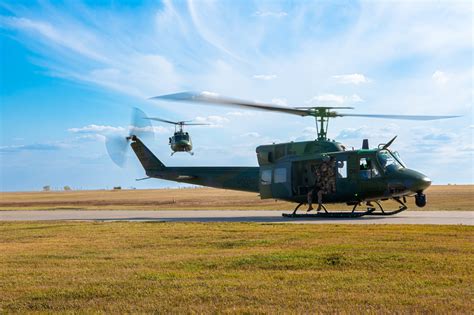
The Huey’s lineage stretches back further than its successor’s by more than two decades. Bell Helicopter’s design was selected in 1955, and the prototype first flew the following year. The Army began ordering it as the HU-1 in 1960, and that designation spawned the nickname “Huey” that stuck long after the official nomenclature changed. By the mid-1960s, Huey variants were flying with every branch of the U.S. military, and the type became inseparable from the imagery of the Vietnam War. By 1969, Army planners were already sketching requirements for a new utility transport capable of carrying roughly twice as many troops as the Huey while delivering comparable lift at a lower estimated operating cost. Sikorsky won that competition in 1976, and the resulting UH-60A Black Hawk entered Army service in 1979, progressively assuming the Huey’s role as the service’s primary utility helicopter.
Branch Adoption and Divergent Upgrade Paths
The Black Hawk family evolved through successive blocks, with the UH-60A giving way to the UH-60L and then the UH-60M, while the broader line expanded to include naval variants such as the Navy’s SH-60B Seahawk. Newer iterations incorporated improvements in performance, survivability, and maintainability rather than wholesale redesign. The Marine Corps, however, charted a different course, retaining its Huey and Cobra lineage and eventually replacing the UH-1N and AH-1W with the UH-1Y and AH-1Z. That decision preserved the Huey’s compact footprint and light-lift character for missions where a medium-lift airframe would be excess capability, giving the older design a continued operational life alongside the helicopter that was built to succeed it.