Delta Air Lines delivered a record-setting year across its long-haul network, carrying roughly 17 million passengers in 2025, a notable 5% year-over-year increase. On the surface, the numbers reflect strength, resilience, and a sustained recovery beyond pre-pandemic levels. Yet beneath this impressive growth lies a quieter, more complex reality: not all routes are thriving. In fact, several long-haul services are operating far below optimal capacity, revealing cracks in an otherwise robust global network.
Despite achieving an average long-haul load factor of 84.6%, certain routes lag significantly behind. These underperformers—some barely exceeding half capacity—offer critical insight into shifting demand patterns, evolving network strategy, and the inherent risks of long-haul expansion.
Where Demand Falls Short: The 10 Emptiest Long-Haul Routes
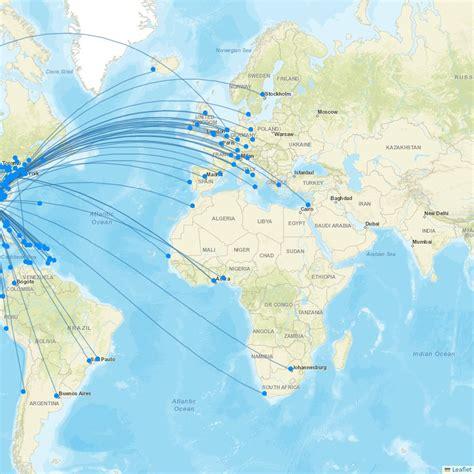
A closer examination of the data reveals that Delta operated 122 long-haul routes in 2025, spanning both domestic and international markets. Among them, ten routes stood out—not for their success, but for their persistently low load factors.
The most striking example is the New York JFK to Lagos route, which recorded a load factor of just 54%. Even more telling is that this route had only recently returned in late 2024, indicating that rebuilding demand in certain markets takes time—even when historical ties suggest strong potential.
Other routes facing similar challenges include:
- Orlando to London Heathrow at 60.1%, discontinued early in 2025
- Los Angeles to Papeete at 66.3%, later suspended mid-year
- Atlanta to Accra at 67.9%, a late-year return with modest uptake
- New York JFK to Dakar at 70.8%, struggling to gain consistent traction
These figures highlight a critical truth: not all long-haul routes are created equal, and even established global carriers must continuously recalibrate their networks.
Seasonality, Timing, and Strategic Risk
Low load factors do not necessarily signal failure. In many cases, they reflect timing mismatches, seasonal demand, or experimental route launches. Routes like Atlanta to Marrakech, introduced in October 2025, fall squarely into this category.
Launching a new intercontinental route is a calculated gamble. Airlines must commit aircraft, crews, and marketing resources long before demand fully materializes. Early performance, therefore, often understates long-term potential.
Delta’s Marrakech service illustrates this dynamic vividly. Operating initially three times weekly—and later increasing frequency during the holiday peak—the route posted a load factor of 71.7% in December, down from November. While this may appear underwhelming, it coincided with a rapid scaling of capacity, which naturally diluted occupancy rates.
The Transit Traffic Reality
One of the most revealing aspects of underperforming routes is their reliance on connecting passengers. For Marrakech, approximately 88% of travelers connected through Atlanta, underscoring how dependent the route is on Delta’s hub network rather than local demand.
This reliance introduces both strength and vulnerability. On one hand, it allows Delta to funnel passengers from across North America into niche international destinations. On the other, it means the route’s success hinges on maintaining seamless connections and competitive pricing across multiple markets.
Interestingly, while transit dominates, point-to-point demand is growing rapidly. Data shows a 470% increase in direct Atlanta–Marrakech travelers year-over-year, albeit from a small base. This suggests that nonstop service itself stimulates demand, gradually building a sustainable market.
Routes That Couldn’t Hold On
Several of the weakest-performing routes were ultimately discontinued, reinforcing the idea that airline networks are fluid, not fixed. The Orlando–London Heathrow service, for example, struggled to compete against more established gateways and premium-heavy routes. Without strong business-class demand, long-haul economics become difficult to justify.
Similarly, Los Angeles–Papeete—a leisure-heavy route—faced seasonal volatility and limited year-round demand. These challenges often lead airlines to redeploy aircraft to more profitable markets, even if the route itself shows niche appeal.

European Routes: Surprisingly Soft Spots
Even traditionally strong transatlantic markets showed signs of weakness. Routes such as Detroit to Frankfurt (73.1%), Seattle to London Heathrow (73.5%), and New York JFK to Geneva (74.4%) all posted below-average load factors.
This underperformance may reflect intense competition, fluctuating corporate travel demand, and shifting alliance dynamics. In an era where premium cabins drive profitability, even a moderately filled aircraft can underdeliver if high-yield passengers are absent.
What This Means for Delta’s Network Strategy
The presence of low-performing routes does not undermine Delta’s broader success. Instead, it highlights a deliberate strategy of experimentation and network diversification. By testing new markets and adjusting capacity dynamically, the airline positions itself to capture emerging demand before competitors do.
Crucially, load factor alone does not determine profitability. Factors such as ticket pricing, cargo revenue, and operational efficiency all play pivotal roles. A route operating at 70% capacity may still outperform a fuller flight with weaker yields.
The Bigger Picture: Growth Through Adaptation
Delta’s long-haul network tells a story of calculated risk-taking and continuous evolution. While some routes struggle to fill seats, others flourish, balancing the overall portfolio. The airline’s willingness to enter underserved markets—even at the cost of short-term inefficiencies—demonstrates a forward-looking approach.
For passengers, this means greater connectivity and more nonstop options. For the airline, it’s a constant balancing act between ambition and performance.
In the end, the emptiest flights are not failures—they are experiments in progress, shaping the future of global air travel one route at a time.