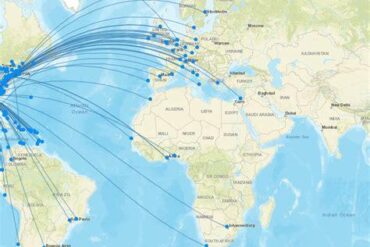
Delta Air Lines remains one of the world’s largest international airlines, yet even a network powerhouse occasionally operates routes that fall well below average occupancy. According to data from the US Department of Transportation covering the 12 months ending in March 2026, Delta carried 17.1 million long-haul passengers while achieving an impressive 84.9% average load factor across flights longer than 2,650 nautical miles (about 5,000 km). Despite that healthy network-wide performance, several long-haul markets stood out for attracting significantly fewer passengers than expected.
Rather than indicating outright failure, these unusually low load factors reveal how airlines continuously invest in future markets, experiment with new destinations, and manage seasonal demand. Many of the routes with the weakest seat occupancy were either newly launched, recently restored, highly seasonal, or discontinued shortly after the reporting period. Looking beyond the headline percentages provides valuable insight into Delta’s broader international strategy.
The figures below highlight Delta’s ten least-filled long-haul routes between April 2025 and March 2026, showing how network development often requires patience before commercial performance reaches maturity.
| Load Factor | Route | Round-Trip Passengers |
|---|---|---|
| 59.3% | New York (JFK) – Lagos | 15,500 |
| 66.0% | Boston – Honolulu | 9,609 |
| 67.1% | Atlanta – Accra | 17,695 |
| 67.3% | New York (JFK) – Dakar | 52,647 |
| 69.7% | Los Angeles – Papeete | 8,988 |
| 72.4% | Atlanta – Marrakech | 26,565 |
| 74.1% | Detroit – Frankfurt | 97,454 |
| 74.1% | Boston – London Heathrow | 151,247 |
| 74.2% | New York (JFK) – Frankfurt | 89,947 |
| 74.4% | New York (JFK) – Geneva | 58,789 |
After several introductory sections, the data begins to reveal an important trend. Nearly every route on the list had exceptional circumstances affecting passenger demand, making direct comparisons with mature year-round services somewhat misleading.

Why Delta’s Lowest Load Factors Do Not Tell The Whole Story
Load factor measures how many available seats are occupied, making it one of aviation’s most closely watched operational metrics. However, it does not indicate whether a route is profitable. Premium cabin demand, cargo revenue, connecting passengers, seasonal pricing, and operating costs all influence financial performance.
Several of Delta’s weakest-performing routes were still in their infancy. Airlines frequently accept lower occupancy during the launch phase while building customer awareness, negotiating corporate contracts, and establishing connecting traffic through major hubs. Others appeared because they operated for only a portion of the reporting year before being suspended or scheduled for future seasonal returns.
Consequently, these routes represent strategic investments rather than simple commercial disappointments.
Lagos Recorded Delta’s Lowest Long-Haul Load Factor
The most surprising figure belongs to the New York JFK–Lagos route, which posted a load factor of just 59.3%, the lowest anywhere in Delta’s long-haul network.
Although the percentage appears concerning, the context explains much of the result. Delta only resumed nonstop service to Nigeria in December 2024, meaning the route spent much of the reporting period rebuilding customer awareness after years without service. International business travel patterns also continue evolving, while premium demand often develops more slowly than leisure traffic following a route relaunch.
With approximately 15,500 round-trip passengers, the service represented an early-stage investment into one of Africa’s largest aviation markets rather than a mature operation.
Several Routes Were Victims Of Seasonality Rather Than Weak Demand
Some entries owe their appearance largely to timing instead of poor long-term performance.
Boston-Honolulu recorded a 66.0% load factor but had already ended operations in April 2025, leaving only a small portion of its activity inside the reporting period. Interestingly, Delta intends to restore the route during December 2026, suggesting confidence remains in the market.
Similarly, the Los Angeles–Papeete service registered 69.7% before ending in June 2025. French Polynesia experiences highly seasonal tourism demand, making capacity planning particularly challenging outside peak vacation periods.
New York-JFK to Geneva also appeared among the lowest-performing routes after ending in October 2025, further illustrating how discontinued services can distort annual averages.

Atlanta To Marrakech Represents A Long-Term Strategic Investment
Among all ten routes, Atlanta–Marrakech arguably offers the clearest example of a market still finding its footing.
Delta inaugurated nonstop flights in October 2025, marking both its return to North Africa after a fourteen-year absence and Atlanta’s first scheduled nonstop connection with Morocco. Operating approximately three weekly flights using the Boeing 767-400ER, the airline later increased frequencies around the Christmas and New Year holiday period before planning future operations with the smaller 767-300ER.
The route achieved a 72.4% average load factor during its first several months, a respectable outcome considering its complete lack of historical traffic and customer familiarity.
Monthly performance also demonstrated encouraging progress. December generated the largest passenger volumes despite additional capacity reducing the monthly load factor to 71.7%. January and February proved more challenging, as winter generally represents one of the industry’s softest travel periods. By March, occupancy improved substantially to 78.4%, suggesting growing market acceptance.
Connecting Passengers Are The Foundation Of Marrakech’s Success
The Marrakech operation illustrates how modern airline hubs support new international destinations.
Only around 6,900 passengers flew solely between Atlanta and Marrakech. Approximately 74% of travelers instead connected through Atlanta to reach other cities throughout the United States.
This connecting traffic transformed what would otherwise have been a relatively small local market into a viable international route. Popular onward destinations included Dallas, Los Angeles, Chicago, Houston, Palm Beach, Sarasota, Tampa, New York, Fort Lauderdale, and Fort Myers.
Even so, aircraft still departed with roughly 64 empty seats per flight on average, highlighting the ongoing challenge of balancing capacity while nurturing an emerging market.
European Routes Also Appeared Surprisingly Low
Several established European services unexpectedly featured among Delta’s least-filled long-haul operations despite carrying large passenger volumes.
Detroit-Frankfurt reached 97,454 passengers while maintaining only a 74.1% load factor. Boston-London Heathrow carried more than 151,000 passengers, yet also averaged 74.1%. Meanwhile, New York-JFK to Frankfurt achieved 74.2% despite transporting almost 90,000 travelers.
These figures emphasize that large passenger totals do not necessarily translate into exceptionally high occupancy. Airlines serving major transatlantic business markets often schedule multiple daily departures to maximize convenience, inevitably spreading demand across additional seats.
Network Strategy Matters More Than Individual Percentages
Delta’s ten lowest-performing long-haul routes collectively demonstrate that airline network planning extends far beyond simple load-factor rankings. New destinations require time to mature, seasonal markets fluctuate naturally, and discontinued routes inevitably produce distorted annual statistics.
The airline’s overall 84.9% long-haul load factor remains exceptionally strong, indicating that these underperforming services represent isolated exceptions within an otherwise highly efficient global network. Many routes on the list have already been adjusted through schedule changes, aircraft substitutions, seasonal operation, or strategic redeployment.
For Delta, maintaining a competitive international presence sometimes means accepting short-term occupancy challenges while pursuing long-term market opportunities. As demand evolves and connecting traffic strengthens, several of today’s least-filled routes could eventually become tomorrow’s strongest international performers.