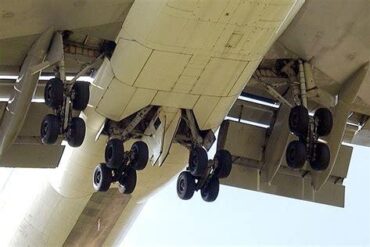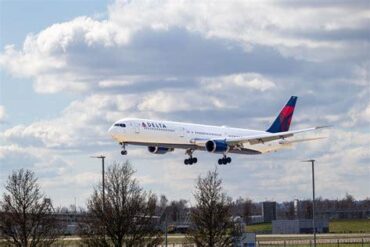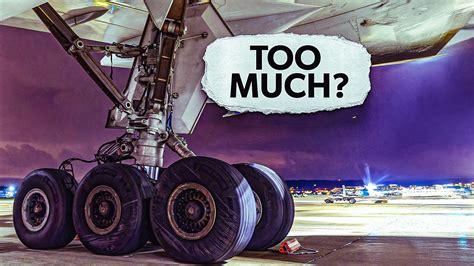
The Boeing 777 does not whisper its presence. It arrives with the quiet authority of a machine built to cross oceans without pause, carrying hundreds of passengers or tens of tons of cargo in a single, elegant arc across the planet. Beneath its sweeping wings and massive turbofan engines sits a detail that often surprises observers on the tarmac: twelve main landing gear tires. Not eight. Not ten. Twelve.
This is not aesthetic ambition. It is structural necessity. The 777’s 12-tire main gear configuration is one of the most calculated engineering decisions in modern aviation, designed to balance immense weight, braking performance, airport compatibility, and redundancy. Every tire has a job. Every wheel is part of a broader conversation between physics, infrastructure, and safety margins measured in microns and milliseconds.
The Boeing 777’s Mission: Carrying Immense Weight Across Immense Distances
When Boeing introduced the 777 in the mid-1990s, it was a milestone: the world’s largest twin-engine commercial jet. It bridged the capacity gap between the Boeing 767 and the iconic 747 while pioneering long-haul efficiency through advanced aerodynamics and powerful high-bypass turbofan engines.
Variants such as the 777-200ER, 777-300ER, and ultra-long-range 777-200LR redefined intercontinental travel. The freighter version, the 777F, became a pillar of global cargo networks. Airlines including Emirates, Cathay Pacific, and American Airlines rely on the 777-300ER to transport dense passenger loads over thousands of nautical miles without compromise.
But scale comes with consequences. The 777-300ER’s maximum takeoff weight (MTOW) exceeds 775,000 pounds. Even the smaller variants approach or exceed 545,000 pounds. That mass must be supported not only during flight, but during taxi, rotation, touchdown, braking, and parking. It must be absorbed by runways built decades ago.
Designing landing gear for such weight is not simply about strength. It is about distribution.
Why The Boeing 777 Uses 12 Main Gear Tires
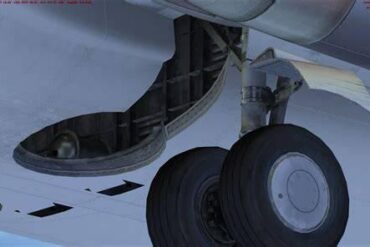
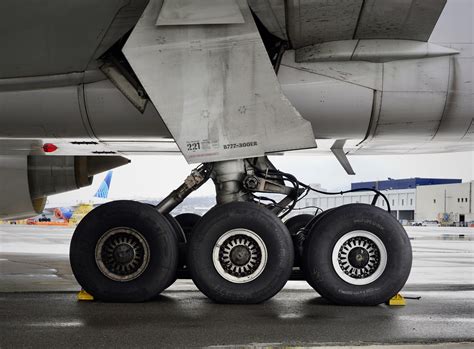
The Boeing 777’s landing gear consists of two six-wheel main gear bogies and a two-wheel nose gear, totaling 14 tires overall. The main gear carries the overwhelming majority of the aircraft’s weight, particularly during landing and braking.
Aircraft tires are extraordinary components. Each main gear tire on a 777 is inflated to roughly 220 psi, far higher than automobile tires. They are reinforced with layers of synthetic rubber, steel, and aramid cord, engineered to withstand extreme vertical loads, lateral forces, and rapid temperature spikes during braking.
The reason for twelve tires becomes clear when considering three interlocking constraints: weight distribution, braking capability, and airport pavement limits.
Weight Distribution and Pavement Loading
Runways are rated according to pavement classification numbers that determine how much weight they can safely absorb. If too much pressure is concentrated in a small area, pavement damage occurs, shortening runway life and potentially grounding aircraft types from certain airports.
By spreading hundreds of thousands of pounds across twelve contact patches instead of eight or four, the 777 significantly reduces the ground pressure per tire. This allows it to operate at a wide range of international airports without requiring exotic reinforcement or infrastructure upgrades.
The aircraft’s footprint becomes its passport.
Braking Performance at Maximum Landing Weight
More wheels mean more brakes. Each main gear wheel on the 777 is equipped with high-performance carbon brake discs. Carbon brakes are lighter than steel and tolerate extreme heat generated during high-energy stops, particularly during rejected takeoffs.
A rejected takeoff at high speed is one of the most punishing scenarios an aircraft can experience. The braking system must convert enormous kinetic energy into heat in seconds. Distributing braking forces across twelve wheels improves stopping performance while preventing thermal overload in any single assembly.
In essence, twelve tires are not merely about holding weight; they are about stopping it safely.
Redundancy and Safety Margins
Commercial aviation designs for failure tolerance. A single tire failure must not escalate into structural damage or loss of control. With twelve tires sharing the load, the aircraft can tolerate one or even two deflated tires while maintaining directional stability and structural integrity.
The 777’s anti-skid systems modulate brake pressure to prevent wheel lock-up. Multiple hydraulic channels ensure braking authority remains even if one circuit fails. Shock-absorbing struts distribute landing forces through the bogie assembly rather than into isolated stress points.
Twelve tires form a network of shared responsibility.
Engineering Comparisons: How The 777 Stacks Up
To understand the 777’s configuration, context matters. A Boeing 737-800 uses four main gear tires and has an MTOW of roughly 174,000 pounds. A 767-300ER uses six. The Airbus A350-1000 uses twelve, similar to the 777.
Larger four-engine aircraft exceed this. The Boeing 747-400 uses sixteen main gear tires. The Airbus A380 uses twenty. Those aircraft approach or exceed 1.2 million pounds at takeoff.
What distinguishes the 777 is that it achieves near-747 weight classes using only two engines. That engineering achievement demanded a landing gear solution capable of supporting extraordinary mass while preserving operational flexibility.
Twelve tires represent the upper practical boundary for a twin-engine jet in this weight category. Any fewer would increase pavement stress and braking load per wheel beyond acceptable margins. Any more would introduce additional structural weight and mechanical complexity.
In aerospace engineering, optimization is victory. The 777’s 12-tire configuration is a case study in optimized compromise.
The Physics of Landing: Impact, Heat, and Friction
When a fully loaded 777 descends toward a runway at approximately 140–160 knots, its tires are not spinning prior to touchdown. At contact, they must accelerate from zero to runway speed almost instantly. This generates smoke, friction, and a rapid spike in temperature.
The landing gear struts compress to absorb vertical loads. The bogie beams pivot to ensure even contact across all six wheels per side. Weight transfers progressively as spoilers deploy and lift decreases.
During rollout, braking converts forward motion into thermal energy. Carbon brake stacks glow internally at temperatures that can exceed 1,000 degrees Fahrenheit in extreme cases. The tires must endure this heat without structural degradation.
Shorter runways amplify stress. Wet or contaminated surfaces require greater braking effort. Heavier landing weights increase vertical load. Every operational variable influences tire wear.
This is not rubber meeting road. It is controlled physics meeting material science.
Tire Lifespan and Maintenance Realities
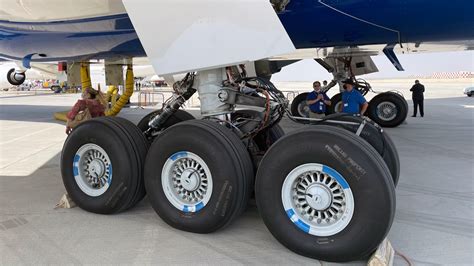
Despite their resilience, Boeing 777 tires are consumable components. On average, they last between 200 and 400 landings, depending on operational factors. Airlines track tire cycles meticulously, using digital maintenance systems to predict replacement intervals.
Long-haul operations produce fewer landing cycles but often at higher gross weights. Short-haul operations produce more cycles with potentially lower landing weights. Both patterns stress tires differently.
Runway surface quality matters. Grooved or rough pavements increase abrasion. Aggressive braking accelerates tread wear. High-speed rejected takeoffs can demand immediate tire replacement.
Not every maintenance event requires replacing all twelve tires. Airlines change tires individually based on wear measurements, visible cuts, or pressure anomalies. Each tire is a monitored component in a broader system of predictive maintenance.
This is logistics choreography performed at global scale.
What Happens If A Boeing 777 Tire Fails?
Tire failures are rare but anticipated in design scenarios. A blowout during takeoff or landing subjects surrounding components to debris risk and asymmetric loads. The 777’s multi-wheel configuration prevents localized overload from compromising the entire gear assembly.
Anti-skid systems maintain directional control. Hydraulic redundancy preserves braking power. Shock absorbers mitigate abrupt force redistribution.
In many cases, an aircraft can complete landing safely with one or two deflated tires. Afterward, runway inspections ensure no debris remains. Structural damage is uncommon because the system was engineered to expect the unexpected.
Redundancy in aviation is not paranoia. It is policy.
The 777X: Proof That The Formula Endures
The forthcoming Boeing 777X, including the 777-8 and 777-9 variants, represents the next evolution of the platform. These aircraft introduce composite wings, folding wingtips, and even greater efficiency. Yet they retain the 12-tire main landing gear configuration.
That continuity speaks volumes. Even with advances in materials and aerodynamic performance, the balance between weight, braking force, and airport compatibility remains governed by the same physical realities.
The 777X will be the largest twin-engine passenger aircraft ever built. Its retention of the twelve-tire layout confirms that the original solution was not temporary. It was correct.
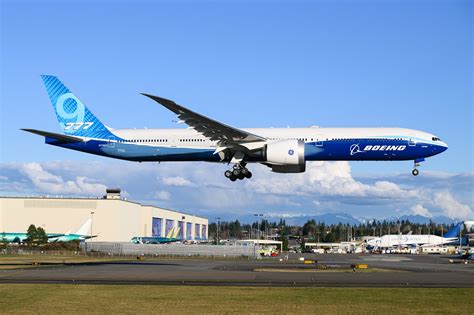
The Smart Engineering Behind Twelve Tires
At first glance, twelve main gear tires may appear excessive. In practice, they represent a finely tuned response to a precise problem: how to move nearly 400 passengers or massive cargo loads across oceans using two engines, while remaining compatible with global airport infrastructure.
The configuration distributes load, enhances braking performance, provides redundancy, and protects runway surfaces. It supports rejected takeoffs, heavy landings, and long taxi operations under varied environmental conditions.
Every tire is part of a system that transforms mass into motion and motion into safe deceleration. Remove four tires from the equation, and compromises ripple outward: higher pavement stress, greater brake heat per wheel, reduced safety margins.
Engineering often hides its brilliance in plain sight. The Boeing 777’s 12 main gear tires are not decorative excess. They are structural logic rendered in rubber and carbon.
From seat 44A or from the edge of a rain-slick runway, those twelve tires quietly uphold one of aviation’s greatest achievements: lifting nearly 400 tons into the sky, then returning it gently to Earth, again and again, across decades of global service.