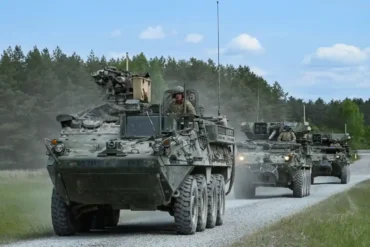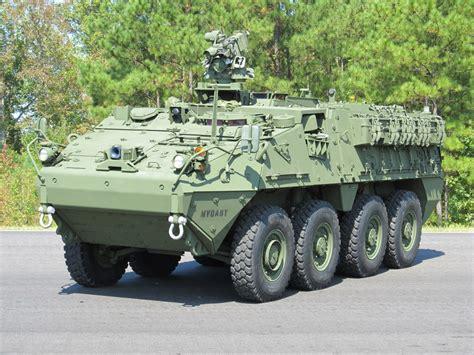
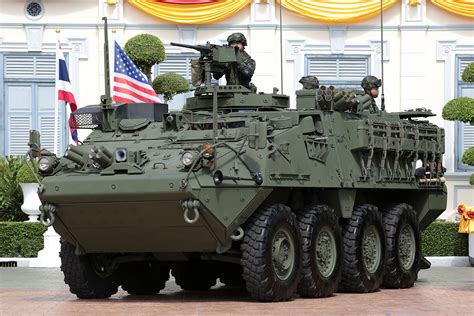
Thailand has taken another decisive step in modernizing its land forces, formally receiving 17 additional U.S.-made Stryker 8×8 Infantry Carrier Vehicles (ICVs) to strengthen border security and mechanized infantry operations. The transfer, conducted under the U.S. Excess Defense Articles (EDA) program, reflects a deepening defense relationship between Bangkok and Washington while reinforcing the Royal Thai Army’s ability to respond rapidly to emerging threats along sensitive frontier zones.
The latest delivery is more than a numerical increase in armored hulls. It represents a calibrated enhancement of Thailand’s protected mobility, tactical flexibility, and interoperability with U.S. forces operating in the Indo-Pacific. At a time when regional security dynamics remain fluid, wheeled armored formations capable of fast road deployment offer a strategic advantage that tracked platforms cannot easily replicate.
As Thailand expands its Stryker fleet, the emphasis is not simply on hardware acquisition but on developing a coherent, deployable mechanized force structure. U.S. Stryker formations continue to engage Thai units in training cycles focused on sustainment, communications discipline, and network-centric warfare methods—critical foundations for ensuring that armored fleets remain operationally ready rather than parked assets.
Expanding Thailand’s Protected Mobility Along Strategic Borders
Thailand’s geography dictates its operational requirements. With extensive land borders spanning Myanmar, Laos, Cambodia, and Malaysia, the Royal Thai Army must maintain the capacity to reinforce remote corridors quickly. Light infantry can move fast but lacks protection against ambushes, small-arms fire, and improvised explosive devices. Heavy tracked units offer formidable firepower yet sacrifice speed and road endurance.
The Stryker 8×8 Infantry Carrier Vehicle fills that gap with deliberate precision. Its wheeled configuration enables sustained high-speed movement across Thailand’s road networks, allowing units to concentrate combat power rapidly where needed. In border security missions—where time, visibility, and deterrence matter—such responsiveness becomes a strategic asset.
By integrating these 17 additional vehicles, Thailand strengthens its ability to conduct rapid reinforcement operations without escalating to heavier formations. The result is a balanced approach: sufficient protection and firepower to dominate localized engagements, paired with the operational tempo necessary for internal security and frontier stabilization.
Tactical Capabilities: Firepower, Protection, and Networked Command
At the tactical level, the Stryker is engineered to deliver infantry squads under armor and transition seamlessly into dismounted combat. The configuration provided to Thailand centers on the Infantry Carrier Vehicle variant equipped with the M2 Flex .50-caliber machine gun mounted on a remote weapon station. This system allows engagement of targets while the crew remains protected inside the hull.
The M2 provides flexible suppression against exposed infantry, light vehicles, and fortified firing positions. Complementing this capability are M6 smoke grenade launchers, enabling rapid obscuration during maneuver or withdrawal. When infantry dismount through the rear ramp, smoke deployment can shield their movement at the most vulnerable moment.
Situational awareness systems further enhance battlefield performance. The integration of the AN/VAS-5 Driver’s Vision Enhancer improves low-light and degraded-visibility driving, essential for night operations along remote border roads. Meanwhile, the AN/VIC-3 intercom system strengthens crew coordination and radio discipline during high-noise maneuver scenarios. These communications elements transform the Stryker from a mere transport platform into a networked node within a broader command-and-control architecture.
Protection remains central to the platform’s appeal. Designed to withstand small-arms fire, artillery fragments, and blast threats, the Stryker incorporates survivability enhancements such as spall liners that mitigate internal fragmentation in the event of armor penetration. Modernization efforts across the Stryker family have emphasized underbody blast protection—an important feature given the realities of roadside explosive threats in contemporary security environments.
From Platform Transfer to Force Development
Thailand’s Stryker journey did not begin with this latest tranche. In 2019, Washington approved a potential Foreign Military Sale package covering up to 60 Stryker vehicles and associated support, valued at approximately $175 million. Initial deliveries marked a significant doctrinal shift, as Bangkok positioned the Stryker to replace aging M113 tracked armored personnel carriers and align more closely with U.S.-style mechanized concepts.
Since those early transfers, cooperation has evolved into a broader force development effort. Engagement with U.S. Army Pacific units has emphasized live-fire drills, dismounted maneuver tactics, and rigorous maintenance standards. Sustainment proficiency—often overlooked in acquisition headlines—determines whether armored fleets remain viable over the long term.
Major combined exercises such as Cobra Gold and Hanuman Guardian have provided platforms for Thai mechanized infantry to operate alongside U.S. formations under realistic tempo conditions. These exercises reinforce communications discipline and battlefield coordination while testing maintenance and logistical resilience under stress.
The arrival of 17 additional Strykers therefore extends a structured modernization pathway. It is not an isolated procurement but part of an institutionalized enterprise that integrates training pipelines, technical support, and doctrinal alignment.
Interoperability in the Indo-Pacific Security Environment
Interoperability is often described abstractly, yet in operational terms it means shared communications protocols, compatible maintenance practices, and common tactical language. For Thailand, expanding its Stryker fleet strengthens the ability to operate seamlessly with U.S. forces during regional contingencies.
In the Indo-Pacific, where multinational coordination is increasingly central to crisis response, common platforms simplify joint planning. Shared vehicle architecture reduces friction in logistics, spare parts supply, and battlefield integration. It also enhances Thailand’s strategic positioning as a reliable security partner within the region.
Beyond bilateral considerations, the move signals Bangkok’s continued engagement with Western defense ecosystems even as it maintains diverse procurement relationships. The Stryker program underscores a deliberate balancing strategy: diversifying equipment sources while ensuring at least one core mechanized capability remains closely aligned with U.S. operational standards.
Positioning Within Thailand’s Armored Fleet
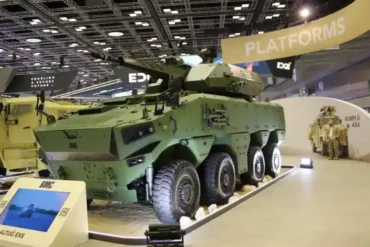
The Royal Thai Army fields a varied inventory of armored vehicles, including Ukrainian-origin BTR-3E1 8×8 platforms, some configured with turreted cannon systems for direct fire support. However, supply chain uncertainties tied to disruptions in Ukraine have highlighted sustainment vulnerabilities.
The Stryker occupies a distinct operational niche. Unlike heavier turreted systems optimized for organic cannon firepower, the Infantry Carrier Vehicle emphasizes protected mobility, digital communications integration, and survivability. Its value lies not in raw kinetic output but in enabling coordinated maneuver and sustaining infantry effectiveness.
Thailand’s parallel investments in battle management modernization—including cooperation with Leonardo DRS and local industry partner Chaiseri Defense—aim to strengthen command, control, communications, computers, and intelligence (C4I) capabilities. When integrated into such networks, the Stryker becomes more than an armored transporter; it functions as a mobile command node capable of sharing real-time data across the battlespace.
Operational Impact and Strategic Outlook
The immediate effect of incorporating 17 additional Strykers will be an expansion of Thailand’s protected infantry footprint. Units can deploy across extended road networks with confidence that they possess adequate protection against common battlefield threats. This capability is particularly relevant for border reinforcement missions and rapid response contingencies where speed and resilience must coexist.
Strategically, the acquisition deepens U.S.–Thailand defense ties at a time when regional power dynamics remain fluid. By investing in interoperability and standardized mechanized doctrine, Bangkok ensures that its forces can integrate swiftly into combined operations if required.
The broader narrative is one of transformation. Thailand’s Stryker program reflects a deliberate evolution from legacy tracked transporters toward agile, network-enabled mechanized formations. The additional 17 vehicles strengthen that trajectory, reinforcing both immediate operational readiness and long-term institutional capacity.
In the calculus of modern land warfare, mobility without protection invites risk, while protection without mobility invites stagnation. The Stryker’s appeal lies in reconciling these demands. For Thailand, this latest delivery is not merely a procurement milestone—it is a measured step toward a more agile, interoperable, and resilient mechanized force prepared to secure its borders and contribute meaningfully to regional stability.