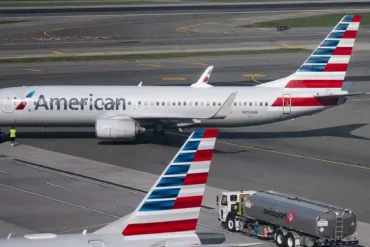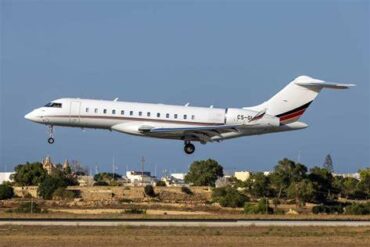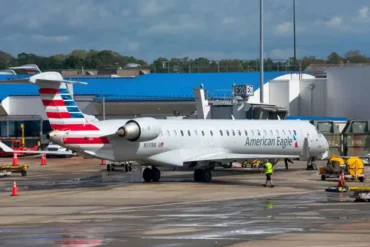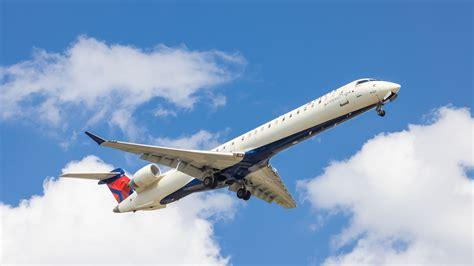
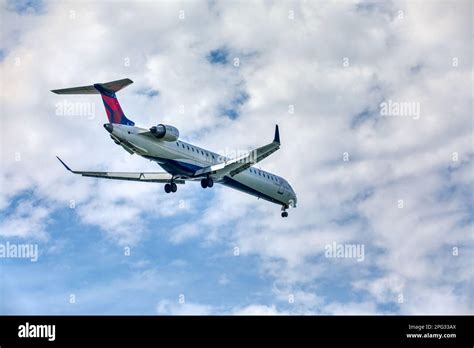
On the afternoon of Wednesday, October 7, Delta Connection flight DL5415 was on a routine descent into LaGuardia Airport (LGA), inbound from Omaha Eppley Airfield (OMA). The aircraft, a Bombardier CRJ900 operated by Endeavor Air, had lined up on Runway 22 from the northeast and was roughly 100 feet above the surface with landing imminent when its crew made a split-second decision that likely prevented a catastrophe. The regional jet pulled up sharply and executed a go-around, abandoning an approach that had been seconds from touchdown.
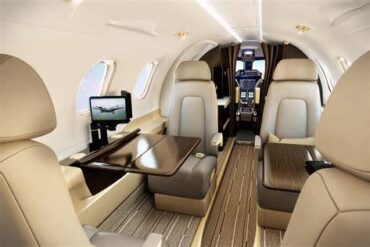
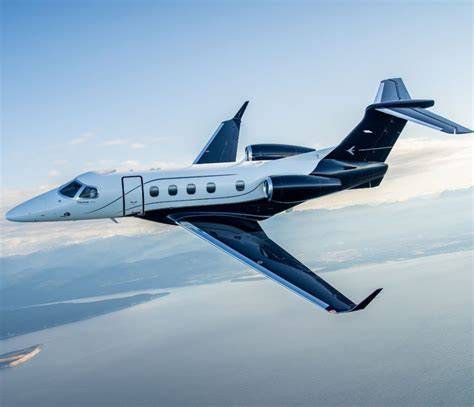
The reason was stark: a NetJets Embraer Phenom 300, flying under the callsign EJA398 for ExecJet, had begun its takeoff roll on Runway 13 — a strip that intersects Runway 22. The two runways cross at LaGuardia’s notoriously constrained layout, meaning the private jet’s departure path cut directly across the Delta jet’s landing corridor.
Flight Data Reveals How Close the Two Aircraft Came
Flight tracking data lays bare the margins involved. The Delta CRJ900 was travelling at approximately 147 mph (128 knots) when it initiated the escape manoeuvre, while the Phenom 300 was rolling at roughly 103 mph (90 knots). At their closest point, the two aircraft came within an estimated 1,000 feet of one another. The near-miss unfolded at around 3:55 PM local time, in daylight and under what should have been entirely predictable traffic conditions.
The precision of the go-around is the detail that lingers. The CRJ900 was already deep into its landing sequence — landing gear down, speed decaying, energy state committed to the runway — when the crew recognised the conflict and converted a landing configuration into a climb. That decision window is measured in seconds, and the Delta crew used it.
ATC Recordings Show the Private Jet Believed It Was Cleared
Air traffic control audio obtained via LiveATC.net provides the clearest picture of how the misunderstanding unfolded. The tower had been issuing instructions to another flight, and when the sequence concluded, the ExecJet pilot responded with “roger that,” then stated: “cleared for takeoff, Runway 13.”
The ground controller’s correction was unambiguous: “I believe you were never cleared for takeoff, sir. You were cleared to line up and wait.”
The ExecJet pilot disputed that account, insisting that “we got cleared for takeoff.” He further noted that his crew had been advised of a United Airlines flight ahead of them and the associated wake turbulence — a claim the controller rejected outright, stating he had never mentioned wake turbulence before informing the pilots of a possible deviation and handing them a phone number.
An analysis of the exchange confirms the sequence: the Phenom 300 was instructed to line up and wait, and no takeoff clearance was ever transmitted.
The FAA Investigation and the Runway Incursion Scale
The Federal Aviation Administration is investigating the incident and has issued a statement confirming that the ExecJet aircraft “departed on an intersecting runway without air traffic control authorization.” That language matters, because it frames the event as an unauthorised runway incursion rather than a controller error or an ambiguous instruction.
The FAA has not yet publicly assigned a severity category. Its runway incursion scale runs from Category D, covering events with no immediate safety consequences, up to Category A, which describes serious incidents in which a collision is narrowly avoided. Given the 1,000-foot separation, the low altitude of the CRJ900, and the intersecting runway geometry, this event sits far closer to the serious end of that spectrum than the routine — though only the agency’s formal determination will settle it.
Delta Air Lines and NetJets have been approached for comment.
A Difficult Year for LaGuardia Airport
This close call compounds an already punishing stretch for LaGuardia. On March 22, Air Canada Express flight AC8646 — a CRJ900 operated by Jazz Aviation — collided with an airport fire truck on Runway 4 moments after landing. Both pilots were killed and dozens more were injured.
The NTSB’s preliminary report found that the truck had been erroneously cleared to cross the runway while the regional jet was on short final. It further noted that LaGuardia’s Airport Surface Detection Equipment failed to alert controllers to the impending collision, partly because the airport’s emergency vehicles were not fitted with transponders. It was later reported that two LaGuardia controllers had left their shifts roughly an hour early that night, leaving just two controllers in the tower to manage unusually heavy traffic alongside a separate ground emergency.
Two CRJ900s, two intersecting conflicts, one airport already under scrutiny. The October 7 go-around adds a third data point to a question regulators can no longer defer: whether LaGuardia’s runway configuration, surface surveillance, and tower staffing can reliably absorb the traffic volume the airport now carries. The Delta crew’s reaction bought everyone time. The next crew may not have the same seconds to spare.