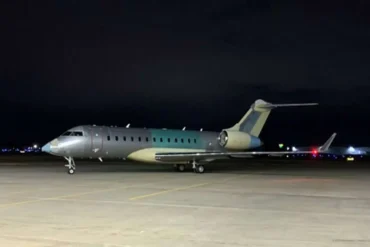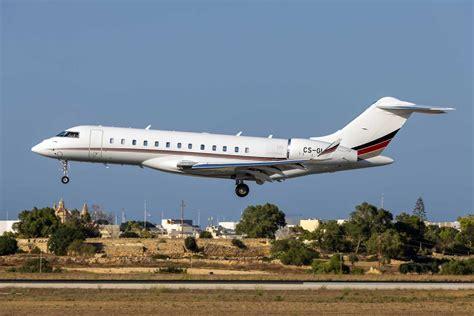
A routine international business aviation flight turned into an unexpected safety event after the crew of a NetJets Bombardier Global 6500 reported a close encounter with an unidentified airborne object shortly after departing New York. The incident occurred during the aircraft’s initial climb and quickly attracted attention across the aviation community after air traffic control communications surfaced online. While no collision occurred and the flight continued safely to Colombia, the report has renewed discussion about unidentified objects operating within controlled airspace and the growing number of similar incidents involving commercial and private aircraft.
The aircraft was operating NetJets flight NJE426K, departing Westchester County Airport (HPN) in White Plains, New York, on a scheduled journey to Matecaña International Airport (PEI) in Pereira, Colombia. According to available flight tracking information, the event took place approximately ten minutes after takeoff while the aircraft was climbing through 15,800 feet near the border between New York and New Jersey.
Pilots immediately informed air traffic control that a large silver object had passed extremely close to the aircraft. Their radio transmission described the object as traveling down the right side of the jet and missing it by only a small margin. Although the encounter lasted only a moment, the crew emphasized that it was significantly larger than a consumer drone while clearly smaller than another aircraft, making immediate identification impossible.
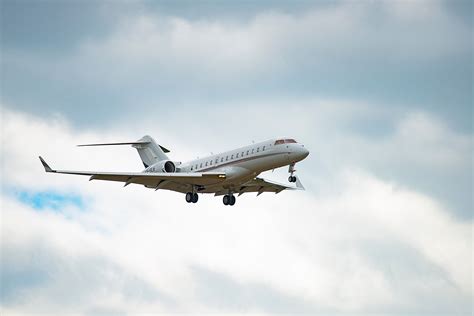
Flight Crew Describes A Fast-Moving Unidentified Object
According to the recorded ATC communications, the pilots stated that the unidentified object moved so quickly that they could not determine its exact shape or origin. They described it as a silver object that appeared suddenly and passed alongside the aircraft before disappearing from view. Because the encounter occurred during the climb phase, the crew had very little time to react or collect additional visual information.
The pilots indicated that the object was “definitely bigger than a drone” but smaller than a conventional airplane. That distinction immediately ruled out many common aerial hazards while raising questions about what exactly had entered the aircraft’s flight path. Despite the alarming proximity, there were no indications that the aircraft made physical contact with the object.
Aircraft Continued Safely To Colombia
Following the near miss, the flight continued normally without any reported mechanical abnormalities or emergency procedures. Flight tracking data shows the Bombardier Global 6500 proceeded south along the eastern coastline of the United States before reaching its cruising altitude of approximately 45,000 feet.
After passing over Cuba, the aircraft turned onto a more direct route toward Colombia, eventually descending into Pereira, where it landed safely after approximately five hours and eleven minutes of flight time. The absence of any operational issues strongly suggests that the aircraft sustained no damage during the encounter.
Available fleet records indicate the aircraft, registered CS-GLJ, is a Portuguese-registered NetJets Europe business jet delivered in late 2021. At just over five years old, the long-range aircraft is configured for VIP operations and remains one of the newest members of the operator’s fleet. Its return to service was confirmed when it later departed Pereira for Rio de Janeiro, demonstrating that post-flight inspections did not identify any significant concerns.
Investigators Face Challenges Identifying Airborne Hazards
Incidents involving unidentified airborne objects present unique challenges for aviation authorities. Unless physical evidence is recovered or radar data provides a clear track, investigators often have limited information beyond pilot observations and air traffic control recordings.
Modern flight crews are trained to report any object that could present a collision hazard regardless of whether its identity is known. These reports contribute valuable safety data that can reveal emerging risks, particularly as the number of drones and other aerial vehicles operating near airports continues to increase.
While there has been no official confirmation regarding the object’s identity, the crew’s description suggests it did not resemble a typical commercial aircraft operating under air traffic control.
Similar Close Calls Have Raised Safety Concerns
The NetJets incident follows several recent reports involving aircraft encountering unexpected objects in American airspace. Only days earlier, a United Airlines Boeing 737 MAX 9 reportedly came within approximately 100 feet of a drone while approaching Newark Liberty International Airport, highlighting the continuing risks posed by unauthorized drone operations near busy airports.
An even more serious occurrence involved a JetBlue Airbus A321, whose crew reported striking a drone while landing at John F. Kennedy International Airport. Following that event, the aircraft underwent inspection, and federal investigators began examining the circumstances surrounding the reported impact.
Growing Focus On Airspace Safety
Although the NetJets aircraft avoided damage, the event underscores the importance of continuous vigilance by pilots and air traffic controllers. Near misses involving unidentified airborne objects remain relatively uncommon, but each occurrence provides valuable information for improving aviation safety procedures.
Whether the object was an unauthorized drone, debris, an experimental device, or another unidentified airborne hazard remains unknown. What is clear is that the professionalism of the flight crew, combined with established reporting procedures, ensured the flight continued safely without jeopardizing passengers or the aircraft.
As aviation authorities gather additional information and operators review similar reports, incidents like this continue to highlight the evolving challenges of maintaining safe and secure skies in increasingly crowded airspace.