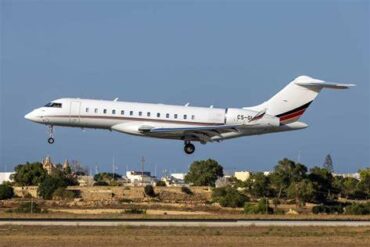
The U.S. Army has taken another decisive step in reshaping its airborne intelligence, surveillance, and reconnaissance posture by adding a fourth Bombardier Global 6500 jet to the High Accuracy Detection and Exploitation System (HADES) program. The move underscores how urgently the service is pushing to replace aging turboprop platforms with high-altitude, long-range jets capable of operating in contested, near-peer environments. More than a procurement update, the decision reflects a broader shift in how the Army intends to sense, understand, and strike across theaters at speed.
Sierra Nevada Corporation’s decision to acquire the aircraft using its own capital is particularly significant. By absorbing the upfront cost, the integrator is effectively shielding the Army from schedule risk while accelerating certification, integration, and mission-system validation. In an era where supply chains, modification backlogs, and test bottlenecks routinely delay defense programs, this approach represents an uncommon but highly strategic industrial commitment to keeping operational timelines intact.
At the heart of the decision lies a recognition that legacy airborne ISR simply cannot meet the demands of modern conflict. Peer competitors have pushed sensors, fires, and air defenses deeper into contested space, compressing decision cycles and increasing the need for persistent, theater-wide awareness. The Army’s embrace of a jet-based ISR architecture signals that deep sensing is no longer a niche capability, but a core enabler of Multi-Domain Operations.
From Turboprop Constraints to Jet-Powered Reach
For decades, platforms such as Guardrail, ARL-M, and EMARSS formed the backbone of Army airborne ISR. While effective in permissive environments, these turboprop aircraft were constrained by altitude ceilings, limited electrical power, modest range, and slow transit speeds. Those limitations increasingly translated into operational risk, particularly against adversaries fielding long-range surface-to-air missiles and sophisticated electronic warfare systems.
The Bombardier Global 6500 changes that equation fundamentally. With a published range of 6,600 nautical miles and an operational ceiling of 51,000 feet, the jet offers a combination of speed, persistence, and survivability that turboprops simply cannot match. High-altitude operation expands radar and sensor horizons, enabling wide-area detection and standoff collection while reducing exposure to ground-based threats. Rapid transit speeds allow ISR detachments to reposition across continents in hours rather than days, transforming responsiveness at the theater level.
Equally important is what the airframe enables internally. The Global 6500 provides substantial cabin volume, power generation capacity, and cooling margin, all of which are essential for hosting advanced radars, signals intelligence suites, and onboard processing systems. These attributes give HADES the growth potential required to evolve alongside rapidly changing threat environments.
HADES and the Army’s Deep-Sensing Imperative
HADES emerged from a clear operational need: the Army must see deeper, faster, and more precisely to support long-range fires and joint targeting. As adversaries disperse and harden high-value assets, detection and exploitation must occur well beyond the forward edge, often under tight time constraints. The Army has been explicit that this mission cannot be fulfilled by legacy aircraft limited in altitude, endurance, and payload capacity.
The program’s foundations were laid in 2020, with the deliberate divestment of turboprop ISR platforms beginning in fiscal year 2023 and concluding in fiscal year 2025. This transition has been closely synchronized with prototype development. The first fully developed HADES prototype is scheduled for delivery in fiscal year 2026, followed by a second in fiscal year 2027. The fourth Global 6500 now acquired by Sierra Nevada Corporation is framed as the first non-prototype aircraft, intended to pull critical milestones forward and reduce integration risk across the fleet.
Accelerating the Timeline Through Private Investment
Sierra Nevada Corporation’s willingness to self-fund the additional jet is a notable deviation from traditional acquisition models. By purchasing the aircraft outright, the company keeps the modification and certification pipeline moving regardless of near-term budget or contracting friction. This approach allows mission systems to be integrated, tested, and refined earlier than planned, compressing the path to operational capability.
The aircraft will support a government-owned, contractor-operated construct during early operational testing. Under this model, SNC retains responsibility for aircraft availability, crews, and maintenance, enabling rapid iteration while the Army focuses on tactics, sensor employment, and network integration. The first HADES prototype is expected to begin flight testing in the spring, with a fully outfitted Global 6500 delivered in the fall to support operational evaluation.
Sensors, Processing, and the Shift to Sense-to-Understand
While many payload specifics remain classified, the mission direction is well established. HADES is designed to deliver theater-level sensing rather than localized collection. Expected capabilities include wide-area ground moving target indication and synthetic aperture radar for detection and precision cueing, paired with advanced signals intelligence for emitter geolocation and network analysis.
A defining feature of the program is the integration of artificial intelligence and machine learning directly onboard the aircraft. Instead of acting solely as a collector feeding raw data to rear-area analysts, HADES aims to process, correlate, and exploit information in near real time. This shift from “sense-to-send” to sense-to-understand dramatically shortens the kill chain, enabling faster decisions and more responsive fires in contested environments.
Institutionalizing Jet-Based ISR
The Army has already experimented with jet-based ISR through contractor-owned platforms such as ARTEMIS, ARES, and ATHENA-S, the latter explicitly described as a precursor to HADES. These efforts demonstrated the operational advantages of business-jet ISR, but they remained interim solutions. HADES represents the institutionalization of that concept as a program of record, built around a modular open-systems architecture designed to accept future sensor upgrades without costly redesign.
This architectural approach is critical. Threat waveforms, radar modes, and electronic signatures evolve rapidly, and ISR platforms must adapt just as quickly. By decoupling sensors from the airframe through open standards, the Army positions HADES as a long-term backbone rather than a static capability.
Strategic and Industrial Implications
Public reporting places Sierra Nevada Corporation’s role under a long-term Army contract potentially valued at up to $1 billion over 12 years, though debate continues over final fleet size. Estimates range from a relatively large operational fleet to proposals for a much smaller force optimized for niche missions. Against this uncertainty, SNC’s decision to invest private capital is a calculated signal of confidence that the Army’s need for jet-based deep sensing is enduring.
The company has stated that it has self-invested nearly half a billion dollars across programs supporting the Army’s airborne ISR transition, with multiple jets currently undergoing modernization for global missions. This level of industrial commitment not only reduces near-term program risk but also strengthens the domestic ISR integration base at a time when demand for high-end sensing platforms is rising across the joint force.
A Clear Signal of the Army’s Future ISR Direction
The addition of a fourth Global 6500 to the HADES program is more than an incremental procurement milestone. It is a clear signal that the Army is committed to operating at altitude, at range, and at speed in future conflicts. By combining a proven high-performance airframe with advanced sensors, onboard processing, and open architectures, HADES is poised to redefine how the Army sees and fights across domains.
As the service closes the chapter on legacy turboprop ISR, the Global 6500-based HADES fleet represents a decisive pivot toward survivable, theater-level intelligence collection. In an era of compressed timelines and contested battlespaces, that pivot may prove as consequential as any new weapon system.