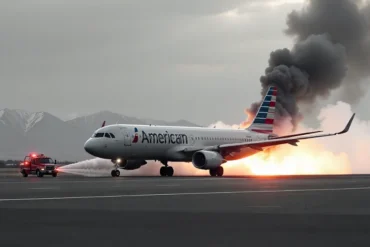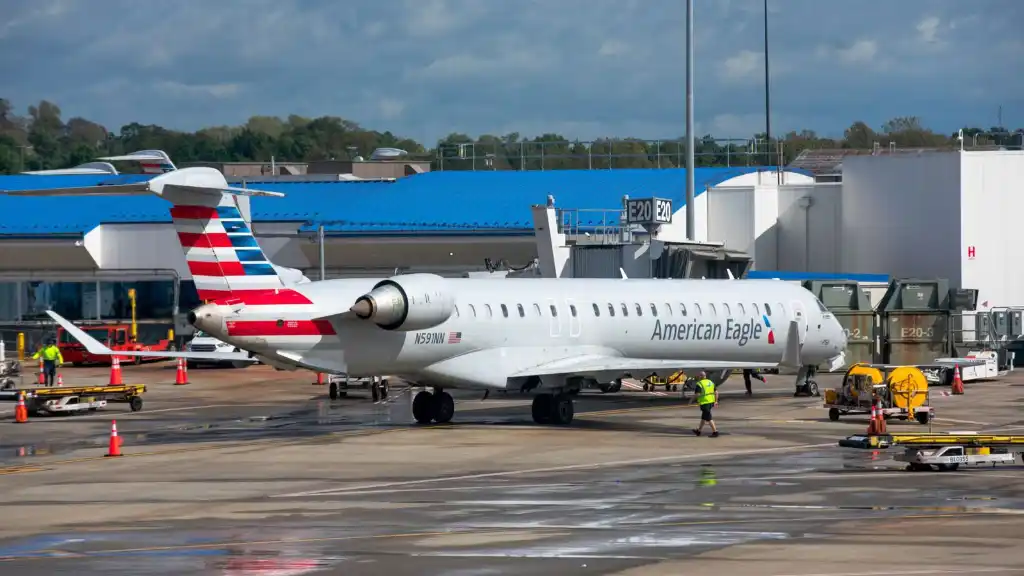
The evening departure from Philadelphia to Savannah turned into an emergency event when American Eagle Flight AA5671, a Bombardier CRJ900, was forced to halt its takeoff roll and evacuate after passengers and crew detected the smell of smoke inside the cabin. The incident occurred on November 26, 2025, at Philadelphia International Airport, adding tension to an already delayed flight schedule and stirring fresh anxiety among travelers still shaken by recent aviation mishaps.
American Eagle AA5671 had already endured a difficult operational day. The six-year-old CRJ900, registered N603NN and operated by PSA Airlines, was slated to depart at 6:44 pm but arrived late from its previous segment. When the aircraft finally pushed back and began taxiing toward Runway 27L close to 10 pm, a distinct smell of smoke began to fill the cabin. Passengers noticed it first, followed quickly by the flight crew, who halted the aircraft on the taxiway and initiated an immediate evacuation.
Evacuations on taxiways are never taken lightly, but every passenger and crew member exited safely without injuries. The airline later confirmed that the event stemmed from a mechanical issue, though the exact source of the smoke remains unconfirmed. The jet was subsequently removed from service and towed to maintenance for inspection.
Timeline of the Evacuation and Response Measures
The delayed flight was preparing for a routine hop to Savannah/Hilton Head International Airport, a journey normally requiring just over two hours. Instead, passengers found themselves waiting until the following morning for a replacement aircraft. The substitute CRJ900 finally departed at 9:52 am on November 27, landing at 11:52 am — a total delay of approximately fifteen hours.
The original aircraft, N603NN, remained grounded throughout November 27 as maintenance teams inspected the smoke source. Early data showed no visible fire damage, suggesting that whatever mechanical anomaly occurred, it was contained before escalating into an onboard fire.
What Early Clues Suggest About the Mechanical Issue
Smoke inside an aircraft cabin typically points to one of several root causes: an electrical component overheating, an environmental control system anomaly, oil or hydraulic fluid contacting a hot surface, or a power-related malfunction. In this case, the absence of physical burn marks or structural damage implies the smoke may have come from a transient issue — perhaps an overheated component or a brief system fault that triggered cabin airflow contamination.
American Airlines issued a brief statement acknowledging the mechanical problem and commending crew actions. While concise, the airline’s message reflected a standard industry stance: identify, isolate, and remove the aircraft from service pending inspection.
Passenger Anxiety Heightened by UPS 2976 Crash
The tense atmosphere onboard AA5671 wasn’t shaped solely by the smoke. Only weeks earlier, the tragic crash of UPS Airlines Flight 2976, an MD-11 freighter, dominated aviation headlines after early evidence pointed to a catastrophic left engine and pylon separation. The haunting mental image of an engine flipping over the wing and triggering a fiery dive remains vivid for many travelers.
Some passengers on the American Eagle flight expressed discomfort and fear during the evacuation, citing the UPS disaster as fresh in their minds. Although the two incidents are unrelated, the psychological ripple effect of high-profile accidents often influences how travelers perceive even minor mechanical irregularities.
Why This Incident Highlights the Effectiveness of Safety Protocols
Despite the dramatic nature of an evacuation, the event ultimately demonstrated the robustness of the aviation safety ecosystem. The crew recognized an abnormal condition, halted the aircraft, executed an evacuation, and ensured everyone exited without harm. The systems functioned exactly as designed.
American Airlines’ maintenance program — among the most extensive in the world — quickly isolated the aircraft for diagnostics and prepared a backup plane. Although inconvenient, the long overnight delay underscored that safety overrides schedules, even on short-haul regional flights.
The CRJ900’s Safety Record and Operational Reliability
The Bombardier CRJ900 fleet serves as the backbone of many regional networks in North America. Known for efficiency and dependable performance, the aircraft rarely appears in major incident logs. Mechanical issues such as odor or smoke events occasionally occur across all aircraft types due to the complexity of modern avionics and environmental systems.
In this case, the lack of structural damage and the rapid turnaround expected for N603NN suggest the aircraft may require only limited repair before reentering service, as early scheduling data showed the jet likely returning to duty on November 28.
Final Outlook for AA5671 and American Eagle Operations
The evacuation of AA5671 serves as an important reminder for both airlines and passengers: rapid response and adherence to protocol prevent minor issues from escalating into serious incidents. While the flight’s significant delay undoubtedly disrupted travel plans, the situation ended with everyone safe and the aircraft undergoing proper inspection.
As maintenance crews complete their work on N603NN, American Eagle’s regional operations are expected to continue without further interruption. For passengers and aviation observers, the event reinforces both the fallibility of machinery and the strength of safety practices that keep air travel one of the safest modes of transportation.