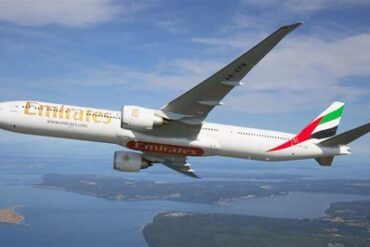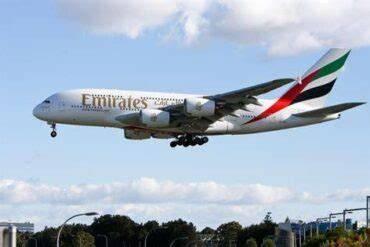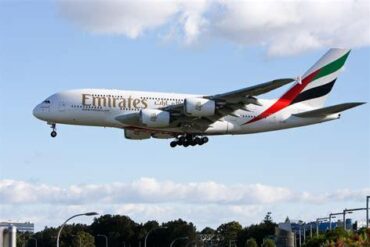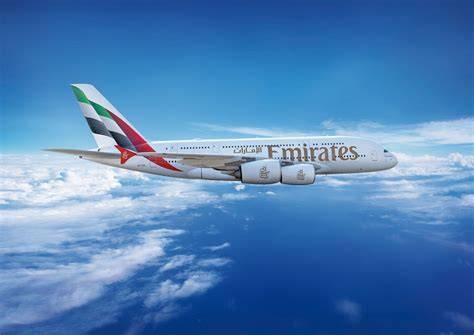
Emirates will bring the Airbus A380 back to Houston George Bush Intercontinental Airport (IAH) on November 1, restoring a 17-hour nonstop link to Dubai International Airport (DXB) barely two months after the superjumbo was pulled from the route in favor of a smaller Boeing 777-200LR. The reinstatement resurrects one of the carrier’s longest A380 missions and injects a significant capacity increase into a market that has spent years flying with a third of its cabin empty.
Emirates Flight Schedule: EK211 and EK212 Timings, Distance and Duration
Beginning November 1, Emirates will operate daily A380 services on EK211/212, covering approximately 8,156 miles (13,125 km) between Dubai and Houston. The westbound flight departs Dubai at 9:45 AM and arrives in Houston at 4:20 PM, a block time of 16 hours and 35 minutes. The return leg pushes back from Houston at 7:10 PM and reaches Dubai at 7:45 PM the following day after 14 hours and 35 minutes aloft.
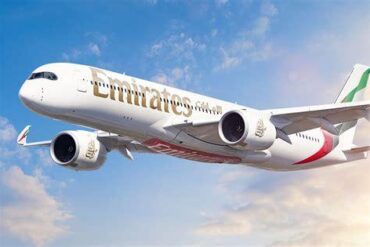
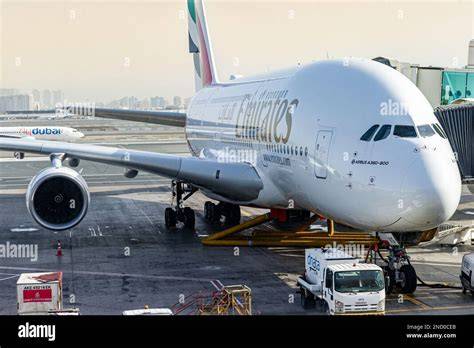
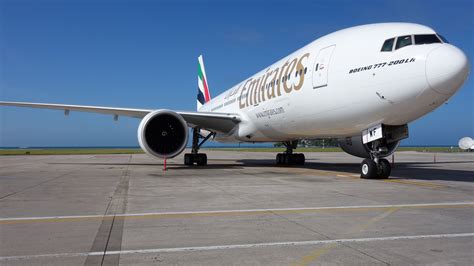
The aircraft swap transforms the economics of the sector. Since August, the route has been flown by a 276-seat Boeing 777-200LR, a downgrade Emirates applied while trimming capacity across several US services. Third-party schedules currently list the same 519-seat A380 that previously served the route, meaning the change theoretically adds 243 seats per departure in each direction. Yet the more probable outcome is that Emirates deploys one of its newly retrofitted 484-seat A380s, which carry 56 premium economy seats alongside refreshed cabins. The lower seat count paired with a higher share of premium inventory would let the airline offset the route’s chronic load factor weakness while chasing stronger yields per passenger.
Why Houston Lost the A380 and What Changed
This is not Houston’s first superjumbo comeback. Emirates introduced the A380 to Houston in December 2014, reduced the route to a Boeing 777-300ER in July 2016, then restored A380 service two years later in June 2018 as the city’s energy sector recovered. The pattern repeated in a different form after the pandemic, when DXB-IAD ran with the 77L for two years before being upgraded to the A380 in December 2022.
The most recent removal came in August, attributed to reported “lower short-term traffic forecasts by the airline.” It landed alongside a broader retrenchment: frequency reductions to Boston, Miami, Orlando, and Seattle, plus the loss of the A380 on the Washington Dulles (IAD) route, which is not scheduled to regain the superjumbo until March 2027. Houston’s earlier reinstatement therefore raises an obvious question — has demand genuinely recovered, or is Emirates positioning capacity ahead of a stronger winter season?
Declining Load Factors Behind the Houston Downgrade
Department of Transportation data shows the DXB-IAH route was underperforming long before the 2026 disruption. Annual load factor slid seven points from 73.3% in 2019 — itself a sub-par figure — to just 66.3% in 2025, even as passenger numbers recovered after the pandemic. Traffic climbed from 166,722 passengers in 2022 to 260,517 in 2023, then eased to 258,472 in 2024 and 251,855 in 2025 while occupancy kept eroding.
Low load factors do not automatically signal unprofitability, given premium fares and cargo revenue, but flying with a third of an A380 empty is difficult to justify against the type’s operating economics. Monthly segment data revealed further deterioration in early 2026: by February, when the Iran War began, Emirates had recorded a 13% decline on DXB-IAH. Average load factor fell to 59.9%, and departures from Houston were especially weak at just 51.7% occupancy — barely 260 passengers on a then-519-seat aircraft. That arithmetic made the shift to the 276-seat 77L the obvious call at the time.
Seasonal Demand and the Premium Economy Calculation
The timing of the November reinstatement, likely temporary, points to seasonal demand rather than a dramatic recovery in passenger volumes. Houston’s combined load factor averaged 73% between November 2025 and January 2026, compared with 58% during the preceding three-month period. Holiday traffic and stronger connecting demand can support a larger aircraft through the winter — particularly a retrofitted A380 with fewer seats, more premium economy, and a cabin mix capable of lifting yields substantially on a route where business traffic has historically been soft.
Houston’s Dependence on Connecting Passengers Through Dubai
Houston’s reliance on transfer traffic makes the route unusually sensitive to disruption far beyond the United States. Traffic data shows 75% of passengers transfer in Dubai, with India accounting for roughly half of those connections. Mumbai, Hyderabad, and Bengaluru lead the onward destinations, followed by Karachi, Delhi, Manila, Chennai, Dammam, Kochi, and Ahmedabad.
That hub-and-spoke structure has made the A380 enormously successful for Emirates, but it also exposes individual sectors to fluctuations across multiple international markets. Weaker demand for travel through Dubai drags on Houston’s performance even when local US-UAE traffic holds relatively steady.
Where Emirates Is Sending Its A380s Instead
Emirates has been redeploying superjumbos toward markets showing firmer demand. Guangzhou Baiyun International Airport (CAN) returned to A380 operations on October 1, replacing the Boeing 777-300ER. Beijing Capital Airport (PEK) regained A380 service on October 4, followed by Delhi Indira Gandhi International Airport (DEL) on October 25, making Delhi the carrier’s third Indian destination served by the superjumbo. The airline also has fewer A380s at its disposal as airframes cycle through the $5 billion refurbishment program.
Against that backdrop, the return to Houston suggests growing confidence in filling the aircraft as the winter travel season approaches. With load factors having declined for several consecutive years and connecting demand still uncertain, the reinstatement looks more like seasonal stabilization than a durable recovery — a capacity bet on winter, premium seats, and the enduring pull of the A380 as a passenger favorite.