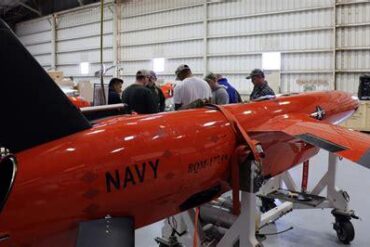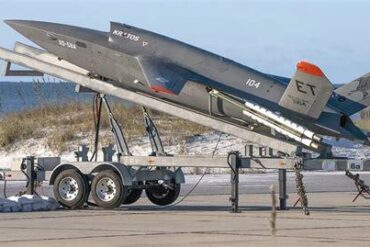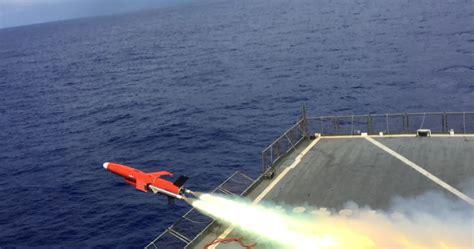
The United States Navy has formally approved full-rate production of the BQM-177A Subsonic Aerial Target, marking a significant milestone in the service’s ongoing effort to modernize fleet training and weapons testing. Backed by a $61 million contract modification awarded to Kratos Unmanned Aerial Systems Inc., this decision reinforces the Navy’s focus on realistic threat replication as anti-ship missile challenges grow more complex across global maritime theaters.
Awarded on February 3, 2026, by Naval Air Systems Command (NAVAIR) in Patuxent River, Maryland, the firm fixed-price modification authorizes Lot Seven production of the BQM-177A, along with 70 rocket-assisted takeoff kits and comprehensive technical and administrative data. The contract underscores institutional confidence in a system that has quietly become indispensable to U.S. Navy readiness, despite operating far from the spotlight occupied by frontline combat platforms.
Rather than launching a new competitive procurement, the Navy exercised an existing option, signaling continuity, program maturity, and operational satisfaction. This approach minimizes integration risk and ensures uninterrupted support for fleet training cycles already structured around the BQM-177A’s performance envelope.
A Distributed Industrial Effort Supporting Naval Readiness
Production of the BQM-177A spans a multi-state industrial base, with activities distributed across California, Texas, Florida, Virginia, Kansas, and Oregon. This geographic spread not only sustains skilled aerospace jobs but also strengthens supply chain resilience for a capability that, while low-visibility, delivers high operational value.
Kratos, headquartered in Sacramento, California, has steadily positioned itself as a key provider of unmanned systems and target drones for the U.S. Department of Defense. The full-rate production decision reflects years of incremental testing, fleet acceptance, and operational use, culminating in a platform that meets demanding performance, reliability, and cost-effectiveness criteria.
Designed to Replicate Modern Cruise Missile Threats
The BQM-177A was selected as the Navy’s next-generation Subsonic Aerial Target specifically to emulate modern anti-ship cruise missiles during live-fire exercises and developmental testing. Unlike legacy targets with limited maneuverability or simplified signatures, the BQM-177A is engineered to challenge integrated air and missile defense systems across the full detection-to-intercept chain.
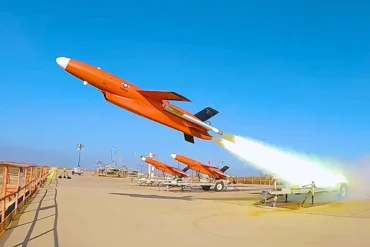
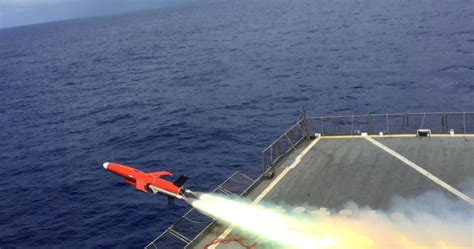
The platform is surface-launched, capable of deployment from ship decks or shore-based ranges, eliminating dependence on runways or extensive ground infrastructure. Launch is achieved via a rocket-assisted takeoff (RATO) unit, which accelerates the air vehicle to flight speed before clean separation, enabling operations in confined maritime environments where realism matters most.
Performance Characteristics Built for Credible Threat Simulation
Once airborne, the BQM-177A is powered by a TR 60-5 turbojet engine, delivering approximately 1,000 pounds of thrust. This propulsion system enables high subsonic speeds exceeding Mach 0.95, placing the target squarely within the performance regime of contemporary cruise missile threats.
The airframe measures roughly 17 feet in length with a 7-foot wingspan and a maximum launch weight of about 1,500 pounds. These dimensions are not optimized for endurance alone but for faithfully reproducing missile-like kinematics, radar signatures, and engagement timelines. With 63 gallons of fuel, the target sustains profiles long enough to stress sensors, command systems, and interceptors without becoming a single-use expendable asset.
Operational altitude ranges from an ultra-low 6.6 feet above sea level for sea-skimming attacks to 40,000 feet mean sea level, allowing the Navy to rehearse engagements across diverse threat geometries. Maneuvering loads from –2g to +9g permit aggressive terminal-phase behaviors within controlled parameters, supporting realistic endgame scenarios against surface combatants.
Modular Payloads and Electronic Warfare Realism
A defining strength of the BQM-177A lies in its modular payload architecture, which allows rapid reconfiguration to match specific training objectives. The platform supports both internal and external payloads, including Identification Friend or Foe (IFF) transponders, passive and active radio-frequency augmentation, and infrared signature enhancement through fixed flares or plume pods.
Electronic warfare realism is further enhanced by integrated electronic countermeasure packages, along with chaff and flare dispensers that simulate defensive measures employed by advanced cruise missiles. This layered signature approach ensures that radar, electro-optical, and infrared sensors encounter a threat environment far closer to operational reality than simplified targets can provide.
The system also supports tow-target capability, enabling it to fulfill multiple training roles within a single sortie. Command and control architecture allows one operator to manage up to eight targets simultaneously, a feature increasingly relevant as naval doctrine emphasizes salvo attacks and coordinated multi-axis threats.
Strengthening Integrated Air and Missile Defense Validation
The BQM-177A plays a foundational role in validating the credibility of the Navy’s integrated air and missile defense (IAMD) architecture. By presenting sensors and interceptors with targets that behave like real threats in speed, altitude, maneuvering, and signature, the system bridges the gap between digital modeling and operational reality.
Live engagements using the BQM-177A enable detailed assessment of sensor fusion timelines, combat system decision logic, and interceptor fly-out performance under conditions that cannot be fully replicated in simulation. Because the target is recoverable, it supports iterative testing cycles where software updates, radar mode changes, or seeker improvements can be evaluated repeatedly against a consistent baseline.
While scripted profiles cannot fully emulate adaptive adversary decision-making, the reliability and repeatability of the BQM-177A make it a reference standard for measuring incremental improvements across the kill chain. In effect, it serves as a controlled constant against which evolving systems are judged.
A Quiet but Strategic Investment
The $61 million contract modification highlights a broader trend in U.S. defense procurement: sustained investment in enabling systems that rarely attract public attention but are essential to operational credibility. While combat aircraft, missiles, and sensors dominate headlines, platforms like the BQM-177A quietly determine whether those systems perform as intended under realistic conditions.
Funding full-rate production several years into the future signals confidence that current and near-term naval air defense architectures will continue to rely on high-fidelity subsonic threat replication. It also reflects enduring threat assumptions centered on the global proliferation of anti-ship cruise missiles, particularly in contested maritime regions.
Implications for Deterrence and Allied Interoperability
Continued investment in advanced aerial target systems reinforces the United States’ commitment to training realism as peer and near-peer capabilities evolve. The ability to rehearse defenses against credible surrogates functions as a form of strategic insurance, ensuring that readiness keeps pace with adversary innovation.
Allied navies benefit indirectly through shared training standards, data exchange, and interoperability frameworks influenced by U.S. testing practices. At the same time, potential adversaries must account for a force that systematically validates its defenses against realistic threats rather than relying solely on theoretical performance.
In this context, the approval of full-rate production for the BQM-177A is more than a procurement milestone. It represents a deliberate choice to prioritize preparation over spectacle, reinforcing deterrence not through display, but through disciplined, repeatable readiness anchored in realism.