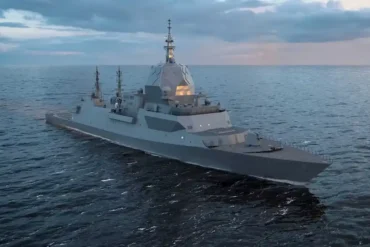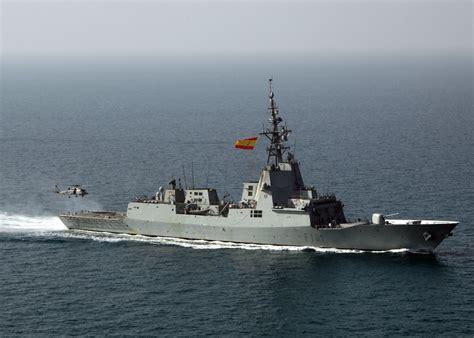
The United States has approved a $1.7 billion Foreign Military Sale that will fundamentally modernize Spain’s five F-100 Álvaro de Bazán-class frigates, reinforcing their role as high-end air-defense escorts within NATO fleets. Authorized on January 29, 2026, the package focuses on a comprehensive Aegis combat system upgrade, encompassing hardware refreshes, software baselines, sensors, launch systems, and long-term sustainment elements. The decision aligns operational urgency with strategic continuity, ensuring that Spain’s first-generation Aegis warships remain relevant against evolving missile, air, and undersea threats through approximately 2045.
The approval underscores Washington’s continued commitment to allied naval interoperability at a time when maritime air defense and integrated command-and-control have returned to center stage. For Spain, the modernization preserves a proven class of frigates that already serve as the backbone of national fleet air defense. For NATO, it ensures that a key European navy retains a fully interoperable Aegis capability, capable of operating seamlessly with U.S. and allied surface combatants during high-intensity operations.
Built by Navantia and delivered between 2002 and 2012, the F-100s were the first European surface combatants designed from the keel up around Aegis. Their original configuration was advanced for its time; this upgrade recognizes that digital combat systems age faster than steel hulls. The result is a deliberate effort to replace obsolescence with resilience, maintaining combat credibility without waiting for entirely new ships to enter service.
Strategic Context Behind the U.S. Approval
At its core, the Foreign Military Sale reflects a convergence of strategic priorities. Spain gains assured access to U.S.-certified Aegis technologies, while the United States reinforces a shared operational framework across allied navies. The upgrade maintains common software lineage, weapons interfaces, and data links, minimizing friction in coalition task groups. In practical terms, that means shared situational awareness, synchronized engagements, and compatible logistics in crisis scenarios.
The approval also fits neatly within Spain’s broader naval roadmap. With the F-110 frigates under development as a next-generation escort class, Madrid faces a transitional decade in which legacy ships must remain capable alongside newer platforms. Modernizing the F-100s avoids a capability dip, allowing the Spanish Navy to field a balanced force while introducing the F-110 incrementally.
Inside the $1.7 Billion Aegis Upgrade Package
The modernization centers on five complete shipsets of upgraded Aegis components, touching nearly every layer of the combat system. A critical element is the integration of Mk 41 Vertical Launching System Baseline VIII, ensuring compatibility with current and future missile loads. This baseline improves launcher electronics, diagnostics, and software interfaces, extending the operational life of the ships’ 48-cell VLS arrays.
Sensor upgrades form another pillar of the package. Each frigate will receive a next-generation surface search radar, enhancing detection and tracking performance in cluttered littoral environments while complementing the Aegis multifunction radar. Communications resilience is strengthened through ultra-high frequency satellite communications radio terminal systems, supporting long-range connectivity and networked operations well beyond line-of-sight.
Navigation and timing robustness receives particular attention. The inclusion of GPS Miniature Precision Lightweight Receiver Engines with M-Code provides encrypted, jam-resistant positioning data, an increasingly critical requirement in contested electromagnetic environments. Undersea survivability is addressed through AN/SRQ-4 Ku-band hardware and materials to upgrade the NIXIE SLQ-25A torpedo countermeasure to the SLQ-25E standard, improving decoy performance against modern torpedoes.
Weapon-system sustainment rounds out the package. Upgrades to Mk 331 torpedo setting panels and Mk 32 torpedo tubes preserve anti-submarine warfare effectiveness, while U.S. government support for the Mk 45 Mod 2 and Mod 2B naval gun systems ensures continued integration with the combat system’s fire-control architecture. Taken together, the elements represent not a piecemeal refit, but a coherent renewal of the ships’ combat spine.
The Aegis System: From Cold War Origins to Modern Fleet Defense
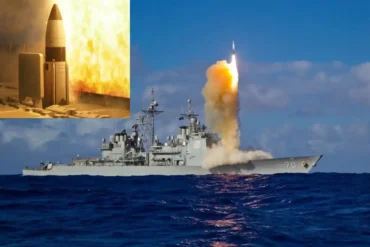
The Aegis combat system emerged in the late 1960s, shaped by the growing threat of high-speed anti-ship missiles and coordinated air attacks. Earlier concepts failed to integrate detection, command, and weapon control quickly enough to counter saturation strikes. Aegis solved this by combining fixed phased-array radar, centralized computing, and automated decision logic into a single architecture capable of continuous, 360-degree surveillance.
First deployed operationally in the early 1980s, Aegis has evolved through successive hardware and software baselines. Its early focus on area air defense expanded to include surface warfare coordination and, eventually, ballistic missile defense. Each iteration preserved a core philosophy: integrate sensors and weapons tightly enough that reaction times shrink from minutes to seconds.
At the heart of Aegis lies an integrated network linking radar, command-and-decision computers, fire control systems, and missile launchers. The radar performs simultaneous search, track, and guidance tasks, while digital processors fuse data into a coherent tactical picture. Automated threat evaluation assigns priorities and recommends responses, allowing operators to manage multiple engagements at once. This architecture remains the benchmark for naval air defense, which explains its adoption by navies across Europe and the Indo-Pacific.
A Global Aegis Community and NATO Interoperability
Today, Aegis equips a diverse fleet of cruisers, destroyers, and large frigates operated by the United States, Spain, Japan, Norway, South Korea, Australia, and Canada, among others. Despite differences in hull size and mission focus, these ships share common combat-system principles and interfaces. Data links such as Link-11 and Link-16 enable real-time information exchange, creating a distributed sensor and shooter network across national lines.
Spain’s F-100s occupy a distinctive niche within this community. Designed to fit Aegis into a frigate-sized hull, they demonstrated that high-end air defense was not limited to cruiser-scale platforms. Their continued modernization ensures that Spain remains a fully integrated participant in multinational maritime operations, from carrier strike group escort to ballistic missile defense support roles.
The Álvaro de Bazán-Class: Design Built for Growth
The F-100 frigates were engineered with growth margins in mind. Their steel hulls and superstructures were shaped to accommodate the fixed radar arrays and cooling demands of Aegis, while internal layouts reserved space, weight, and power for future upgrades. Machinery mounted on resilient foundations reduces acoustic signatures, enhancing anti-submarine performance without compromising combat-system stability.
Stealth considerations influenced hull and superstructure shaping, lowering radar cross-section compared with earlier Spanish escorts. These design choices, made decades ago, now pay dividends by allowing extensive modernization without structural redesign. The current upgrade leverages that foresight, replacing digital brains while leaving the physical platform largely untouched.

Multi-Mission Capability Anchored by Aegis
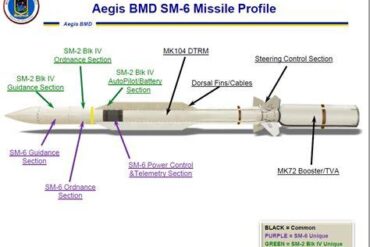
Operationally, the F-100s were conceived as multi-mission escorts with a pronounced emphasis on fleet air defense. Their 48-cell Mk 41 VLS supports SM-2 and Evolved Sea Sparrow Missiles, providing layered protection against aircraft and anti-ship missiles. A 127 mm Mk 45 naval gun offers surface engagement and naval gunfire support, while dedicated anti-ship missiles extend offensive reach.
Anti-submarine warfare remains a core task. Mk 32 torpedo tubes, lightweight torpedoes, a towed countermeasure, and an embarked SH-60 Seahawk helicopter combine to create a flexible undersea warfare suite. Electronic warfare systems and decoy launchers add another defensive layer, enhancing survivability in complex threat environments.
Technical Profile and Operational Reach
The first four ships displace approximately 5,800 tonnes, with the fifth reaching around 6,400 tonnes. Measuring 146.7 meters in length with an 18.6-meter beam, the class balances stability with speed. A combined diesel or gas propulsion system using General Electric LM2500 turbines enables speeds of up to 28 knots, while range extends to roughly 4,500–5,000 nautical miles at cruising speed.
Crew complements typically range from 200 to 216 personnel, reflecting a high degree of automation for ships of their size. Designed for sustained blue-water operations, the F-100s routinely integrate into multinational task groups, a role that will only expand as their combat systems are refreshed.
Industrial Impact and Long-Term Sustainment
Beyond operational benefits, the upgrade dovetails with Spain’s mid-life upgrade program, an industrial effort estimated at €3.2 billion over approximately 120 months. Work centered at the Ría de Ferrol shipyard is expected to sustain around 3,500 jobs, combining direct, indirect, and induced employment. The program aligns military readiness with national industrial policy, reinforcing domestic expertise in complex naval systems integration.
Environmental compliance and efficiency improvements are also part of the modernization, reflecting contemporary standards for naval sustainment. By addressing obsolescence systematically rather than reactively, Spain aims to reduce lifecycle costs while maintaining predictable availability across the class.
Extending Relevance Into the 2040s
The approved U.S. sale ensures that Spain’s F-100 frigates will remain credible, interoperable, and resilient well into the 2040s. In an era defined by missile proliferation, electronic warfare, and contested seas, the value of a modernized Aegis platform lies not only in raw capability, but in its ability to plug into a broader allied system of systems.
As new threats emerge and naval warfare grows increasingly networked, the decision to invest in a comprehensive Aegis upgrade reflects a clear-eyed assessment of risk and return. Steel may endure for decades, but combat effectiveness depends on digital evolution. With this $1.7 billion modernization, Spain ensures that its pioneering Aegis frigates continue to stand watch at the sharp end of NATO’s maritime defense.