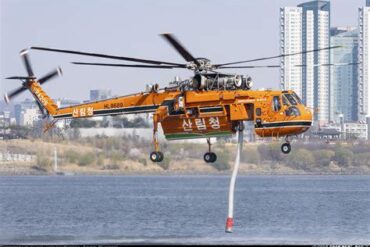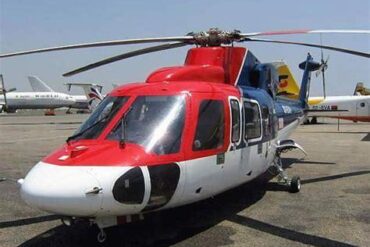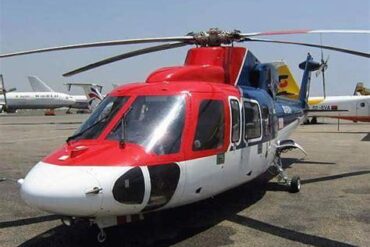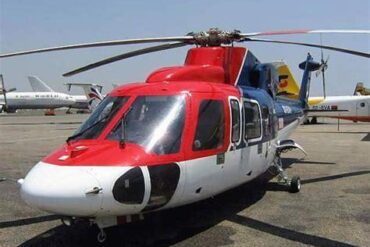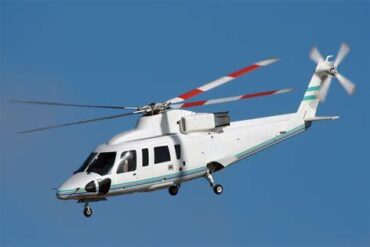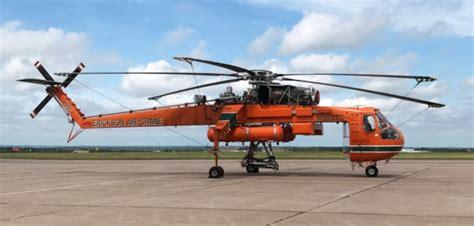
The Sikorsky S-64 Skycrane is one of the most iconic heavy-lift helicopters in aviation history, renowned for its unmatched vertical lift capabilities and essential role in aerial firefighting, infrastructure assembly, and large-scale logistics. Designed originally by Sikorsky Aircraft and later manufactured and modernized by Erickson Inc., this aircraft is a cornerstone in specialized vertical lift operations across the globe.
While its rugged frame and proven performance are well-documented, the cost of a Sikorsky S-64 Skycrane remains a subject of interest, not only for government contractors and utility providers, but also for aerospace analysts and aviation enthusiasts. The last publicly known sale occurred in 2010 at a reported price of $30 million USD for a new S-64F variant, a figure that serves as a baseline for evaluating its current market value.
The Legacy and Capabilities of the S-64 Skycrane
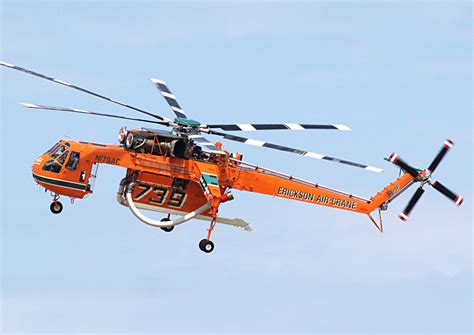
Originally conceived in the early 1960s, the Sikorsky S-64 was designed as a military cargo helicopter, adopted as the CH-54 Tarhe by the U.S. Army. It boasted a unique skeletal frame with a modular cargo pod system, enabling it to lift extraordinary payloads up to 20,000 pounds (9,072 kilograms).
Today, the aircraft continues to be produced and supported by Erickson Inc., which acquired the type certificate from Sikorsky in 1992. In modern operations, the Skycrane is deployed primarily for wildfire suppression, precision construction, heavy cargo transport, and disaster relief. The helicopter’s twin Pratt & Whitney JFTD12A-5A engines deliver a combined 9,000 horsepower, enabling powerful vertical lifts in challenging conditions.
Its modular design allows for specialized configurations, including:
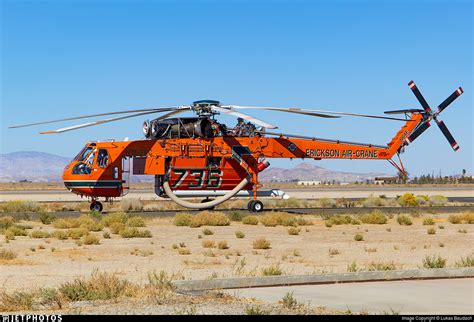
- Firefighting systems with 2,650-gallon (10,000-liter) water tanks
- Aerial crane operations using slings and remote-controlled cargo hooks
- Disaster relief payloads for emergency supply delivery in inaccessible regions
These capabilities justify the high price tag, especially when tailored for critical infrastructure and emergency applications.
Establishing a Baseline: The 2010 Sale
The most authoritative price point for a new Sikorsky S-64 Skycrane comes from a 2010 sale in which Erickson Inc. sold a newly manufactured S-64F Aircrane to San Diego Gas & Electric (SDG&E) for $30 million USD. This figure was publicly disclosed by Fire Aviation, making it a vital reference point for market analysis.
The sale was not just about purchasing an aircraft; it represented a strategic investment in wildfire suppression capabilities. The S-64F delivered to SDG&E was equipped with advanced firefighting systems and represented the pinnacle of Erickson’s modernization efforts at the time.
In 2012, Erickson bought back the same helicopter for $21.75 million, highlighting the depreciation factor in used aircraft pricing and offering a second data point for those evaluating the S-64’s secondary market value.
Adjusting for Inflation: What Would It Cost Today?
Considering the 2010 sale occurred 15 years ago, a direct price comparison to 2025 requires adjusting for inflation. Assuming an average annual inflation rate of 2%, the original $30 million price inflates to an estimated $40.41 million today.
This inflation-adjusted figure provides a reasonable upper-end estimate for acquiring a new S-64F in today’s market, although final prices are likely to depend on specific configuration requirements and optional systems.
Variants That Impact Pricing: S-64E vs. S-64F
Erickson’s production of the Skycrane includes two primary variants:
- S-64E: Based on the CH-54A, featuring older but upgraded avionics and payload capacities. Typically sold as refurbished models.
- S-64F: Derived from the CH-54B, with higher horsepower engines, upgraded structural components, and enhanced flight systems. Offered as new builds or extensively modernized versions.
The S-64F variant commands a premium due to its superior specifications and more recent production history. In contrast, the S-64E is often seen on the resale market, particularly from units manufactured between 1992 and 2016, at lower prices based on age, flight hours, and maintenance history.
Helivalues.com, a respected helicopter valuation service, has reported on resale pricing for these variants, though detailed figures are subscription-based. Nonetheless, it’s widely acknowledged that a used S-64E would cost substantially less than a new S-64F.
Comparative Pricing: Skycrane vs. Chinook
To contextualize the S-64 Skycrane’s price, it is useful to compare it with the Boeing CH-47 Chinook, another heavy-lift helicopter with global deployment in both military and civilian sectors.
- The CH-47F Chinook has a reported price range from $32 million to $83 million, depending on configuration, support packages, and international delivery contracts.
- A notable example includes a 2019 sale to the UAE, where 10 CH-47Fs were purchased for $830.3 million, or roughly $83 million per unit, inclusive of spare parts, logistics, and training support.
This comparison reveals that the Sikorsky S-64, despite being older in design, remains competitively priced—particularly when evaluated purely on heavy-lift capability and role-specific applications like firefighting.
Market Availability and Scarcity
One of the most compelling factors influencing the price of a Skycrane is scarcity. Unlike mass-produced models like the Chinook, S-64 production is limited. Erickson operates as both the original equipment manufacturer (OEM) and MRO (Maintenance, Repair, and Overhaul) provider, meaning all new sales or major refurbishments go through a single channel.
This monopoly-like structure allows Erickson to control production volumes, pricing, and customer qualification. Pricing is not published publicly and requires direct inquiry, further reinforcing its status as a custom, contract-driven asset rather than a market commodity.
Moreover, online aircraft sales platforms like Globalair.com and HeliTrader seldom list Skycranes, and when they do, pricing is withheld, reinforcing the aircraft’s exclusivity and custom nature.
Operating Costs and Ownership Considerations
Beyond acquisition cost, prospective operators must factor in the operating cost per flight hour, which is substantial. Estimated figures for the S-64 range from $8,000 to $10,000 per hour, depending on mission type, payload, and fuel consumption.
Additional ownership considerations include:
- Hangar and storage costs due to the aircraft’s large footprint
- Specialized pilot training and certification
- Insurance premiums for aerial crane operations
- Maintenance scheduling and parts procurement from Erickson
These ongoing expenses underscore that the Skycrane is an aircraft for specialized, high-return missions, often employed by governments, utility providers, and private operators with significant operational budgets.
Summary of Key Price Milestones
| Year | Transaction | Price (USD Million) | Notes |
|---|---|---|---|
| 1962 | U.S. Army Purchase (6 units) | 13 (2.17 each) | Historical pricing; outdated for modern estimates |
| 2010 | New S-64F sold to SDG&E | 30 | Best reference for new aircraft cost |
| 2012 | Erickson buyback of same S-64F | 21.75 | Used price; reflects depreciation |
Conclusion: What You Should Expect to Pay
Given all available data, the best current estimate for the price of a new Sikorsky S-64F Skycrane in 2025 is between $38 million and $42 million, accounting for inflation and typical equipment packages. For used S-64E variants, prices are likely to fall between $10 million and $20 million, depending on condition and hours.
Ultimately, pricing is heavily influenced by use-case, configuration, and the necessity for specialized mission readiness. With its enduring design and vital applications in wildfire suppression and industrial logistics, the Sikorsky S-64 Skycrane remains a premium solution in the vertical lift market—one whose value is defined as much by scarcity and reliability as by raw financial figures.