The Boeing 747 was not merely a new airplane. When the first prototype emerged from Boeing’s new factory in Everett, Washington, in 1968, it represented one of the most ambitious industrial projects ever attempted in commercial aviation. The aircraft was larger than anything Boeing had previously produced, demanded new manufacturing techniques, required a completely new assembly facility, and had to enter service while supersonic passenger aircraft appeared poised to transform long-distance travel.
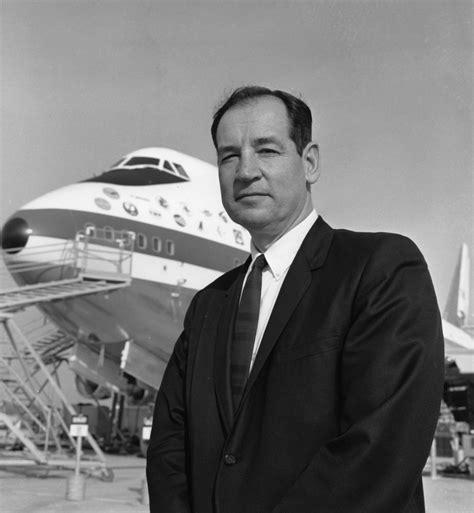
At the center of that enormous undertaking was Joe Sutter, the engineer who became chief project engineer for the 747. Around him was a vast workforce of engineers, mechanics, designers, production specialists, test personnel, and managers who became known collectively as “The Incredibles.” Their challenge was not simply to design a giant aircraft. They had to invent a practical way to build it, test it, certify it, and deliver it to an airline on a schedule that left almost no room for failure.
The result was extraordinary. Boeing began production of the 747 in 1967, constructed the immense Everett assembly facility while the aircraft itself was being developed, and rolled out the first airplane on September 30, 1968. Less than five months later, the prototype took flight. On February 9, 1969, the world’s largest passenger aircraft at the time lifted away from Paine Field, beginning a test program that would lead to Pan Am’s introduction of the 747 on the New York-London route in January 1970.
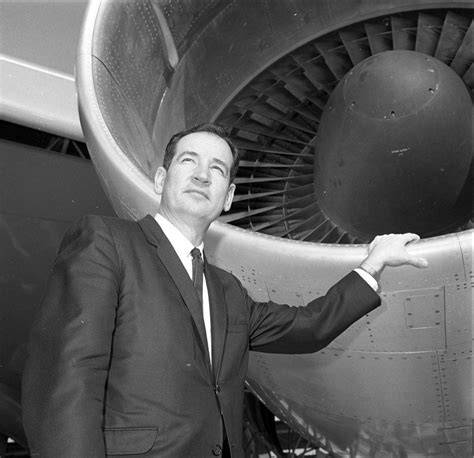
Joe Sutter: The Engineer Behind the Boeing 747
Joe Sutter arrived at Boeing with a background that combined academic training with practical aircraft experience. After studying aeronautical engineering at the University of Washington, he joined Boeing in 1945 and worked on several important programs, including the 377 Stratocruiser, 707, 727, and 737. By the 1960s, he had developed a reputation for solving difficult engineering problems while understanding how those solutions affected production workers on the factory floor.
That combination became particularly valuable on the 747. Boeing was being asked to build an aircraft capable of carrying approximately two and a half times as many passengers as the 707, while the commercial aviation industry was simultaneously investing heavily in supersonic transport. The company therefore faced a complicated strategic problem: it needed a dramatically larger conventional jet that could be economically useful even if supersonic aircraft eventually dominated long-distance travel.
Sutter’s approach was to treat the airplane and the manufacturing process as parts of the same engineering problem. He strongly supported keeping engineers close to production rather than separating design teams from the people responsible for physically constructing the aircraft. His philosophy was straightforward: engineering decisions had to survive contact with manufacturing reality.
That principle mattered enormously because almost every part of the 747 challenged existing Boeing practices. Structures were larger, components were heavier, tooling requirements were different, and the number of people involved expanded rapidly. Sutter also resisted attempts to reduce engineering resources as costs increased because he believed cutting technical staff could jeopardize the entire program.
Why the Boeing 747 Was Designed With a Hump
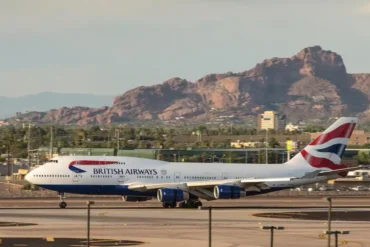
The 747’s distinctive shape was the result of practical decisions rather than an attempt to create an instantly recognizable icon. Its widebody fuselage provided substantially more cabin space than previous commercial jets and introduced two passenger aisles, allowing travelers and cabin crews to move through the aircraft more efficiently.
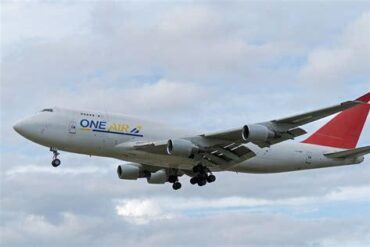
The upper deck was equally important. Boeing placed the flight deck above the main passenger cabin, creating the famous hump that became the defining feature of the aircraft. This configuration had a particularly important connection with the 747’s expected future as a freighter. A raised cockpit allowed Boeing to develop cargo versions with a forward-opening nose door, making it possible to load large freight directly through the front of the aircraft.
The decision also reflected Boeing’s uncertainty about the future of passenger aviation. If supersonic aircraft eventually captured much of the premium long-haul passenger market, the 747 would need another commercial role. Its enormous fuselage and cargo-friendly configuration provided that flexibility. The aircraft could become a passenger jet, a combination passenger-freighter, or a dedicated cargo aircraft without abandoning its fundamental architecture.
The four-engine arrangement also reflected the technological and regulatory environment of the 1960s. Engines capable of powering an aircraft this large were still relatively new, while long overwater twin-engine operations were subject to much stricter limitations than they are today. Four engines therefore provided the thrust and operational flexibility required for an aircraft of unprecedented size.
The original 747’s architecture established a template for the modern long-haul widebody. Instead of creating two complete passenger decks, Boeing used a wide lower fuselage with two aisles and a smaller upper deck. The result offered exceptional capacity while remaining practical for airport operations, maintenance, and cargo applications.
Everett Became Part of the 747 Engineering Challenge
Designing the airplane was only half the problem. Boeing needed somewhere to build it.
The company selected Everett, Washington, north of Seattle, for a new manufacturing complex. Construction began in 1966, before the 747 had even reached production. The enormous building was developed specifically to accommodate the new aircraft, and the factory and airplane program advanced simultaneously.
This created an extraordinary situation. Workers began assembling the first 747 while parts of the new facility were still being completed. Boeing had to recruit and train a rapidly expanding workforce while developing the tools, procedures, transportation systems, and production methods required for an airplane far larger than previous Boeing jets.
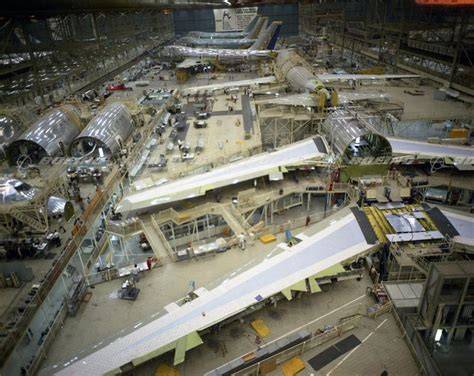
The Everett facility became more than a giant building surrounding an assembly line. It was effectively part of the aircraft’s engineering solution. The enormous dimensions of the 747 meant that conventional production arrangements could not simply be enlarged. Boeing had to rethink how major sections were moved, aligned, assembled, inspected, and eventually rolled out.
Sutter’s insistence on maintaining close contact between engineering and manufacturing was especially valuable in this environment. Engineers could observe production problems directly and work with manufacturing specialists to modify designs or procedures. Instead of allowing problems to travel slowly through layers of organizational communication, the people responsible for designing the airplane could see how their decisions affected the people building it.
The scale of the effort explains why The Incredibles became such an appropriate name. The 747 program involved thousands of Boeing employees, with contemporary accounts describing a broader workforce of roughly 50,000 people connected to the program. The famous aircraft was therefore the visible product of an enormous human network extending far beyond Sutter’s engineering office.
The First Boeing 747 Emerged in Just 29 Months
The speed of the project was remarkable. From the beginning of serious development to rollout, the 747 moved forward in roughly 29 months. Boeing had to design an entirely new aircraft, develop new manufacturing methods, construct a new factory, recruit workers, coordinate suppliers, and prepare the airplane for flight testing within an exceptionally compressed schedule.
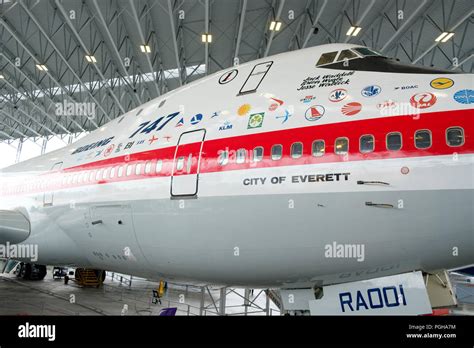
On September 30, 1968, the first 747 was rolled out before thousands of employees and invited observers. Registered as N7470, the prototype later became known as the City of Everett. For the people who had spent years designing and building it, the rollout represented the moment when an enormous collection of engineering drawings, calculations, components, and production decisions finally became a complete airplane.
Yet rollout was not the finish line. It was the beginning of one of the most important test programs in Boeing history.
February 9, 1969: The Jumbo Jet Takes Flight
The first flight of the 747 took place on February 9, 1969, from Paine Field in Everett. Boeing test pilot Jack Waddell occupied the captain’s seat, with Brien Wygle serving as copilot. The conditions were hardly theatrical. The weather was cold, clouds covered much of the area, and the ground around the airport was described as slushy.
Nevertheless, after years of development, the enormous aircraft accelerated down the runway and climbed into the sky.
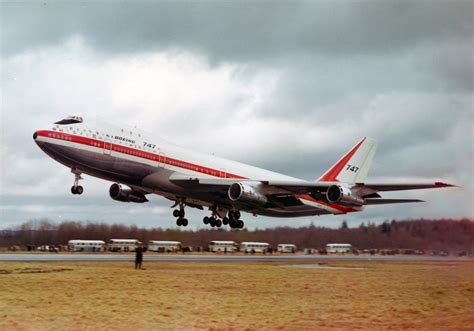
The aircraft was powered by Pratt & Whitney JT9D engines, themselves representing a major technological step. The flight test program would examine everything from handling characteristics and structural behavior to systems performance, engines, and operational procedures. The prototype became an extraordinarily valuable test bed as Boeing continued refining the aircraft before airline service.
The first flight was therefore not simply a ceremonial event. It was the moment when thousands of engineering assumptions began confronting real aerodynamic forces. Every successful test reduced uncertainty, while every unexpected result provided another problem for the Incredibles to solve.
After extensive testing and certification work, the 747 finally entered commercial service with Pan Am on January 22, 1970, flying between New York and London. The transition from experimental prototype to working airliner marked one of the most significant changes in commercial aviation.
The Incredibles Created More Than a Passenger Airplane
The 747’s influence became apparent almost immediately. Its enormous capacity allowed airlines to transport far more passengers across oceans, helping reshape the economics and physical experience of international travel. Long-haul aviation could now operate at a scale that had previously been difficult to imagine.
More importantly, the basic design proved remarkably adaptable. Boeing developed multiple generations and specialized versions, including the 747SP, 747-300, 747-400, and eventually the 747-8. Freighter versions became particularly important, benefiting from the architecture that had originally placed the flight deck above the main deck.
Other 747 airframes were transformed for highly specialized missions. NASA used modified 747s as Space Shuttle Carrier Aircraft, while other variants served military command-and-control roles, presidential transport duties, and unusual cargo missions. Boeing also converted 747-400 aircraft into the enormous Dreamlifter transports used to move major aircraft components around the company’s global production network.
This versatility helped explain why the aircraft remained in production for more than half a century. Boeing ultimately built 1,574 747s during a production run lasting 54 years. The final aircraft, a 747-8 Freighter, was delivered to Atlas Air in 2023.
Joe Sutter’s Legacy Reached Beyond the 747
Sutter remained associated with the 747 for approximately a decade before moving into broader engineering leadership. He eventually became Boeing’s chief of engineering and product development and retired in 1986 after a four-decade career with the company.
His influence extended beyond the technical specifications of one airplane. Sutter demonstrated the importance of connecting engineering decisions with manufacturing realities. The 747 could not have succeeded if its designers had worked in isolation from the people responsible for building it. The relationship between those groups became one of the defining organizational lessons of the program.
The Smithsonian Institution later honored Sutter’s contribution, including its 2013 Lifetime Achievement Trophy. The National Air and Space Museum also became closely associated with the title “Father of the 747,” recognizing his central role in turning Boeing’s enormous concept into a functioning aircraft.
The Boeing 747’s End Was Not a Failure
The end of 747 production in 2023 can look, at first glance, like the conclusion of an outdated technological era. In reality, it demonstrates how successfully the aircraft fulfilled its original purpose.
Modern twin-engine widebody aircraft can now carry large passenger loads over enormous distances while using less fuel and benefiting from highly efficient engines. Advances in engine reliability, certification standards, aerodynamics, and composite structures gradually weakened the economic case for four-engine passenger aircraft.
The 747 nevertheless remained commercially useful for decades, particularly in the cargo market. Its large fuselage, enormous payload capability, and distinctive nose-loading arrangement gave it capabilities that newer aircraft could not immediately replace.
By the time production ended, Boeing reported that the global 747 fleet had accumulated more than 118 million flight hours and almost 23 million flight cycles. Those figures provide a remarkable measure of how deeply the aircraft became embedded in global aviation.
The Real Achievement of Joe Sutter and the Incredibles
The greatest achievement of Joe Sutter and The Incredibles was not simply producing the world’s first jumbo jet. It was proving that an engineering organization could coordinate an extraordinary number of people, technologies, suppliers, manufacturing systems, and commercial requirements around a single high-risk objective.
The 747 required Boeing to solve problems that had never existed at that scale. The company needed a new factory because the airplane was too large for its existing facilities. It needed new production techniques because conventional assembly methods were insufficient. It needed powerful new engines because the aircraft demanded unprecedented thrust. And it needed a management philosophy capable of keeping thousands of specialists focused on one coherent product.
That is why the story remains important even after the final 747 left the production line. Aircraft programs today rely on advanced digital engineering, automated manufacturing, composite materials, sophisticated simulation, and global supply chains, but the fundamental challenge remains familiar: designing an aircraft is inseparable from figuring out how to build and operate it.
Joe Sutter understood that principle unusually well. His insistence that engineers remain close to production helped create an environment in which problems could be confronted directly rather than hidden behind organizational boundaries. The thousands of people who carried those ideas into practice became the Incredibles.
The Boeing 747 ultimately became one of the most recognizable aircraft ever built, but its silhouette tells only part of the story. Behind the hump, four engines, massive wings, and enormous fuselage was an equally impressive human achievement: a team that transformed an almost unimaginable aircraft concept into a machine that carried millions of passengers, moved vast quantities of cargo, and remained in production for 54 years.
The 747 was therefore more than a jumbo jet. It was proof that aviation could dramatically expand its scale without abandoning practicality. And behind that achievement stood Joe Sutter and the Incredibles, the people who made the impossible look manufacturable.