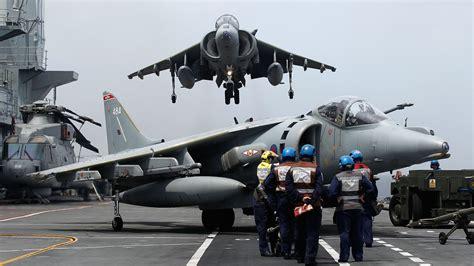
In December 2010, the Royal Air Force (RAF) flew its last Harrier II formation, a dramatic 16-ship display that symbolized not just the end of a fleet, but the conclusion of a bold era in British military aviation. The Harrier, a jet that had become synonymous with vertical/short takeoff and landing (V/STOL) innovation and battlefield versatility, wasn’t decommissioned because it had become obsolete or ineffective. It was grounded because the books didn’t balance.
The decision to retire the Harrier GR9 was less about operational performance and more about fiscal survival. The 2010 Strategic Defence and Security Review (SDSR) struck during a brutal £38 billion defense budget shortfall, and something had to give. With the Queen Elizabeth-class aircraft carriers already locked into production and financially unmovable, the Ministry of Defence faced a brutal tradeoff between capability and affordability.
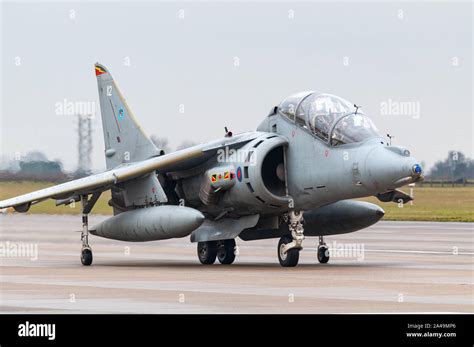
The Tornado vs Harrier: A Ruthless Zero-Sum Game
Despite a £500 million upgrade to the Harrier fleet, including the integration of Sniper targeting pods, helmet-mounted cueing systems, and precision-guided munitions, the RAF leadership leaned toward keeping the Tornado GR4. Why? Because the Tornado came armed with strategic long-range capabilities, notably the Storm Shadow cruise missile, and had already proven itself in sustained Afghanistan operations.
The Tornado offered broader mission profiles, greater payloads, and more established logistics. In contrast, the Harrier’s edge — its agility and V/STOL — was now redundant without aircraft carriers to operate from. With carrier-based operations suspended until the arrival of the F-35B Lightning II, the Harrier was effectively an aircraft with no runway — metaphorically and literally.
In a decision rooted in politics rather than performance, the British government chose Tornado over Harrier. By the end of 2010, the once-proud Joint Force Harrier was no more.
A Jet With Nowhere Left to Land
The Harrier’s original selling point — its ability to launch from makeshift airfields, roads, and ships — no longer offered strategic leverage. The Royal Navy’s Sea Harrier was already retired by 2006, and the Invincible-class carriers that once launched Harriers were heading to decommissioning, with the last retired by 2014. At the time of the Harrier’s retirement, the new Queen Elizabeth-class carriers weren’t yet operational, and would not be for several more years.
With naval platforms gone and Tornados monopolizing the RAF’s strike role, the Harrier’s continued presence became an uncomfortable anachronism. The British government, in an uncharacteristically swift move, culled the entire Harrier fleet within two months of the SDSR decision.
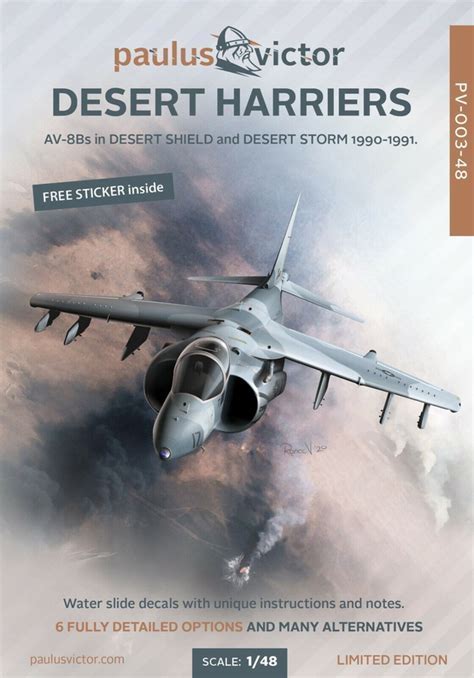
The abruptness of the move caught many by surprise. The final batch of Harriers was sold to the United States Marine Corps as spare parts donors. Today, many of those jets rest in the baking heat of Arizona’s military aircraft graveyards, slowly stripped to prolong the life of America’s own Harrier force.
A Proud Legacy, Now Flying Under a Different Flag
The Harrier II’s combat résumé was as storied as any Cold War-era aircraft. It flew in the Falklands War, played key roles in Bosnia and Kosovo, and later proved indispensable during missions in Iraq and Afghanistan. Its ability to provide close air support in rugged terrain made it a warfighter’s favorite. But its true influence was always more than just tactical.
Britain’s Harriers, especially the GR7 and GR9 variants, had evolved significantly from their 1970s ancestors. Outfitted with digital cockpits, advanced navigation, thermal imaging, and smart weapons, the aircraft was still combat-relevant in 2010. Yet its grounding underscored a brutal military reality: even legends can be outpaced by procurement cycles.
Meanwhile, the United States Marine Corps continued flying the AV-8B Harrier II, the American derivative of the British design. Despite being notoriously difficult to fly, the AV-8B remained in front-line service for years. It flew critical missions over Libya, Syria, Iraq, and Yemen, delivering pinpoint strikes with LITENING targeting pods, all while maintaining the V/STOL edge.
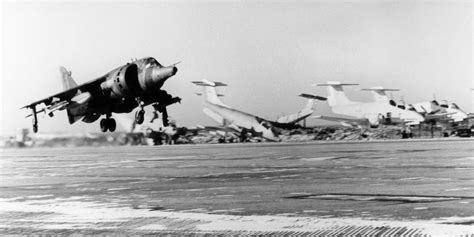
Unlike the RAF’s Tornado, which retired in 2019, the USMC managed to keep its Harriers relevant through steady upgrades and operational creativity. In doing so, they extended the life of a platform that the UK had abandoned not for lack of utility, but for lack of runway — and runway funding.
The Cost of Capability: Economics Over Engineering
The Harrier’s cancellation didn’t just remove a class of aircraft; it created a capability gap. From 2011 until the F-35B’s introduction nearly a decade later, Britain lacked a fixed-wing carrier strike capability. In a geopolitical era defined by rapid response and flexible projection, that absence was deeply felt.
In retrospect, many experts have questioned the SDSR’s logic. If the UK had delayed Harrier retirement until the Queen Elizabeth-class carriers became operational or invested in temporary sea platforms for V/STOL operations, the story might have been different. Instead, Britain found itself reliant on allies for carrier-borne aviation, temporarily severing a capability it had once pioneered.
And while the F-35B offers stealth, sensors, and network integration beyond anything the Harrier could achieve, it also comes with astronomical costs, complex maintenance, and a long ramp-up time. The Harrier, though old, was a known quantity — reliable, rugged, and ready.
Harrier in British Memory: A Jet Ahead of Its Time
For many RAF pilots, engineers, and aviation enthusiasts, the Harrier’s retirement felt premature and politically driven. It had defined an era of British aerospace innovation, representing a unique marriage of engineering ambition and combat practicality. Born from the need to operate where others couldn’t, the Harrier turned short stretches of road into airstrips and small ships into strike platforms.
The decision to end its career wasn’t an operational critique, but a financial sacrifice. It reflected how budgetary expedience can override battlefield experience. In the end, the Harrier GR9 was a jet with nowhere to land, and no room in the budget to wait.
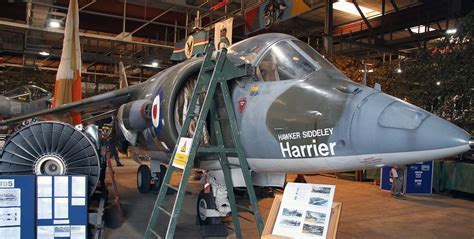
Yet, even today, the Harrier’s spirit lives on. Every time a Lockheed Martin F-35B rises vertically from a British carrier deck, it owes a debt to the British engineers at Hawker Siddeley who made defying gravity a combat capability, not just a gimmick.
Conclusion: A Legend Lost to Ledger Lines
The RAF didn’t retire the Harrier because it was broken. It retired it because the money ran out. While the Tornado was prioritized for strategic flexibility, and the F-35B loomed on the horizon as a next-generation solution, the Harrier II was left in a gap between two eras.
Its story is a cautionary tale: that cutting-edge capability isn’t always enough to ensure survival when defense budgets become battlegrounds. But its impact lives on — in flight decks, in doctrine, and in the enduring belief that a fighter jet doesn’t always need a runway to make history.