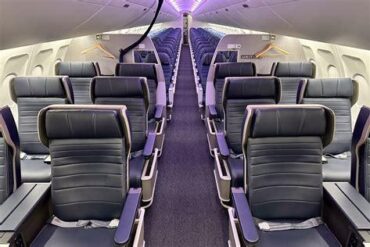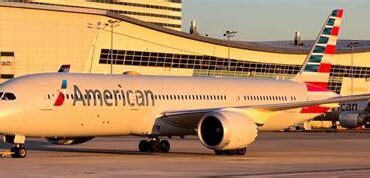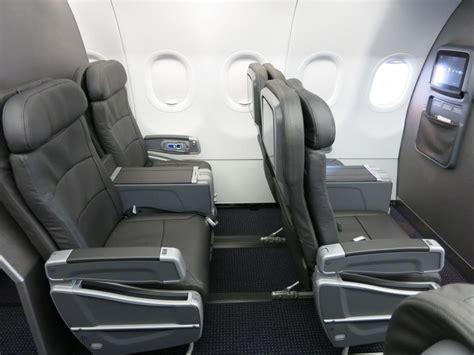
American Airlines is moving forward with a significant cabin refresh for its Airbus A319 and A320 fleet, a change that reflects shifting passenger demand and the airline’s evolving revenue strategy. At the heart of the plan is a clear premium push: more First Class seats on aging narrowbody aircraft that still form a crucial part of American’s domestic network. The move promises tangible benefits for premium travelers and frequent flyers chasing upgrades, but it also introduces compromises that economy passengers and cabin crews are unlikely to cheer.
This retrofit program was first announced in March 2024 alongside American’s massive order for more than 260 new aircraft across Airbus, Boeing, and Embraer. While the new jets represent the airline’s long-term future, the A319s and A320s remain very much part of the present. Rather than sidelining these older aircraft, American is choosing to modernize them—selectively.
The most attention-grabbing change is simple to state but complex in impact: an additional row of First Class seats on every A319 and A320.
A Calculated Premium Expansion Across the Airbus Narrowbody Fleet
Under the new configuration, Airbus A319 aircraft will increase from eight to 12 First Class seats, while Airbus A320 aircraft will grow from 12 to 16 First Class seats. That represents a 33% to 50% jump in premium seating, a striking increase on aircraft that traditionally leaned heavily toward economy capacity.
American frames this decision as a response to sustained demand for premium cabins, even on short- and medium-haul domestic routes. That demand is real. Travelers are increasingly willing to pay for extra comfort, early boarding, and bundled perks, especially as corporate travel rebounds unevenly and leisure travelers “buy up” when fares feel reasonable.
For AAdvantage elites, the expansion raises cautious optimism. More First Class seats theoretically mean more upgrade opportunities, particularly on routes where premium cabins regularly sell out. In practice, however, the modern reality is more nuanced. Many of those seats are already being filled through cash upgrades and buy-up offers, often priced dynamically to capture last-minute willingness to pay.
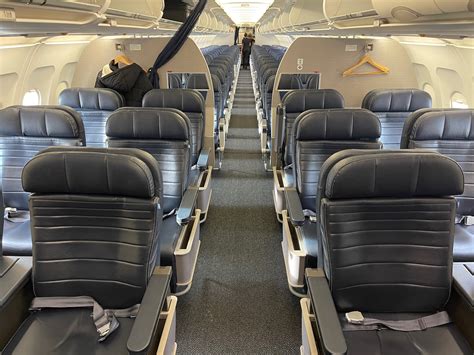
Still, from a revenue perspective, the logic is difficult to argue with. A First Class seat, even discounted, almost always generates more value per square foot than an economy seat.
Timeline and the First Aircraft Entering Service
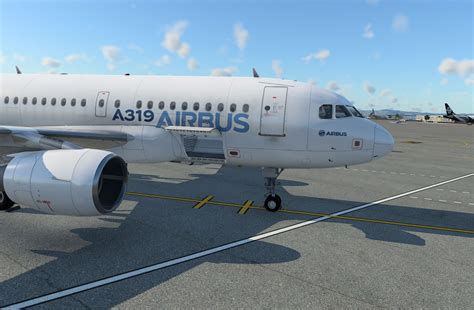
The retrofit program is no longer theoretical. The first reconfigured aircraft, A319 registered as N9002U, is expected to enter service imminently. The jet, approximately 12 years old, has spent months in San Salvador, widely believed to be the site of the interior conversion work.
American is prioritizing legacy American Airlines A319s first, followed by the legacy US Airways A319s. All A320s in the fleet originate from US Airways, and their turn will come after the A319 work gains momentum.
In total, American operates 132 A319s and 48 A320s, making this refresh far from a cosmetic side project. These aircraft are heavily used across North America, with particularly dense deployment in the Northeast, where premium demand tends to be strongest on short-haul business-heavy routes.
Modern Interiors, Power Everywhere, and Bigger Bins
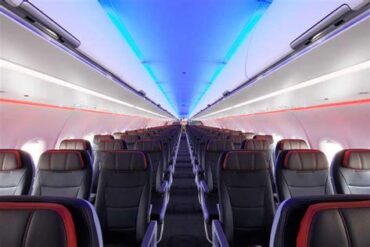
The retrofit is not limited to seat counts. American is rolling out a full interior refresh that brings the A319 and A320 cabins closer to the airline’s newer narrowbody standard. Passengers can expect power ports at every seat, a long-overdue improvement on aircraft that have lagged behind competitors in this area.
Overhead bins are also being replaced with larger-capacity designs, easing one of the most persistent pain points in domestic flying. Full bins slow boarding, fuel gate-check anxiety, and amplify frustration in already tight cabins. Larger bins do not make the seat any wider, but they do meaningfully improve the lived experience onboard.
New seats with updated trim and finishes complete the visual overhaul, giving cabins a fresher look that masks, at least partially, the aircraft’s age.
The Quiet Loss: Seatback Screens Disappear
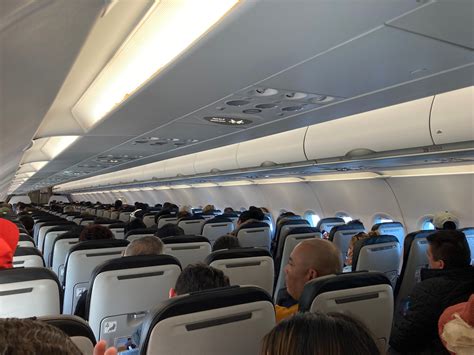
Not all modernization is additive. The 32 legacy American A319s slated for early reconfiguration are currently the airline’s only standard narrowbody jets with seatback entertainment screens. Those screens will be removed.
This marks the final erosion of American’s earlier experiment with a more traditionally premium domestic product. The airline has fully committed to a bring-your-own-device entertainment strategy, leaning on streaming rather than embedded hardware. From a maintenance and weight perspective, the decision makes sense. From a passenger standpoint, it feels like another small subtraction in a cabin already defined by compromises.
Economy Gets Tighter as Total Capacity Increases
The most consequential change for most passengers lies behind the curtain of First Class expansion. American is not merely reallocating seats; it is increasing total aircraft capacity.
An A319 that currently seats 128 passengers will rise to 132 seats, matching Delta’s configuration. On the A320, capacity is expected to climb from 150 seats to roughly 157, depending on final certification and crew requirements. The math works because economy seating becomes denser.
This density comes from slightly reduced seat pitch and, more significantly, a radically reworked rear galley. Lavatories are being pushed into space previously dedicated to galley functions, shrinking crew work areas and relocating jump seats to less-than-ideal positions, sometimes directly adjacent to lavatory doors.
For passengers in the last rows, this redesign concentrates foot traffic, noise, and congestion into a smaller zone. For cabin crews, it means tighter workflows and fewer ergonomic concessions on already long duty days.
Following Delta’s High-Density Playbook
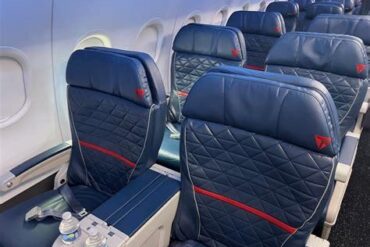
In many ways, American is following a path already well-trodden by Delta Air Lines. Delta has demonstrated that high-density seating paired with strong branding, mood lighting, and consistent onboard tech can outperform competitors financially, even on older aircraft.
The irony is sharp. While American is adding seats, Delta has managed to make many travelers feel less acutely aware of the squeeze through design and presentation. American’s refresh narrows that gap visually, but the physical reality remains: more passengers, less shared space.
Strategic Limits and What Isn’t Changing
Notably, American is not expanding First Class seating on its Boeing 737-800s, 737 MAX 8s, or Airbus A321 variants beyond current levels. Those aircraft already strike a balance the airline appears comfortable with—16 First Class seats on most 737s and 20 on A321s.
The A319 and A320 refresh is therefore targeted, not universal. It addresses a specific fleet segment where premium demand has outgrown the original cabin design.
A Mixed Bag with Clear Winners and Losers
From a strategic standpoint, American’s decision is coherent. Premium seats sell, and consistency across the fleet reduces operational friction. For First Class passengers and elites angling for upgrades, the changes are broadly positive.
For economy travelers and flight attendants, the experience moves in the opposite direction. Tighter seating, reduced galley space, and the loss of seatback screens collectively erode comfort, even as marketing language emphasizes “refresh” and “modernization.”
The retrofit underscores a central truth of modern airline economics: comfort is no longer expanded evenly. It is concentrated where revenue is strongest.
American’s A319 and A320 overhaul delivers exactly what it promises—more First Class seats and a cleaner, more consistent cabin. The cost of that promise is paid quietly, row by row, at the back of the plane.