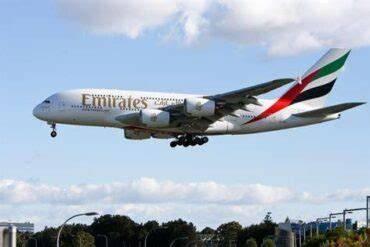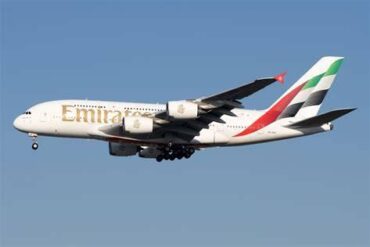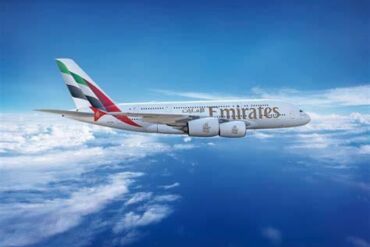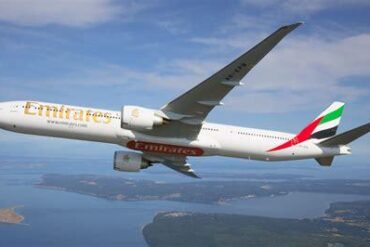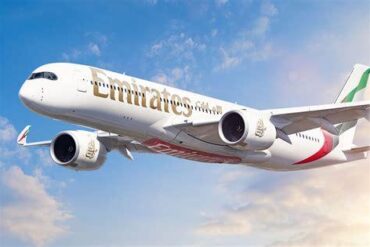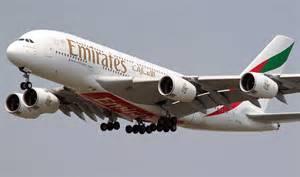
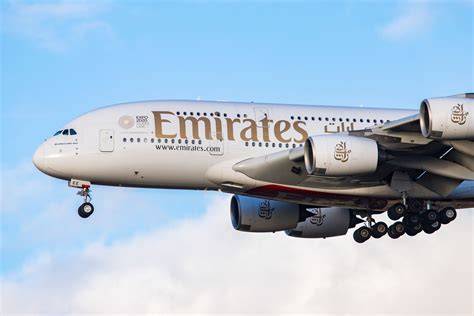
Emirates has restored Airbus A380 service between Dubai International Airport (DXB) and Houston George Bush Intercontinental Airport (IAH), putting the double-decker back on one of the longest sectors in the airline’s network. The first superjumbo departure under the relaunched schedule left Dubai on November 1, landing in Texas after a block time of 17 hours and 00 minutes on flight EK211. Houston thus regains the 484-seat aircraft that had become the route’s signature equipment before the schedule was interrupted.
Emirates A380 Is Back on the Dubai–Houston 17-Hour Route
The return is the second superjumbo restart in the space of a week. Emirates brought the A380 back to Glasgow two days before Houston, restoring Emirates’ A380 service to a Scottish city that had not seen the type since early March. The two relaunches confirm the aircraft’s central role in Emirates’ long-haul network rather than any retreat from the A380 as a tool for ultra-long nonstop missions.
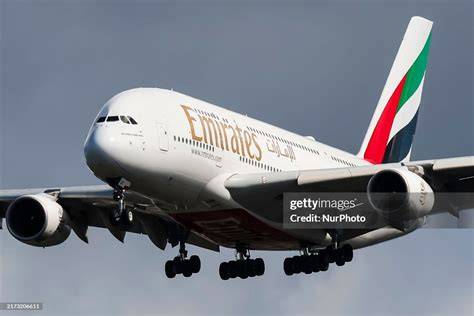
Houston’s A380 History Stretches Back to December 2014
Houston was never an overnight addition to the superjumbo map. Emirates began serving IAH in December 2007 with the Boeing 777-200LR, an aircraft designed for ultra-long thin routes. The larger 777-300ER, which carries substantial belly freight, followed in March 2012. The A380 first reached Houston in December 2014, seven years after the route opened, and operated daily until early 2020. It returned in December 2022 and, according to Flightradar24 data, flew the sector until February 2026, when the conflict involving Iran forced a temporary pause of both the aircraft and the route.
Service resumed in May 2026 with the 484-seat A380 after a gap of roughly six weeks. That deployment lasted until August 24, 2026, when Emirates switched back to the 276-seat 777-200LR, the route’s original equipment. The swap removed 43% of the seats on offer and simplified the cabin: no first class, and considerably fewer business seats, but fuller aircraft as a result.
Nonstop Distance, Avoided Airspace and Daily Schedule
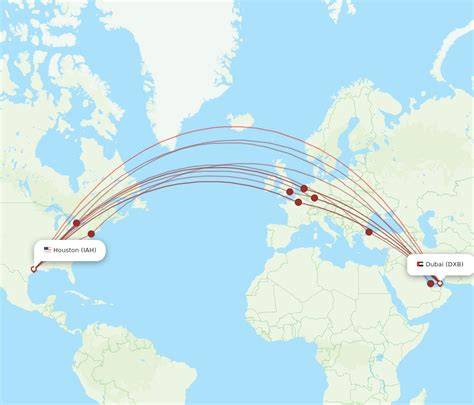
The great-circle distance between Dubai and Houston is 7,098 nautical miles (13,146 km) each way, but real routings run longer. Circumventing Iranian, Ukrainian and Russian airspace pushes the flown distance to approximately 7,211 nautical miles (13,355 km), an increase of about 1.6% and a modest penalty for the political constraints involved. The route operates daily in both directions.
- EK211, DXB–IAH: departs 9:40 AM, arrives 4:40 PM (17 hours 00 minutes)
- EK212, IAH–DXB: departs 7:00 PM, arrives 7:45 PM the following day (14 hours 45 minutes)
The westbound sector is longer because it battles headwinds across the North Atlantic and European corridors, while the eastbound return benefits from tailwinds.
Cabin Configuration: 14 First, 76 Business and 338 Economy Seats
Emirates has configured the Houston A380 with 14 first-class suites, 76 business-class seats, 56 premium-economy seats at a 40-inch pitch in a 2-4-2 layout, and 338 economy seats at 32 inches in 3-3-3. The economy cabin alone seats 62 more passengers than the entire 777-200LR that flew the route until October 31, a reminder of how much capacity the superjumbo restores to a market that had been running on a smaller airframe.
3.5 Million Passengers and a Houston Market Tied to South Asia
US Department of Transportation data shows Emirates carried just over 3.5 million round-trip passengers between DXB and IAH from December 2007 to February 2026. In the 12 months to February, the airline moved 249,000 passengers with a reported load factor of only 66.0% — a figure that raises questions about the accuracy of the government tally. Even so, the presence of first class and a large business cabin points to yield performance strong enough to justify a long, expensive sector.
Booking patterns explain the route’s logic. Roughly 70% of Houston traffic connects onward in Dubai, and India is by far the largest country market, trailed by Pakistan, Saudi Arabia, the Philippines, Thailand, Kuwait, Malaysia, Iran, Bangladesh and Singapore. The top city pairs run Houston to and from Mumbai, Hyderabad, Bengaluru, Karachi, Delhi, Manila, Chennai, Dammam, Ahmedabad and Kochi — a profile shaped by energy traffic, diaspora travel and one-stop access to the Gulf.
What the Superjumbo’s Return Means for Houston Travelers
For travelers, the change is immediate and tangible. Houston flyers regain a first-class product and a far deeper business cabin, alongside premium economy, on a nonstop link to Dubai and, through it, to a vast South Asian network. For Emirates, the A380’s return signals confidence that premium demand on the 17-hour sector can again support the aircraft’s scale. The Texas gateway is once more a superjumbo city, and the Dubai–Houston nonstop is once again flown by the largest passenger jet in service.