Europe’s pursuit of greater defense independence took a notable step forward when French defense giants ArianeGroup and Thales revealed the FLP-T 150 long-range guided rocket launcher, a system designed to restore France’s deep-strike artillery capability while eliminating reliance on U.S. export-controlled technologies. The unveiling marks a significant moment in Europe’s evolving military landscape, where the ability to deploy advanced weapons systems without International Traffic in Arms Regulations (ITAR) restrictions is becoming increasingly important for strategic autonomy.
The FLP-T 150 program forms part of France’s broader effort to replace its aging LRU (Lance-Roquettes Unitaire) launchers and to provide the French Army with a modern long-range precision artillery platform capable of striking targets at distances up to 150 kilometers. With modern warfare increasingly defined by precision fires, mobility, and electronic resilience, the new system is intended to restore a capability that French land forces risk losing as their current rocket artillery approaches the end of its operational life.
Unlike many Western systems currently deployed by NATO forces, the FLP-T 150 is being designed from the outset as a fully sovereign European system, built without American components that would trigger export controls. This independence could enable France and potentially other European operators to export or deploy the weapon without the diplomatic constraints often associated with U.S.-controlled technologies.
A New Generation of European Long-Range Rocket Artillery
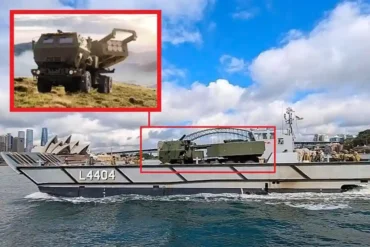
The FLP-T 150 represents a new generation of mobile precision rocket artillery designed for high-intensity warfare scenarios. Its concept closely mirrors the operational flexibility seen in leading systems such as the American M142 HIMARS and the South Korean K239 Chunmoo, but with design choices tailored to France’s operational requirements and industrial independence.
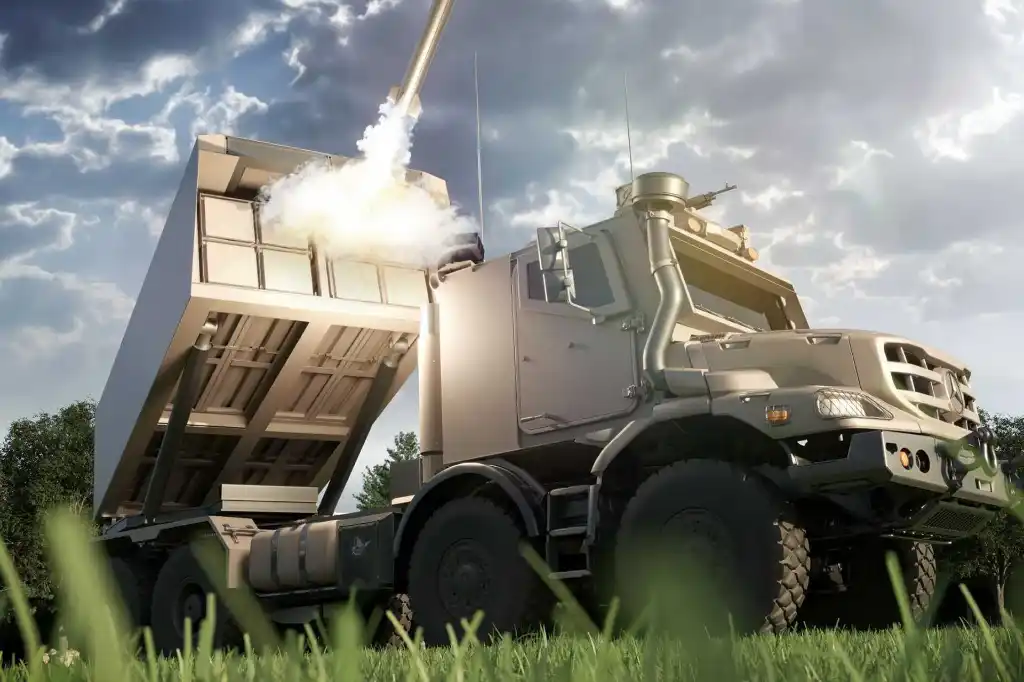
The launcher is mounted on a Mercedes-Benz Zetros 8×8 heavy tactical truck, providing the system with high mobility across difficult terrain. France has already ordered thousands of Zetros vehicles as part of a broader military logistics modernization effort, making the chassis a logical choice for integration into future weapon systems.
Behind the armored cabin sits a rectangular launcher module capable of carrying eight guided rockets arranged in two rows of four. This containerized configuration differs significantly from comparable systems. HIMARS typically carries a single six-rocket pod, while Chunmoo generally employs two independent pods with varying rocket types. The FLP-T 150’s unified container design is intended to simplify reloading operations and logistical handling, allowing artillery units to rapidly swap out ammunition modules in the field.
Mobility and survivability remain central to the system’s concept of operations. Modern artillery engagements often involve counter-battery fire, where enemy forces quickly detect and strike the source of rocket launches. To survive in such an environment, launchers must deploy, fire, and relocate within minutes. The FLP-T 150’s truck-mounted architecture and hydraulic elevation system are specifically designed to support this rapid “shoot-and-scoot” doctrine.
Precision Strikes at 150 Kilometers
At the heart of the system lies the FLP-T 150 guided rocket, a munition engineered by ArianeGroup to achieve a maximum strike range of 150 kilometers while maintaining exceptional accuracy. According to the developers, the rocket can achieve a circular error measured in single-digit meters, placing it among the most precise rocket artillery munitions currently envisioned for European land forces.
The munition’s guidance system has been designed to remain operational even in environments where satellite navigation signals such as GPS are degraded or jammed. Electronic warfare has become a defining characteristic of modern battlefields, particularly in conflicts where advanced militaries employ aggressive signal disruption techniques. A rocket dependent solely on satellite navigation could quickly lose effectiveness under such conditions.
To address this vulnerability, the FLP-T 150 integrates advanced flight control and trajectory correction systems capable of maintaining precision through alternative guidance methods. The rocket follows a high ballistic arc similar to other long-range artillery systems, reaching significant altitudes before descending toward its target at high terminal velocity.
The design leverages ArianeGroup’s extensive expertise in ballistic and high-speed aerospace technologies. The company is widely known for developing the Ariane family of space launch vehicles as well as contributing to France’s M51 submarine-launched ballistic missile program. These programs have provided decades of experience in high-velocity flight dynamics, propulsion systems, and guidance technologies—knowledge now being applied to advanced artillery rockets.
Restoring a Critical Capability for the French Army
The urgency behind the FLP-T 150 project stems largely from the declining operational status of France’s current rocket artillery systems. The French Army currently operates only nine LRU launchers, which are modernized versions of the American M270 Multiple Launch Rocket System (MLRS).
While the LRU platform once represented a formidable artillery capability, it now faces growing limitations. The system’s maximum strike range of approximately 70 kilometers falls far short of modern operational requirements. Many contemporary rocket artillery systems can strike well beyond 100 kilometers, allowing them to hit targets deep behind enemy lines.
As France moves toward building a division-level force capable of high-intensity warfare by 2027, the need for longer-range precision fires has become critical. Without a replacement, the country risks losing its ability to conduct long-range rocket strikes entirely once the remaining LRUs reach the end of their service life.
Doubling the strike range to 150 kilometers dramatically expands the battlefield impact of French artillery. With this reach, commanders can engage high-value targets such as logistics hubs, command centers, air defense systems, and troop concentrations located far behind the front line.

Europe’s Quest for Defense Sovereignty
Beyond its technical features, the FLP-T 150 carries significant political and strategic implications for Europe’s defense industry. The project reflects a growing desire among European governments to reduce dependence on non-European military technologies, particularly those subject to American export control regimes.
The ITAR framework often governs the export and use of defense equipment containing U.S. components. While the system helps regulate sensitive technologies, it can also restrict how allied nations deploy or sell weapons developed with American parts.
By designing the FLP-T 150 without such components, France ensures that the system remains fully sovereign, giving Paris complete control over its export decisions and operational use. This independence could make the system attractive to European countries seeking alternatives to American rocket artillery.
Currently, the M142 HIMARS dominates the global market for mobile rocket artillery, especially following its highly visible operational success in recent conflicts. However, European countries interested in acquiring similar capabilities must often navigate lengthy approval processes tied to U.S. export regulations.
France’s new launcher therefore enters a competitive landscape that includes systems such as EuroPULS, GMARS, and the South Korean Chunmoo. Each offers modern rocket artillery capabilities, yet many rely on partnerships or components originating outside Europe.
Competition and Industrial Innovation
The FLP-T 150 is not the only domestic solution under consideration by French defense planners. The Direction générale de l’armement (DGA) has launched a competition involving multiple industrial teams to determine which system will ultimately equip the French Army.
Among the competing concepts are the Foudre rocket artillery system developed by Turgis & Gaillard and the Thundart system designed by MBDA and Safran. Thundart, in particular, leverages guidance technology derived from the AASM precision air-to-ground weapon, another well-known French system used on combat aircraft.
This competitive environment is expected to drive rapid innovation and technological maturity across France’s defense sector. Demonstration firings scheduled for May 2026 will allow the DGA to evaluate each system’s performance in real operational scenarios.

ArianeGroup has confirmed that the FLP-T 150 demonstrator is expected to conduct its first flight tests during the first half of 2026, potentially just weeks before the official evaluation trials. Successful testing would significantly strengthen the system’s position in the competition.
A €600 Million Program with Long-Term Strategic Impact
The FLP-T initiative represents a major investment in the future of French artillery capabilities. The overall program is estimated at approximately €600 million, reflecting the complexity of developing both the launcher platform and the advanced guided rocket.
Initial procurement plans suggest that the French Army could acquire at least 13 launchers by 2030, although future orders could expand if the system proves successful and additional European partners join the program.
Beyond France, the FLP-T 150 could play a role in shaping the future of European long-range fires doctrine. The war in Ukraine and other recent conflicts have highlighted the decisive impact of precision rocket artillery capable of striking command centers, logistics depots, and air defense assets far from the front line.
By combining long range, high accuracy, electronic resilience, and strategic independence, the FLP-T 150 embodies the type of capability European militaries increasingly consider essential. As the continent continues to strengthen its defense posture, systems like this may become central pillars of a more autonomous European security architecture.
If development proceeds on schedule and testing confirms its capabilities, the FLP-T 150 could emerge not only as France’s next-generation rocket artillery system but also as a symbol of Europe’s evolving defense sovereignty in an era of rapidly shifting geopolitical dynamics.