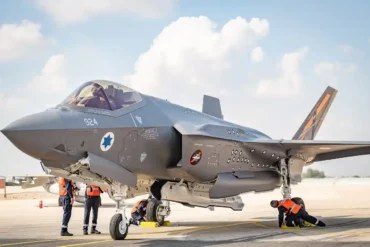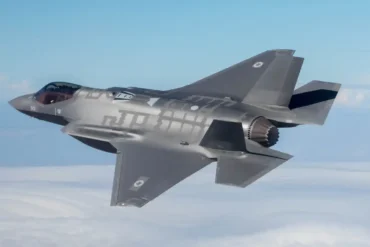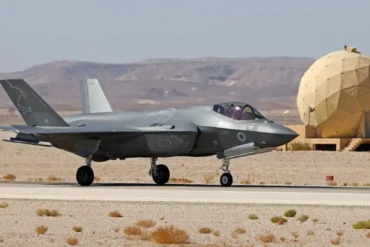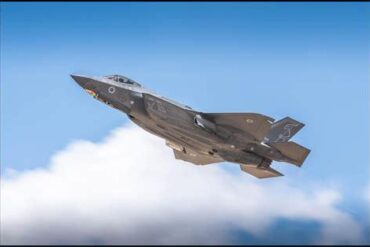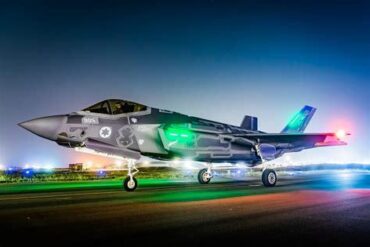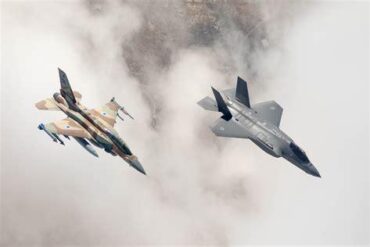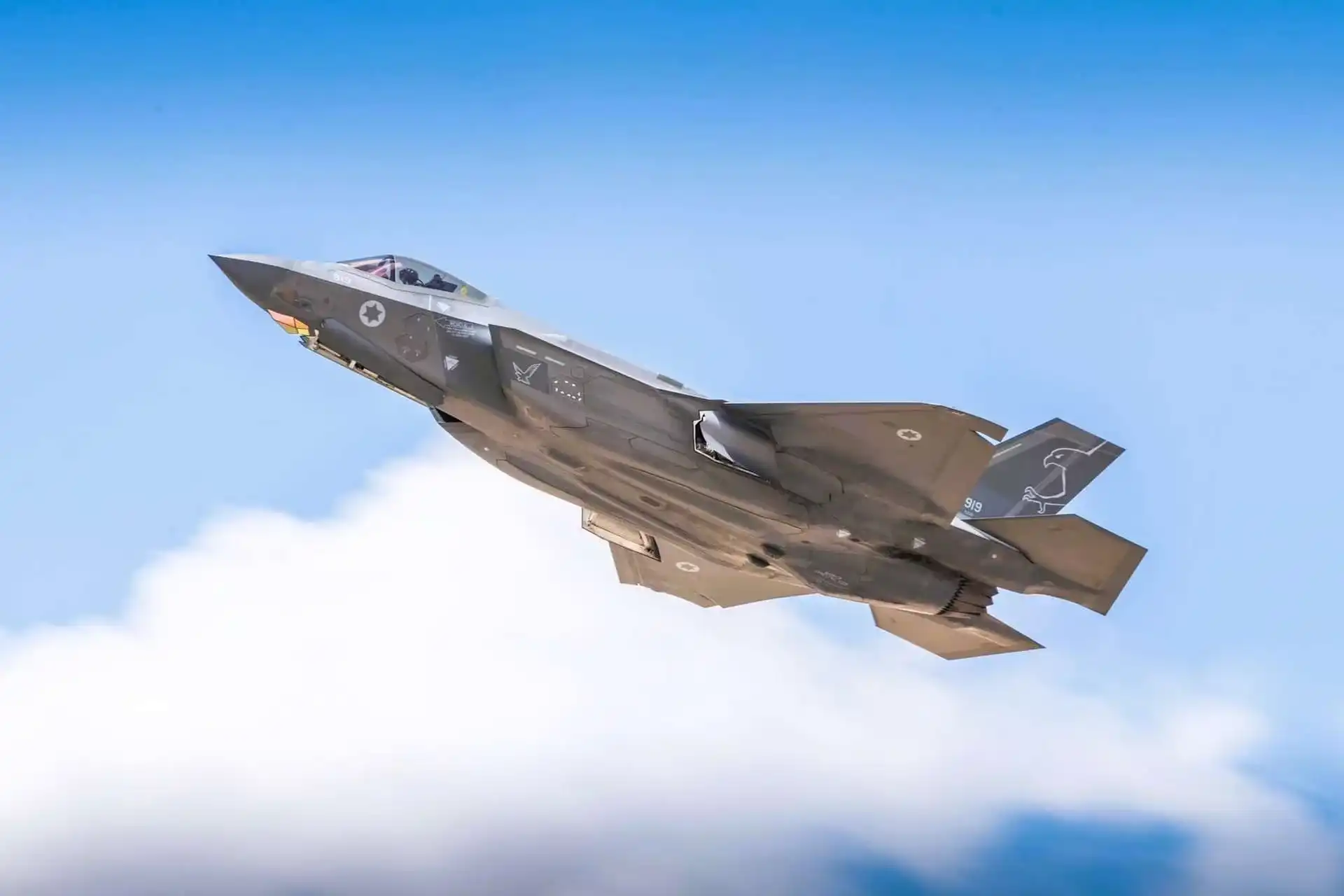
Israel has quietly shifted the operational calculus of Middle Eastern airpower. By equipping its F-35I Adir fleet with newly engineered low-observable fuel tanks, the Israeli Air Force has signaled that it intends to extend its strike reach without surrendering the stealth advantages that define fifth-generation warfare. The development, publicly referenced by Israel’s ambassador to the United States, reflects years of classified engineering work and lessons absorbed from recent high-intensity operations, including the June 2025 air conflict with Iran.
At its core, the announcement is less about fuel and more about autonomy. For a country whose strategic depth can be measured in minutes of flight time, the ability to conduct deep, unrefueled strike missions alters deterrence geometry. Traditional external drop tanks would dramatically increase radar cross-section, undermining the F-35’s signature management. Israel’s claim that these tanks preserve the aircraft’s low observable profile suggests a conformal or semi-conformal design approach—one that aligns tightly with the jet’s fuselage contours and integrates into its fuel and mission systems rather than hanging conspicuously from pylons.
The F-35I Adir is not a standard export fighter. It is a customized derivative of the F-35A, uniquely adapted to Israel’s operational doctrine and industrial ecosystem. Unlike most international operators, Israel secured permission to incorporate indigenous electronic warfare systems, mission computers, data links, and weapons integration. That contractual flexibility has transformed the Adir from a mere platform into a modular ecosystem, capable of iterative evolution as threat landscapes shift.
A Stealth Fighter Reimagined for Strategic Depth
Open-source assessments typically place the F-35A’s combat radius at roughly 1,000 kilometers on internal fuel under representative strike conditions. That figure, while formidable, imposes planning constraints when targets lie deep within adversary territory. Aerial refueling mitigates those constraints, but tankers themselves are high-value, vulnerable assets that must orbit far from contested airspace.
By introducing range-extending conformal fuel tanks, Israel reduces reliance on tanker support during the most sensitive phases of mission planning. The logic is straightforward but powerful: the fewer moving parts in a strike package, the lower the exposure risk. Tanker aircraft such as the aging Boeing 707-based platforms Israel is replacing with KC-46A Pegasus systems remain critical, but minimizing dependency increases operational resilience.
Conformal tanks differ fundamentally from traditional drop tanks. Instead of hanging beneath the wings and creating substantial radar reflections, they are engineered to follow the aircraft’s outer mold line. In theory—and careful phrasing matters here—if their shaping and materials are properly aligned with the F-35’s signature-management architecture, their radar impact can be minimized. Absolute stealth is a myth; signature reduction is a science of margins. Israel appears to be optimizing those margins rather than abandoning them.
Engineering Within the Fifth-Generation Envelope
Any modification to the F-35 platform must navigate a complex matrix of structural loads, flight-control software adjustments, stores-separation testing, and radar cross-section validation. The aircraft’s flight-control laws—essentially the digital brain translating pilot inputs into aerodynamic responses—must account for altered weight distribution and drag characteristics. Even slight asymmetries can ripple through stability calculations at supersonic speeds.
The integration process likely required close coordination with Lockheed Martin and the Joint Program Office. Safety certification, aerodynamic modeling, and electromagnetic signature testing are not optional bureaucratic rituals; they are the gatekeepers of survivability. If the tanks are jettisonable, separation dynamics must be validated to prevent collision with the airframe. If they are fixed conformal structures, then endurance and aerodynamic penalties must be balanced against mission gains.
The engineering story here is not flashy, but it is decisive. The F-35’s modular design—its digital backbone and open architecture—makes such customization feasible. Israel’s long-standing aerospace industry, including companies like Israel Aerospace Industries and Elbit Systems, has cultivated deep expertise in mission-system integration. The Adir is therefore not simply modified; it is domesticated to Israeli doctrine.
Pairing Range with Firepower: Expanding the “Beast Mode” Concept
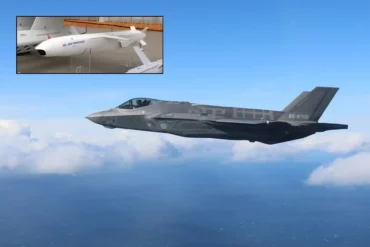
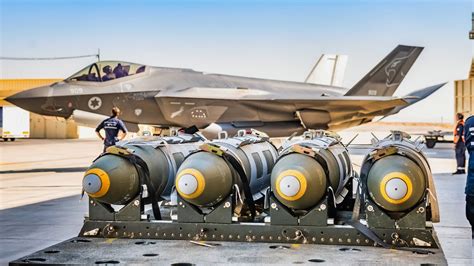
Ambassadorial remarks also referenced the addition of four missiles mounted on the wings, underscoring another evolutionary step. The F-35 was designed to carry its primary munitions internally to maintain stealth. However, once enemy air defenses are degraded, external carriage dramatically increases sortie lethality.
The so-called “beast mode” configuration trades some stealth margin for payload volume. Israeli F-35Is have already been observed in combat carrying external precision-guided munitions. By combining expanded fuel capacity with selectable external weapon stations, the Adir becomes more versatile across mission phases. A typical concept of operations might unfold as follows: ingress in a reduced-signature configuration, tanks attached; jettison tanks before penetrating dense air-defense networks; conduct precision strikes internally; and, in subsequent waves, employ heavier external loads when airspace risk decreases.
This layered adaptability reflects modern air warfare’s reality. Stealth is not a binary switch. It is a spectrum shaped by mission timing, threat density, and electromagnetic conditions. Israel appears to be designing its Adir fleet to move fluidly along that spectrum.
Lessons from Operation Rising Lion
The June 2025 air conflict with Iran—referred to in Israel as Operation Rising Lion—provided a crucible for fifth-generation doctrine. Reports indicated that F-35I aircraft were central to penetrating defended airspace and striking high-value targets, including components of Iran’s nuclear and missile infrastructure.
Combat experience tends to compress theory into necessity. When sortie duration, loiter time, and tanker vulnerability become operational bottlenecks, engineering solutions follow. The reported introduction of stealth-compatible fuel tanks suggests that lessons from those missions accelerated development timelines.
Strategically, extending the F-35I’s reach reinforces Israel’s independent strike option. Even if aerial refueling remains available, demonstrating the ability to operate at extended ranges without it changes adversary risk assessments. Deterrence is partly psychological; credible capability reshapes strategic imagination.
Reducing Tanker Exposure in Contested Airspace
Aerial refueling is often described as the invisible backbone of modern airpower. Yet tankers operate far from contested zones precisely because they lack stealth and are difficult to defend against long-range missiles. In a confrontation involving advanced surface-to-air systems or long-range air-to-air threats, tanker survivability becomes a planning constraint.
By increasing organic fuel capacity, Israel can push its stealth fighters farther before requiring tanker rendezvous. That reduces the geographic footprint of support aircraft and complicates adversary targeting calculations. Even marginal range extensions can translate into significant operational flexibility when planning strike routes around radar coverage and missile engagement zones.
This adjustment aligns with broader trends in airpower doctrine. Nations investing in fifth-generation platforms are increasingly focused on distributed operations, resilient basing, and reduced logistical vulnerability. Fuel capacity, in that sense, becomes a strategic asset rather than a mere performance statistic.
Industrial Feedback into the Global F-35 Ecosystem
Israeli officials have suggested that combat-driven modifications to the Adir generate valuable data for the broader F-35 community. Operational feedback from real-world missions—particularly against sophisticated air-defense networks—carries immense analytical weight. Manufacturers refine threat libraries, electronic warfare algorithms, and maintenance practices based on such insights.
While precise technical details remain classified, Israel’s integration of indigenous systems demonstrates how national customization can coexist within a multinational program framework. It also highlights the delicate balance between shared architecture and sovereign control. For Israel, maintaining the ability to independently update software, integrate local munitions, and adjust hardware configurations is not a luxury; it is a strategic necessity.
Implications for Regional Airpower Balance
In the Middle East, airpower is not merely tactical—it is strategic theater. The introduction of stealth-compatible fuel tanks on the F-35I shifts the parameters of long-range engagement. Iran’s integrated air-defense systems, already under scrutiny after recent conflicts, must now account for aircraft capable of traveling farther with reduced logistical signatures.
This does not render air defenses obsolete. Every technological advancement triggers countermeasures. Radar operators refine detection algorithms; missile designers pursue improved seekers; electronic warfare systems evolve. The dance continues. Yet the extension of the Adir’s operational envelope complicates defensive planning and widens Israel’s spectrum of response options.
The credibility of a strike capability rests not only on hardware but on demonstrated willingness and capacity to employ it. By publicly acknowledging the modification, Israel communicates both technological maturity and strategic intent. It invites adversaries to update their assumptions.
The Quiet Evolution of Fifth-Generation Doctrine
The F-35 program has often been framed around stealth as its defining characteristic. Yet its true power lies in sensor fusion, data integration, and adaptability. By modifying the Adir with conformal fuel tanks and expanded external armament, Israel underscores that fifth-generation warfare is not static. It evolves with threat landscapes and operational experience.
Range, payload, and stealth are not mutually exclusive absolutes; they are variables in a complex equation. Israel’s engineering effort appears to be an attempt to rebalance that equation in favor of greater strategic autonomy. The result is an aircraft capable of flying farther, carrying more, and still leveraging reduced observability when it matters most.
In a region defined by compressed geography and extended rivalries, such adjustments reverberate widely. As other F-35 operators observe Israel’s adaptations, similar concepts may migrate into broader program upgrades. Meanwhile, Iran and other regional actors will scrutinize every available detail, recalibrating defensive doctrines accordingly.
Airpower rarely announces its revolutions with fanfare. More often, it advances through incremental refinements that collectively reshape strategic horizons. The integration of stealth-preserving fuel tanks on the F-35I Adir represents precisely that kind of evolution—a technical adjustment with geopolitical resonance, extending the reach of a fighter already central to Israel’s deterrent posture.