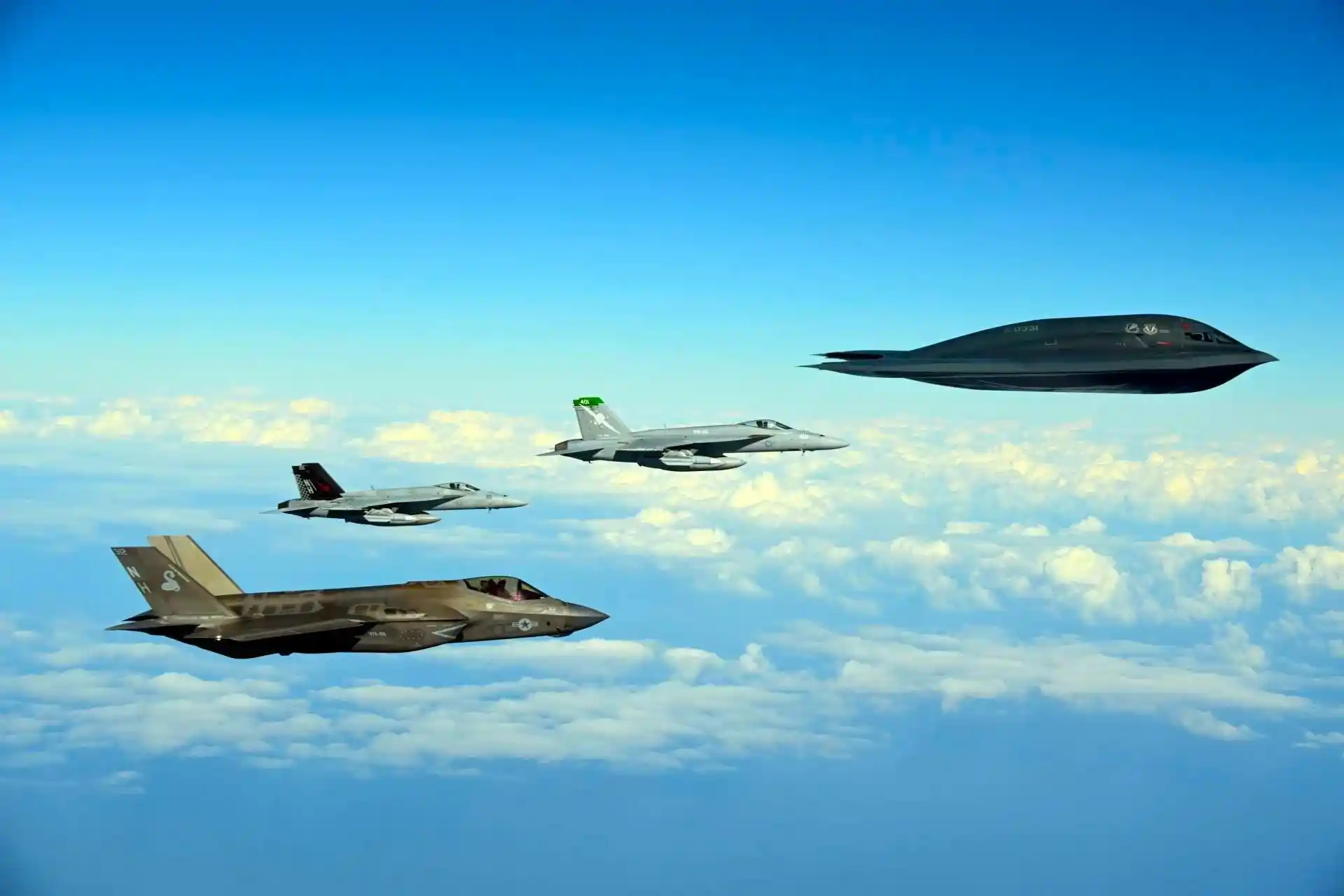
The United States has taken another visible step toward refining its high-end warfighting architecture at sea, as a B-2 Spirit stealth bomber from the 509th Bomb Wing joined Carrier Air Wing Eleven fighters for a complex long-range maritime strike drill off the California coast on February 24, 2026. The exercise demonstrated how strategic bombers and carrier-based aircraft are increasingly woven together into a single, networked combat system designed to operate across vast ocean distances and against advanced anti-access and area-denial threats.
Conducted in a realistic blue-water scenario, the sortie paired the Air Force’s only operational stealth bomber with Navy F-35C Lightning II and F/A-18E Super Hornet fighters. The objective was clear: validate a distributed “kill web” capable of detecting, tracking and engaging maritime and airborne threats hundreds of miles from friendly forces. At a time of intensifying great-power competition in the Indo-Pacific, the ability to synchronize long-range sensors and shooters across services has become central to credible deterrence.
The drill was disclosed through official channels at Whiteman Air Force Base, home of the 509th Bomb Wing. Beyond the imagery and messaging, the integration itself reveals a deliberate evolution in U.S. joint doctrine—one that leverages stealth, advanced sensors and extended-range weapons to hold adversary naval forces at risk while complicating their own targeting calculations.
B-2 Spirit: Stealth Penetration and Global Maritime Reach
At the core of the exercise was the B-2 Spirit, a flying-wing strategic bomber engineered to penetrate dense, layered air defenses. With its radar-absorbent materials, carefully contoured airframe and internal weapons bays, the B-2 maintains an exceptionally low radar cross-section, allowing it to approach defended targets with minimal detection. Unlike conventional bombers reliant on stand-off munitions alone, the B-2 is designed to survive deep inside contested airspace.
In a maritime strike context, the aircraft offers unique value. Operating from the continental United States and sustained through aerial refueling, the B-2 can conduct intercontinental missions against high-value naval targets, coastal anti-ship missile batteries, hardened command nodes or logistics hubs that underpin an adversary’s sea-denial strategy. Its global reach allows U.S. leaders to generate combat power without forward basing, adding strategic unpredictability.
During the California exercise, the bomber functioned not merely as a weapons carrier but as a survivable node within a broader kill chain. In modern joint operations, the kill chain refers to the sequence from detection and identification to decision and engagement. Increasingly, this linear chain is replaced by a resilient network—often called a “kill web”—where multiple platforms share data and provide overlapping engagement options. The B-2’s stealth and payload make it a powerful deep-strike anchor within that web.
F-35C Lightning II: Sensor Fusion at Sea
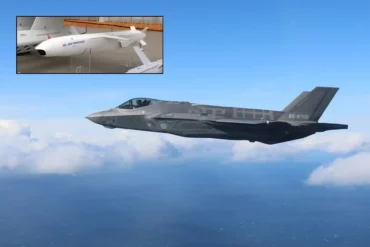
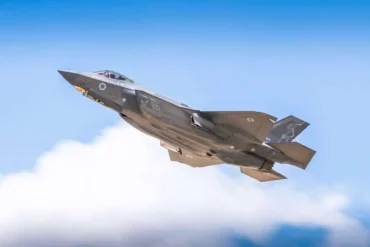
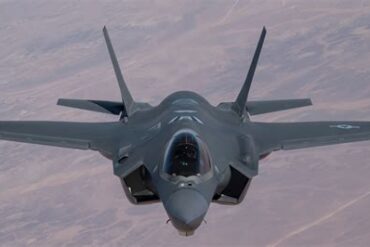
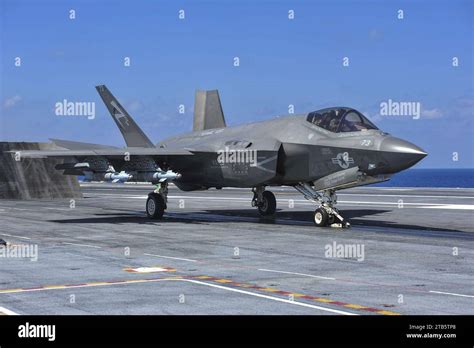
Flying alongside the B-2 was the carrier-optimized F-35C Lightning II, the Navy’s fifth-generation strike fighter. Distinguished by its larger wings and reinforced landing gear for catapult launches and arrested recoveries, the F-35C combines low-observable design with an advanced sensor suite that includes the AN/APG-81 AESA radar, Distributed Aperture System and a robust electronic warfare capability.
In a maritime battlespace defined by long distances and limited radar horizons, information superiority becomes decisive. The F-35C’s sensor fusion architecture aggregates inputs from onboard systems and offboard sources into a coherent operational picture. Pilots receive an integrated display rather than disjointed data streams, enabling rapid threat identification and targeting decisions.
Within the integrated drill, the F-35C likely acted as a forward sensor and battle manager. Operating in a stealthy configuration, it can penetrate closer to contested zones, geolocate enemy emitters, identify maritime targets and transmit secure targeting data to other aircraft and command centers. By tightening the sensor-to-shooter loop, the F-35C helps ensure that weapons launched from standoff distances are guided by accurate, real-time information.
F/A-18E Super Hornet and the AIM-174B “Gunslinger”
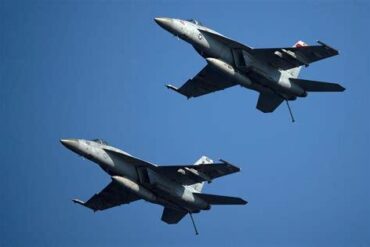
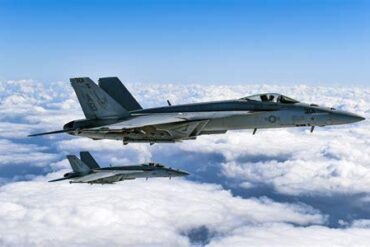
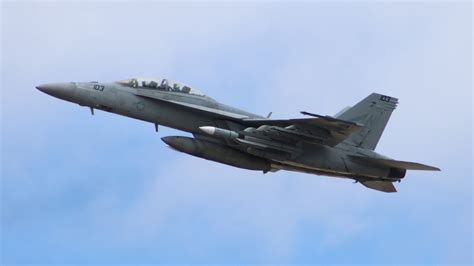
Behind the stealth elements, two F/A-18E Super Hornets from VFA-25 “Fist of the Fleet” and VFA-211 “Fighting Checkmates” provided complementary combat mass and weapons flexibility. The Super Hornet remains the backbone of the carrier air wing, equipped with the APG-79 AESA radar, advanced defensive systems and the capacity to carry a diverse mix of precision-guided munitions.
During the exercise, the aircraft were photographed carrying inert AIM-174B missiles. Nicknamed “Gunslinger,” the AIM-174B represents a significant expansion of the Navy’s beyond-visual-range engagement capability. Derived from the SM-6 family and adapted for air launch, the missile is publicly acknowledged to exceed 130 nautical miles in range, with assessments suggesting substantially greater reach when launched at altitude and high speed.
The missile uses inertial guidance in its midcourse phase, transitioning to active or semi-active radar homing during terminal engagement. This architecture enables carrier-based fighters to threaten high-value airborne assets—such as tankers, airborne early warning aircraft and long-range bombers—well before those platforms can release their own stand-off weapons. In maritime operations, denying the adversary’s enablers can be as decisive as sinking ships.
By validating AIM-174B carriage and employment profiles in conjunction with stealth aircraft and a strategic bomber, the Navy and Air Force are demonstrating an integrated approach to air dominance and sea control. Super Hornets equipped with long-range missiles can establish extended combat air patrol barriers, guided by data from stealthy F-35Cs and supported by the broader strike package.
Building a Resilient Maritime Kill Web
The significance of the drill lies not in any single platform, but in the architecture they collectively represent. A B-2 penetrating deep to strike maritime nodes, F-35Cs feeding targeting data from forward positions, and Super Hornets wielding long-range air-to-air missiles form a layered and distributed force posture.
In practical terms, this configuration allows U.S. forces to mass effects without physically concentrating assets. Distributed maritime operations depend on synchronized timing, emissions control and deconflicted flight profiles. Tanker sequencing, secure datalink management and mission planning integration between a bomber wing at Whiteman and a carrier strike group at sea are non-trivial tasks. Training in peacetime ensures those complexities are addressed before crisis conditions compress decision timelines.
Such integration directly addresses modern anti-access and area-denial strategies. Potential adversaries are investing heavily in anti-ship ballistic missiles, long-range surface-to-air systems and advanced fighter aircraft armed with extended-range weapons. The counter to these layered defenses is not brute concentration but flexible, networked operations that stretch an opponent’s sensors and engagement capacity.
The “kill web” approach enhances survivability. If one sensor is degraded or one shooter is unavailable, others can assume the role. This redundancy complicates enemy targeting cycles and reduces the vulnerability inherent in centralized command structures.
Strategic Messaging and Indo-Pacific Relevance
Beyond tactical proficiency, the California exercise carries strategic weight. The Indo-Pacific theater is defined by vast oceanic distances and the presence of capable peer competitors. Forward bases may be threatened in a conflict, increasing reliance on long-range strike from the U.S. homeland and carrier groups maneuvering at sea.
The 509th Bomb Wing’s participation underscores the enduring relevance of Air Force Global Strike Command in conventional deterrence. Historically associated with nuclear missions, the B-2 force has repeatedly demonstrated its ability to execute precision conventional strikes across intercontinental ranges. Pairing that capability with a carrier air wing validates options for national leadership that blend strategic and operational reach.
The imagery of a B-2 flying in formation with Navy fighters also conveys a message of interoperability. Joint operations are no longer episodic; they are foundational. Training events such as this ensure that procedures, communications protocols and targeting processes are aligned across services. The result is a force able to transition from peacetime presence to high-end combat with minimal friction.
As maritime competition intensifies, exercises integrating stealth bombers, fifth-generation fighters and long-range missiles will likely become more frequent. They signal a deliberate effort to preserve sea control, assure allies and deter adversaries by demonstrating credible, scalable response options.
The February 24 drill off California’s coast therefore represents more than a training sortie. It is a visible manifestation of a joint air-maritime strike architecture built around stealth, sensor fusion and extended-range engagement. By synchronizing the deep-penetration capabilities of the B-2 Spirit, the information dominance of the F-35C, and the expanded reach of the AIM-174B-equipped Super Hornet, the United States is reinforcing its capacity to project power across contested oceans and to maintain the initiative in any future high-end conflict at sea.