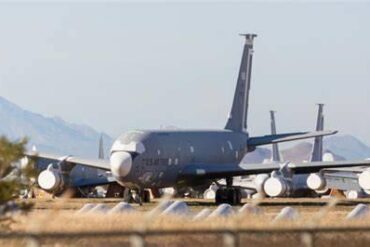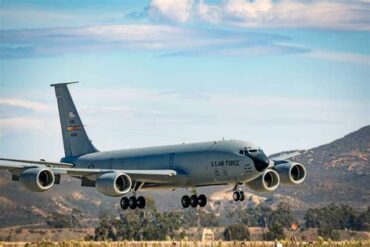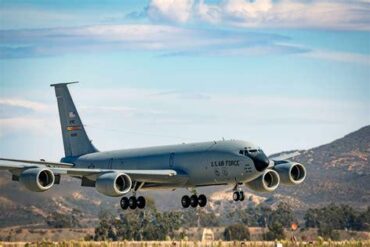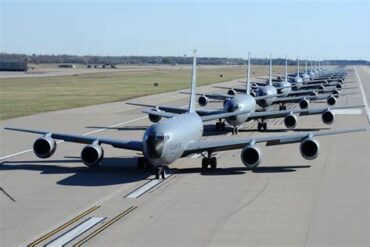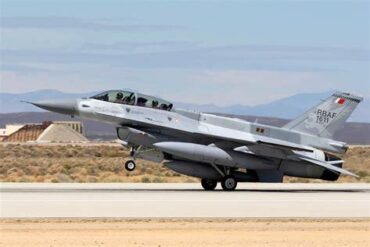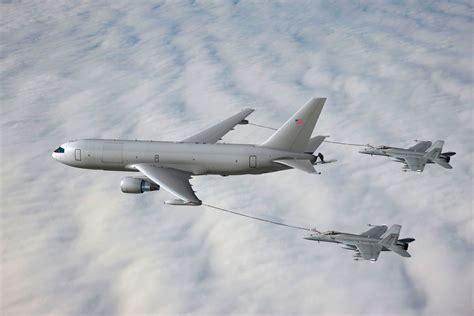
The quiet workhorses of modern airpower are being dragged into the blast radius of twenty-first-century missile warfare. Tankers once orbited safely behind friendly lines, extending the reach of fighters and bombers while rarely starring in threat briefings. That comfort zone has evaporated. The U.S. Air Force is now moving toward hard-kill missile defense for the KC-135 Stratotanker and KC-46A Pegasus, acknowledging that the aircraft that make long-range operations possible are themselves becoming primary targets in a world of sprawling sensor networks and missiles that can chase a support aircraft from hundreds of miles away.
This shift reflects a wider recalibration of how air mobility forces are expected to fight. Long-range air-to-air missiles, surface-to-air systems tied into integrated air defense networks, and sensor fusion across air, sea, land, and space have collapsed the distance that once protected non-stealth platforms. The tanker’s traditional sanctuary is shrinking. As the Air Force’s leadership compresses planning timelines for potential peer conflict, survivability upgrades that once lived on whiteboards are being pulled into real programs. The idea of a tanker physically destroying an incoming missile, rather than only confusing it, marks a philosophical turn as much as a technical one.
Large, non-stealth aircraft sit at the wrong end of modern detection physics. The KC-135 and KC-46A carry massive radar cross-sections and glowing infrared signatures, a thermal lighthouse against the cold background of the upper atmosphere. Stealth fighters like the F-22 and F-35 are shaped and coated to blur themselves into sensor noise. Tankers are not. They are easy to see, easy to track, and increasingly easy to target with missiles whose seekers can switch modes, resist jamming, and accept targeting cues from distant sensors. The old assumption that tankers could remain outside weapons engagement zones no longer holds in an era of air-to-air missiles approaching strategic reach.
The threat picture is not theoretical. Modern air combat is less about a lone radar and a single missile and more about kill chains—webs of sensors, shooters, and data links that compress detection-to-engagement timelines. Imaging infrared seekers do not broadcast their presence and cannot be jammed in the traditional radiofrequency sense. Radar-guided weapons increasingly hop frequencies, alter waveforms, and exploit networked targeting updates. The practical result is brutal simplicity: some missiles will get through soft defenses. Hard-kill systems exist for the same reason body armor exists. They are not the first line of defense; they are the last line when everything else fails.
Current tanker survivability relies on layered soft-kill measures. Directional infrared countermeasures use laser energy to confuse heat-seeking guidance. Electronic warfare suites attempt to break radar lock through jamming and deception, guided by constantly updated threat libraries. Crews deploy flares, chaff, and radiofrequency decoys in patterns refined by decades of operational data. These systems work, but they are part of a contest of adaptation. Adversaries change seeker logic; libraries must be rewritten. Reaction windows shrink as missile speeds climb. The Air Force’s interest in kinetic interceptors is not an abandonment of soft-kill tools. It is an admission that deception alone is an increasingly thin shield against a missile that only needs to succeed once.
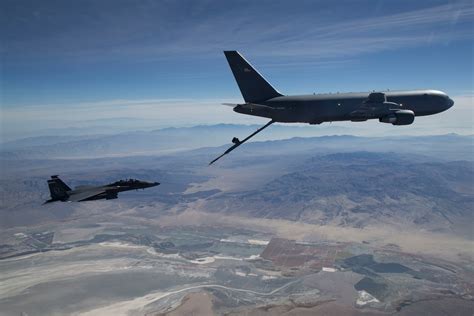
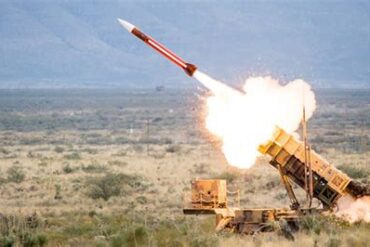
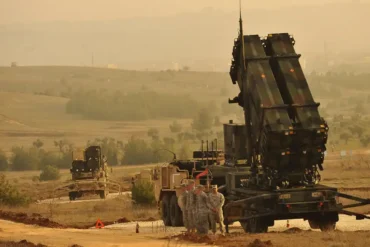
Hard-kill defense for aircraft is not science fiction, but it is unforgiving engineering. An interceptor small enough to live on a tanker must detect, launch, maneuver, and collide with a supersonic threat in seconds. Earlier research into miniature self-defense munitions explored interceptors roughly a meter long, far smaller and cheaper than traditional air-to-air missiles. The U.S. Navy’s requirements for transport aircraft defense envisioned internal launchers or external pods capable of engaging multiple inbound threats in quick succession. Concepts patented by defense firms imagine compact launch cells tucked into fairings, coupled to automated cueing from onboard sensors and networked feeds. The design constraints are merciless. Weight competes with fuel. Drag competes with range. Magazine depth competes with internal space needed for cargo, crew systems, and refueling equipment.
The sensing problem is as hard as the interceptor itself. A tanker does not carry the same sensor suite as a frontline fighter. To make hard-kill feasible, detection must be fused from infrared search and track, onboard radar, and offboard cues from other aircraft and space assets. This is where survivability stops being just hardware and becomes a data problem. Resilient connectivity is the bloodstream of the concept. The Air Force’s push toward proliferated low Earth orbit satellites and hybrid communications is not an abstract modernization effort. It is the scaffolding that allows a lumbering tanker to see what a stealth fighter or a space sensor sees, in time to react. When links hold, a tanker can adjust its route, posture its defenses, and engage threats earlier in the timeline. When links fail, reaction collapses back into seconds.
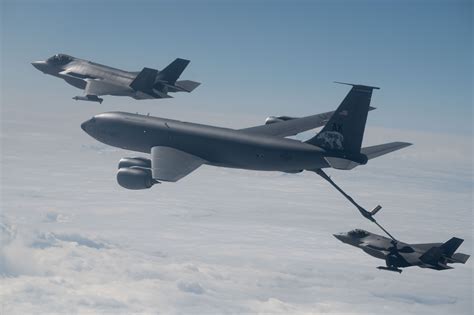
This networked vision also reshapes how tankers operate alongside stealth aircraft. The traditional geometry of air refueling—fighters darting forward, tankers loitering far behind—grows brittle when adversaries can reach into rear areas with precision. A tanker that can defend itself kinetically changes the calculus of where refueling tracks can be placed and how close support aircraft can push toward contested airspace. The effect is not invulnerability. It is resilience. It widens the envelope of survivable operations in a battlespace that is otherwise closing in on high-value enablers.
Global trends underline the same pressure. Support aircraft around the world are being asked to do more in environments where sanctuary is a myth. Japan’s exploration of palletized strike capabilities for the Kawasaki C-2 transport aircraft reflects a willingness to turn logistics platforms into participants in long-range fires. The logic is unsettling and practical at the same time. When adversaries can target the enablers, the enablers must either defend themselves or contribute directly to deterrence. Even civilian-derived aircraft operating near contested airspace have begun to integrate infrared countermeasures, a quiet acknowledgement that the boundary between military and civilian risk is blurring wherever modern air defenses reach.
The American tanker fleet’s sheer scale magnifies the stakes. The United States operates the overwhelming majority of the world’s air-to-air refueling capacity, with hundreds of aircraft forming the circulatory system of global power projection. The KC-135, a design that first flew when slide rules ruled engineering desks, still makes up the bulk of that force. The KC-46A is growing into the role, but production timelines stretch into the next decade. Future concepts under the Next Generation Air Refueling System look at blended wing bodies and signature-managed designs, hints of a future where tankers are less conspicuous by design. Hard-kill self-protection sits in the awkward middle. It is a retrofit for a fleet that cannot be replaced overnight and cannot afford to operate as if the sky behind the front lines is empty of danger.
There is also a cultural adjustment underway. Mobility forces have long been framed as support, not shooters. Kinetic self-protection blurs that boundary. It asks crews to think about engagement envelopes, interceptor inventories, and the choreography of defensive fires, all while maintaining the mission of refueling and airlift under pressure. Training pipelines, command and control doctrine, and even cockpit ergonomics must adapt to a world where a tanker crew may face the same split-second decisions as a fighter pilot, without the luxury of fighter agility.
The strategic meaning of this move is not subtle. Targeting tankers has always been a way to unravel an air campaign by pulling on its logistical threads. By hardening those threads, the Air Force signals that it expects adversaries to try exactly that. Hard-kill defenses will not make tankers invisible, and they will not eliminate risk. They change the economics of attack. An adversary must allocate more weapons to achieve the same effect, complicate their kill chains, and accept higher uncertainty. In deterrence theory, uncertainty is not a bug. It is friction that slows escalation and buys time for maneuver.
The sky over future battlefields will be crowded with sensors, decoys, data links, and fast-moving threats. In that sky, a lumbering tanker launching an interceptor at an inbound missile looks like a scene borrowed from speculative fiction. The strange part is not the image. The strange part is how quickly it is becoming normal.