The question of whether a Boeing KC-767 tanker is bigger than a KC-135 Stratotanker sounds deceptively simple. Bigger can mean length, wingspan, weight, fuel carried, fuel actually offloaded, or the kind of missions the aircraft can sustain far from home. In aerial refueling, size is not a beauty contest. It is a physics problem wrapped in strategy, engineering trade-offs, and decades of operational scars.
The KC-135 is the elder statesman, a jet that entered service when slide rules were cutting-edge and nuclear deterrence defined design priorities. The KC-767 lineage—expressed most clearly today in the KC-46A Pegasus—comes from a different era, shaped by efficiency, survivability, and global reach. If the goal is to understand “bigger” in the only way tankers truly care about—how much fuel they can deliver where it matters—the comparison becomes sharply revealing.
Before diving into numbers, it helps to frame the comparison correctly. The KC-135 and KC-767-based tankers do not merely differ by decades of technology; they were optimized for different operational worlds. One was built to keep bombers topped up near forward bases. The other is meant to act as a mobile fuel bridge across oceans, feeding fighters, bombers, and transports deep into contested airspace. That context turns raw dimensions into meaning.
The KC-135 Stratotanker: A 1950s Giant That Refuses to Retire
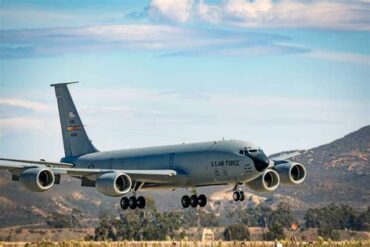
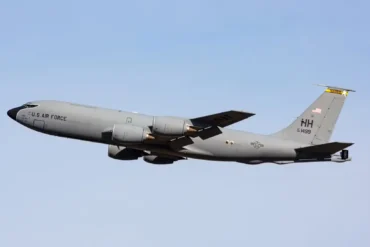
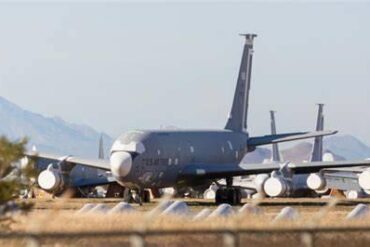
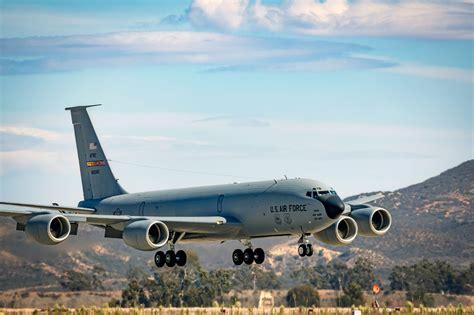
The KC-135 Stratotanker is the original workhorse of U.S. aerial refueling, derived from the Boeing 367-80 prototype that also birthed the 707. Its longevity borders on the mythic. The oldest active KC-135 airframes predate many B-52s still flying today, which is a neat trick for a jet designed during the Eisenhower administration.
Physically, the KC-135 is compact by modern widebody standards. It stretches a little over 136 feet in length, with a wingspan just under 131 feet. Empty, it weighs roughly 98,000 pounds, and at maximum takeoff tips the scales at about 322,500 pounds. Four engines hang beneath its wings—today modernized to CFM F108 turbofans—but the basic aerodynamics remain rooted in mid-century thinking.
Where the KC-135 still impresses is availability. Hundreds remain in service, and the aircraft excels at shorter-range refueling missions where efficiency penalties are manageable. Its total fuel capacity of around 198,000 pounds sounds respectable until distance enters the equation. Older wings, higher drag, and conservative reserve requirements eat into what matters most: transferable fuel.
The Stratotanker’s design assumed refueling relatively close to base. As missions stretch outward—1,000 nautical miles and beyond—the KC-135’s usable offload drops sharply. At that distance, it can typically deliver about 88,000 pounds, roughly 44 percent of what it carries. The aircraft is not failing; it is behaving exactly as designed, in a world that has since changed.
The KC-767 Lineage and the Rise of the KC-46A Pegasus
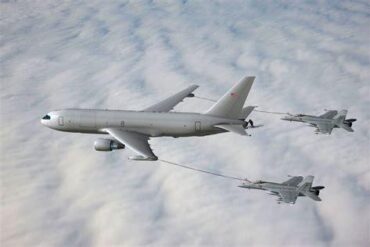
The KC-767 concept matures in the KC-46A Pegasus, the U.S. Air Force’s modern tanker derived from the Boeing 767 airliner. Although the name KC-767 is often used generically, the KC-46A is the operational reality, and it represents a step change in scale, efficiency, and mission flexibility.
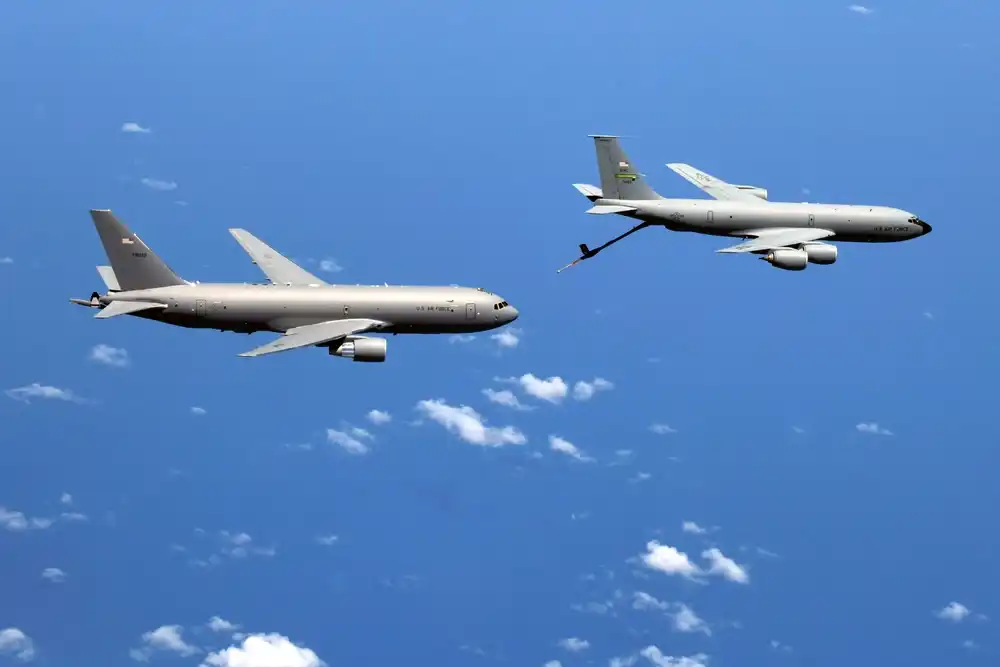
The Pegasus is visibly larger. It measures over 165 feet long and spreads a wingspan close to 158 feet. Empty weight jumps dramatically to around 181,600 pounds, and maximum takeoff weight reaches 415,000 pounds. Despite having only two engines—Pratt & Whitney PW4000s—the KC-46 carries more structural mass, more systems, and far more growth potential than the KC-135.
That extra size is not decorative. It translates into fuel, payload, and endurance. The KC-46’s total fuel capacity sits at roughly 212,000 pounds, only modestly higher than the KC-135 on paper. The real story emerges once the tanker flies a long mission, loiters, and still needs to come home with reserves intact.
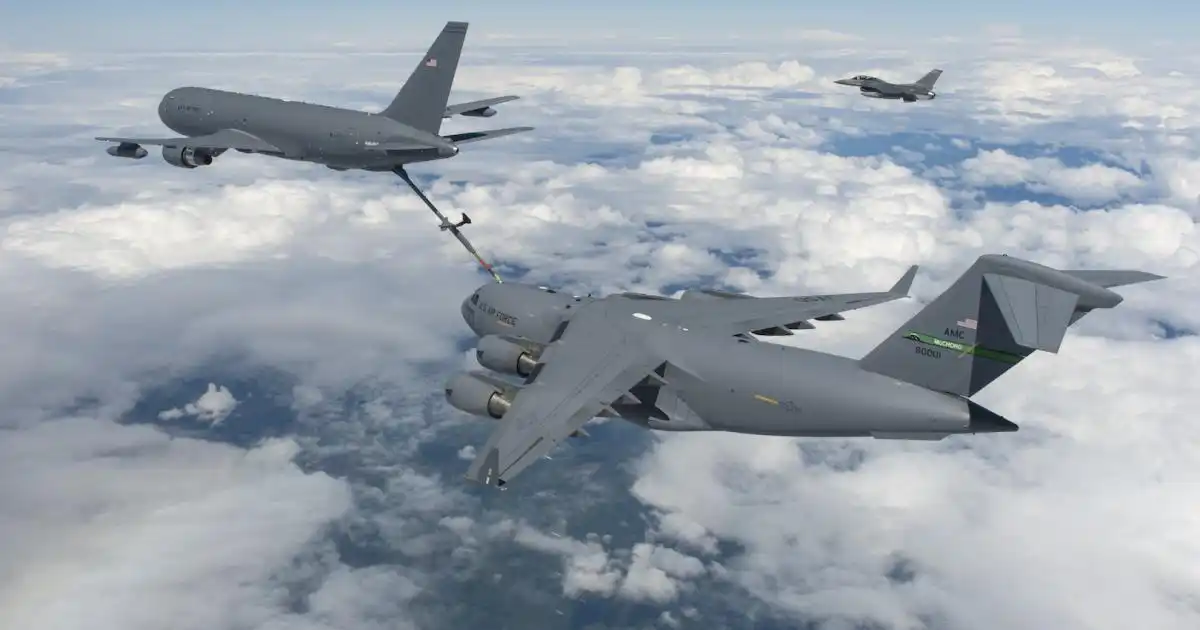
At 1,000 nautical miles, the KC-46 can typically offload between 132,000 and 143,000 pounds of fuel. That is roughly 60 to 67 percent of its total capacity—an efficiency leap that reshapes operational planning. The aircraft’s higher-aspect-ratio wings, supercritical airfoils, and optimized engines simply burn less fuel per pound carried. Modern aerodynamics pay rent every mile.
Dimensions Versus Capability: What “Bigger” Really Means
If “bigger” is interpreted as physical dimensions, the KC-767-based tanker wins cleanly. It is longer, wider, heavier, and built on a more substantial airframe. If “bigger” means maximum takeoff weight, the gap widens further. The KC-46A outweighs the KC-135 by nearly 100,000 pounds at takeoff.
Yet tankers live or die by a different metric: fuel delivered at distance. Here, the difference is not incremental; it is transformative. The KC-135 carries fuel, but the KC-46 projects fuel. At range, the Pegasus behaves like a flying pipeline, sustaining operations that would require multiple Stratotankers cycling in and out.
This is why modern air forces increasingly judge tankers by transferable fuel percentages, not raw capacity. Carrying fuel that you must burn yourself is like hauling groceries home on a treadmill. Efficiency converts mass into mission effect.
Fuel Loads in Context: Where the KC-46 Pulls Ahead
Across today’s tanker fleet—the KC-135R, KC-46A, retired KC-10A, Airbus A330 MRTT, and Il-78 variants—total fuel capacities range from about 200,000 to over 350,000 pounds. The KC-135 sits at the bottom of that range. The KC-46 inches higher in total capacity but leaps ahead in usable offload.
At operational distances, the KC-135’s transferable fuel collapses fastest because it must retain larger reserves and burns more fuel per mile. The KC-46’s reserve requirements are lower as a percentage of total fuel, and its engines are happier loitering with heavy loads. The result is not just more fuel delivered, but more predictable fuel delivery across varied scenarios.
The practical effect is fewer tankers needed to support the same strike package. That reduces congestion, simplifies command and control, and lowers risk in contested airspace. Bigger, in this sense, becomes synonymous with operational leverage.
Why the KC-135 Is Penalized by Age, Not Neglect
It is tempting to frame the KC-135’s limitations as a failure to modernize. That would be unfair. The aircraft has been repeatedly upgraded, most notably with modern turbofan engines that dramatically improved reliability and noise characteristics. What cannot be upgraded away is geometry.
The Stratotanker’s wing area, lift-to-drag ratio, and structural margins reflect assumptions from the 1950s. It was never meant to haul fuel halfway across an ocean, loiter for hours, and then sprint home. Modern tankers are shaped by computational fluid dynamics, fuel efficiency mandates, and global basing realities that did not exist when the KC-135 first flew.
Reserve policies compound the issue. The KC-135 must keep a higher proportion of fuel untouched to meet safety and regulatory requirements. Newer tankers, designed with different risk models and performance envelopes, can legally and practically offload more of what they carry.
Survivability and Systems: Size With a Purpose
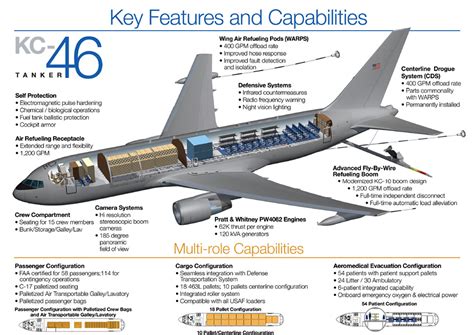
The KC-46’s size also enables systems the KC-135 simply cannot host. The Pegasus incorporates electromagnetic pulse hardening, chemical and biological protection, flight deck armor, and modern countermeasures. Infrared suppression, radio-frequency warning systems, and night-vision-compatible lighting allow it to operate closer to threats.
Those features matter because modern refueling often occurs nearer to contested zones. A tanker that can defend itself and persist longer on station effectively multiplies the combat radius of every aircraft it supports. Bigger here means harder to push away.
The KC-135, by contrast, thrives in mature theaters with established air superiority. It remains invaluable, but its comfort zone is narrower. That difference in survivability further tilts the definition of “bigger” toward the KC-46’s side of the ledger.
Mission Flexibility Beyond Refueling
Another quiet advantage of the KC-767 platform is its multi-role capability. The KC-46 is not just a tanker; it can carry passengers, cargo, and medical evacuation pallets. It can function as an airborne communications node, extending networks across theaters. These roles do not replace refueling, but they make the aircraft more useful per sortie.
The KC-135 can carry passengers and cargo, but within tighter limits. Its cabin and systems were never designed for the breadth of roles now expected from strategic enablers. In a world where aircraft are judged by how many problems they solve per flight hour, that matters.
Answering the Question Directly: Is the KC-767 Bigger?
Measured by length, wingspan, empty weight, maximum takeoff weight, and fuel offload at range, a KC-767-based tanker like the KC-46A Pegasus is unequivocally bigger than the KC-135 Stratotanker. More importantly, it is functionally bigger, turning fuel into operational reach with far less waste.
The KC-135 remains a marvel of endurance and value, a jet that has outlived generations of doctrine. It continues to refuel fighters, bombers, and transports every day. Yet when distance, survivability, and efficiency define the mission, the KC-767 lineage steps into a different weight class altogether.
In the end, “bigger” in aerial refueling is not about silhouette on a runway. It is about how much combat power arrives on time, topped up and ready to work. By that measure, the KC-767-based tanker does not just edge out the KC-135—it redefines the scale of the mission itself.