The sheer scale of American air power is one of the most misunderstood aspects of modern military balance. Casual observers often assume the US Navy, with its globe-spanning aircraft carriers, dominates the skies by virtue of visibility alone. In reality, the United States Air Force (USAF) operates a vastly larger and more diverse aircraft inventory, designed to sustain global operations at a tempo no other nation can match. Size, however, is only the opening act. The real story lies in why these fleets look the way they do and how their differences shape American military power.
At a glance, the numbers are stark. The US Air Force fields nearly 4,900 aircraft, while the US Navy and US Marine Corps combined operate around 3,800. That gap alone would place the Air Force among the largest air forces in history, even if the Navy did not exist. But numbers without context can mislead. Each service is engineered for a different problem set, and those design philosophies echo loudly in their fleet composition.
Airframes are not just machines; they are physical expressions of doctrine. The Air Force is built for strategic depth, long-range strike, and global mobility. The Navy and Marines are designed for forward presence, sea control, and rapid power projection from contested waters. Understanding how much bigger the Air Force is means understanding why its fleet had to grow that way in the first place.
The Scale Gap That Defines US Air Power
The Air Force’s numerical advantage is not incremental; it is structural. With roughly double the total number of aircraft, the USAF operates at a scale unmatched by any other branch or foreign military. Even when the Navy and Marine Corps aviation arms are combined, the Air Force still maintains a commanding lead.
This disparity becomes clearer when broken down by aircraft role. Fighters, often seen as the glamour assets of air power, show a narrower gap. The Air Force operates about 1,610 fighters, while the Navy and Marines together field 748. That difference shrinks further when accounting for joint naval aviation operations, where Marine squadrons routinely deploy aboard Navy carriers.
Where the gap explodes is everywhere else. Airlift, tankers, bombers, and special mission aircraft overwhelmingly favor the Air Force. These categories rarely make headlines, yet they form the connective tissue of modern warfare. Without them, fighters and carriers become static symbols rather than functional instruments of power.
The result is a paradox. The Navy often appears more visible, but the Air Force quietly underwrites nearly every major US military operation worldwide.
Fighters: Near Parity at the Sharp End
At the so-called pointy end of the spear, the numbers tell a more balanced story. When US Navy and US Marine Corps fighters are combined, their total comes surprisingly close to the Air Force’s fighter inventory. This near parity reflects operational reality. Naval and Marine aviation function as a single ecosystem, trained, deployed, and fought as an integrated force.
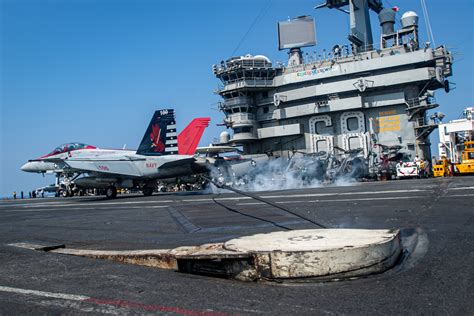
Carrier aviation changes the geometry of combat. Aircraft like the F/A-18 Super Hornet and F-35C Lightning II trade raw range for proximity. A fighter launched from a Nimitz- or Ford-class supercarrier starts its mission hundreds of miles closer to the target than a land-based jet. That proximity compensates for smaller internal fuel loads and heavier airframe reinforcement required for carrier operations.
The Air Force counters with different strengths. The F-35A, free from carrier structural penalties, carries more fuel and payload. Legacy platforms widen the performance gap even further. The F-15 Eagle, especially in its modernized variants, remains a dominant air superiority and strike platform. Above all sits the F-22 Raptor, the world’s first fifth-generation fighter, which the Navy never fielded due to carrier compatibility constraints.
In fighter terms, the fleets reflect balance rather than dominance. The difference lies not in who has more jets, but in where those jets fight and how quickly they can be brought to bear.
Strategic Mobility: Where the Air Force Pulls Away
The largest numerical chasm between the services appears in airlift and refueling. The Air Force operates over 1,150 airlift and tanker aircraft, compared to just 246 for the Navy and Marines combined. This imbalance is deliberate and absolute.
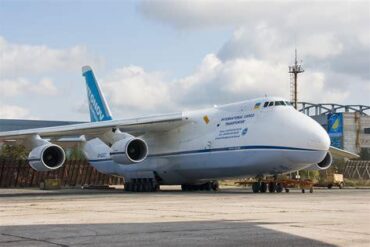
The USAF is the exclusive logistics backbone of the US military. From humanitarian relief to full-scale war, nearly every large movement of troops, vehicles, and supplies depends on Air Force cargo aircraft. Platforms like the C-17 Globemaster III, C-130 Hercules, and the colossal C-5 Galaxy move everything from special operations teams to main battle tanks across continents.
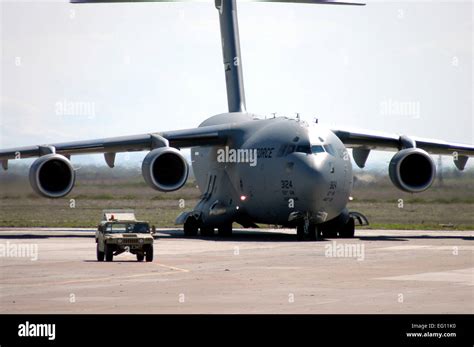
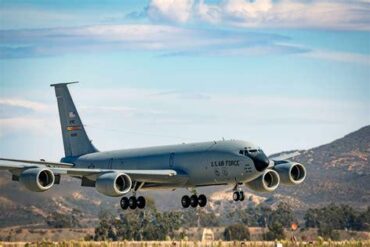
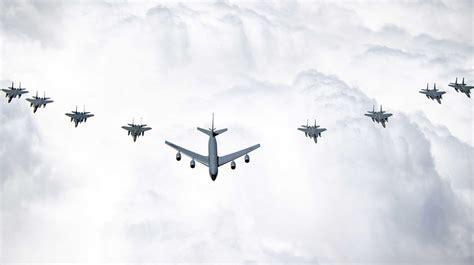
Airlift is inseparable from refueling. The Air Force’s fleets of KC-135 Stratotankers and KC-46 Pegasus aircraft give US forces global reach. Fighters, bombers, and transports alike rely on aerial refueling to sustain long-range operations. The Navy and Marines maintain a modest KC-130 capability, but it is tactical in nature and limited in scale.
This monopoly on mobility explains why the Air Force is so much bigger. It is not simply another combat arm; it is the enabler of all others.
Bombers and the Strategic Strike Monopoly
If airlift explains the Air Force’s size, bombers explain its uniqueness. The US Air Force is one of only three services on Earth to operate strategic bombers, and the only one to do so at scale. The Navy has none. The Marines have none. This is not a gap; it is a categorical difference.
The Air Force controls two legs of America’s Nuclear Triad: intercontinental ballistic missiles and nuclear-capable bombers. Aircraft carriers, no matter how powerful, cannot host bombers of this class. That reality was settled decades ago when even large carrier-based aircraft like the A-5 Vigilante proved impractical for sustained strategic strike roles.
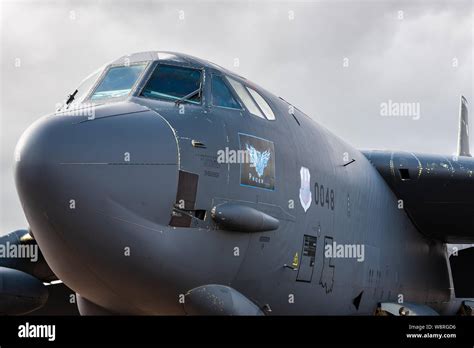
Today, the bomber fleet spans generations. The B-52 Stratofortress, designed in the 1950s, remains operational and is projected to serve into its second century. The B-2 Spirit introduced stealth to strategic bombing, and the forthcoming B-21 Raider will define sixth-generation strike warfare. No naval equivalent exists, nor could one realistically be developed.
This alone accounts for hundreds of additional airframes and cements the Air Force’s numerical superiority.
Rotary-Wing Reality: Naval Aviation’s Hidden Strength
The balance flips dramatically when the discussion turns to helicopters and tilt-rotors. Here, the Navy and Marines dominate. They operate over 1,220 rotary-wing aircraft, compared to just 218 in the Air Force inventory.
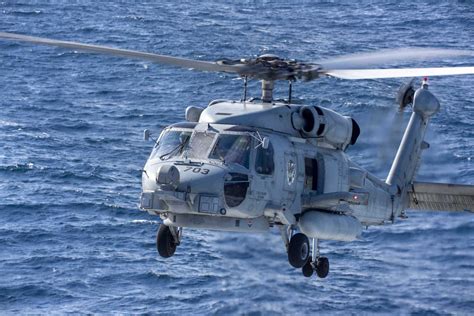
This is mission-driven. Naval warfare depends on helicopters for anti-submarine warfare, search and rescue, vertical replenishment, and ship-to-shore logistics. Marines rely on them to execute amphibious assaults and rapid troop movement across contested littorals.
The V-22 Osprey exemplifies this philosophy. Operated primarily by the Marines, it combines helicopter-like vertical lift with turboprop speed and range. The Navy has now adopted a carrier-based variant to replace the aging C-2 Greyhound, simplifying logistics and aligning naval aviation more closely with Marine operations.
Heavy-lift capability further tilts the scale. The CH-53K King Stallion, the largest single-rotor helicopter in the Western world, allows Marines to move artillery and vehicles directly from ships to the battlefield. The Air Force maintains rotary assets only for niche roles like combat search and rescue.
Special Mission Aircraft and Electronic Warfare
Beyond fighters and transports lies a shadow fleet of special mission aircraft that shape the modern battlespace. Here, the numbers are closer, but the roles diverge sharply.
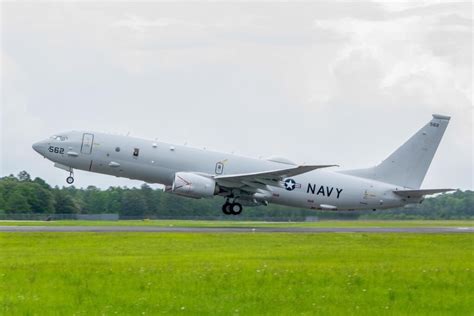
The Navy’s P-8A Poseidon and MQ-4C Triton dominate maritime surveillance, providing persistent coverage of oceans and chokepoints. These platforms are indispensable in the Pacific, where distances dwarf those of any other theater.
Electronic warfare reveals a rare case where the Air Force depends on the Navy. The EA-18G Growler provides escort jamming for strike packages, a capability the Air Force lacks in a comparable form. While the USAF operates standoff jamming aircraft like the EC-130H, it often relies on Navy Growlers in high-threat environments.
Airborne early warning presents another contrast. The Navy’s E-2D Hawkeye has proven adaptable and survivable, while the Air Force’s aging E-3 Sentry fleet faces retirement amid uncertainty over replacements. This divergence hints at future shifts in fleet composition rather than simple numerical growth.
Doctrine Explains the Numbers
The reason the US Air Force fleet is so much bigger than the Navy’s is not waste or redundancy. It is doctrine. The Air Force exists to project power globally, independent of basing agreements or naval presence. That mission demands scale, redundancy, and endurance.
The Navy and Marines focus on forward-deployed power, accepting smaller numbers in exchange for proximity and flexibility. Their aircraft do not need to cross oceans; their ships do that for them.
Each fleet looks oversized only when judged by the other’s standards. Together, they form a complementary system that allows the United States to fight across domains, distances, and durations that no other military can replicate.
Size Versus Influence in Modern Warfare
Raw numbers tell only part of the story, but they matter. The Air Force’s sheer size allows it to absorb losses, sustain rotations, and operate simultaneously in multiple theaters. The Navy’s aviation arm, though smaller, delivers immediate influence wherever carriers sail.
In practice, American air power is not a competition between services. It is an ecosystem. The Air Force is the deep reservoir, the Navy and Marines the forward edge. Remove either, and the structure collapses.
That is why the comparison is so revealing. The Air Force is bigger because it has to be. The Navy is smaller because it can be. Together, they form the largest, most flexible, and most lethal air power system ever assembled.