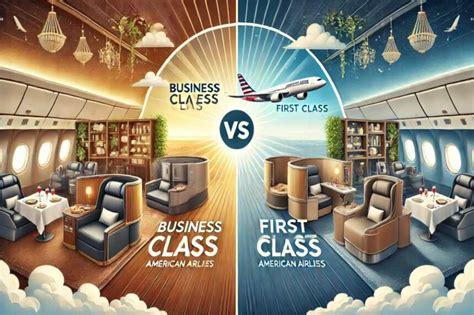
For decades, the battle between first class and business class revolved around a simple equation: more space, better food, and a quieter cabin. That equation no longer tells the full story. Modern long-haul business class cabins now offer fully flat beds, direct aisle access, large entertainment screens, premium dining, and privacy doors that would have seemed futuristic only fifteen years ago. On paper, many travelers could reasonably ask a dangerous question for airlines: if business class has become this good, what exactly is left for first class to justify fares that can exceed the price of a luxury car?
The answer emerges most clearly on ultra-long-haul flights. Once travel time stretches beyond 12, 14, or even 16 hours, the difference between these cabins transforms from incremental comfort into entirely separate lifestyles in the sky. One focuses on efficient premium travel for executives and affluent travelers. The other attempts to create a controlled private environment designed to minimize every form of friction associated with international flying.
Airlines increasingly understand that true luxury is no longer defined merely by a comfortable seat. Comfort has become standardized. The new battlefield is privacy, personalization, silence, timing control, and exclusivity. The modern first class experience is not built around transportation anymore. It is built around isolation from the stress of transportation itself.
Passengers stepping onto an Emirates A380, Singapore Airlines Airbus A380, or Lufthansa Boeing 747-8 immediately notice that the atmosphere changes dramatically depending on which curtain they pass through. In business class, there is sophistication and efficiency. In first class, there is intentional separation from the rest of the aircraft.
Modern Business Class Has Become Exceptionally Good
The rise of modern business class is the single biggest reason airlines have struggled to maintain traditional first class cabins. A decade ago, business class often meant angled seats, awkward sleeping positions, limited privacy, and cabin layouts that forced passengers to climb over strangers during overnight flights. That era is effectively over among leading global carriers.
Today’s flagship business products resemble miniature hotel rooms more than airplane seats. Qatar Airways’ celebrated Qsuite introduced closing privacy doors, customizable quad seating arrangements, and sophisticated cabin architecture that blurred the line between business and first class. ANA’s “The Room” expanded personal space to extraordinary levels, while Delta One Suites, Air France Business, and British Airways Club Suite modernized privacy expectations across the Atlantic market.
The transformation has democratized premium comfort. Travelers can now expect:
- Fully flat beds
- Direct aisle access
- Large high-definition entertainment displays
- Elevated dining menus
- Bedding partnerships with luxury brands
- Wi-Fi connectivity
- Extensive airport lounge access
These improvements matter enormously on ultra-long-haul sectors. Flying from New York to Singapore or Dubai to Los Angeles means spending nearly an entire day inside a metal tube. Under those conditions, sleep quality becomes more important than champagne labels.
Yet even with this dramatic leap forward, business class still operates within the constraints of scale. Airlines must maximize revenue while accommodating dozens of premium passengers simultaneously. A typical business cabin may contain between 40 and 76 seats, even on luxury-oriented airlines.
That density fundamentally changes the atmosphere onboard.
First Class Sells Space More Than A Seat
The biggest difference between first class and business class is not the seat itself anymore. It is the amount of personal territory surrounding that seat.
In business class, privacy exists within a shared environment. In first class, airlines attempt to create the illusion that other passengers barely exist at all.
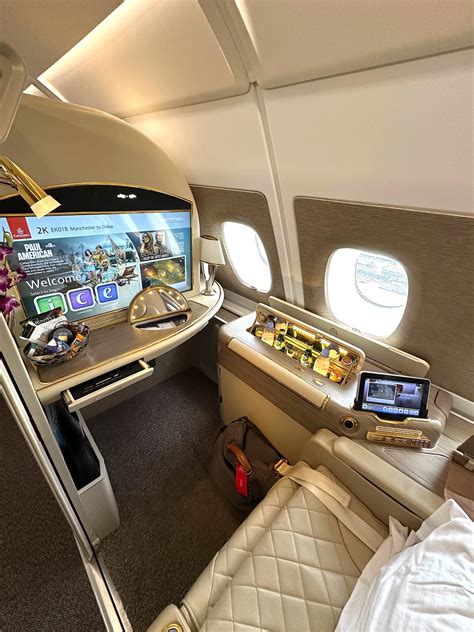
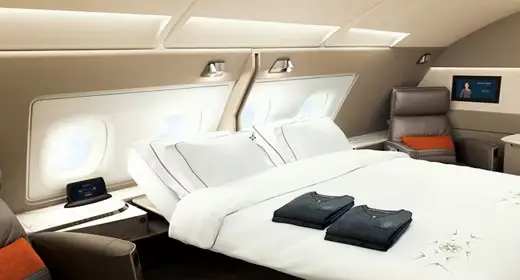
Singapore Airlines Suites exemplify this philosophy perfectly. Each suite includes sliding doors, a separate bed detached from the seat, premium leather finishes, and enough room to stand comfortably without feeling confined. Emirates first class goes even further with fully enclosed suites featuring virtual windows on center seats, personal minibars, vanity stations, and individualized climate controls.
The hardware is impressive, but the true differentiator is cabin density. An Emirates A380 may carry around 76 business class passengers upstairs while dedicating the nose of the aircraft to only 14 first class suites. Some airlines reduce that number even further. Japan Airlines and Air France increasingly focus on ultra-exclusive cabin layouts with only a handful of passengers.
This low-density environment creates several cascading advantages.
Cabins remain quieter because fewer people are moving around. Lavatories stay cleaner because they are shared among fewer travelers. Flight attendants provide far more personalized attention because passenger ratios are dramatically lower. Meal timing becomes flexible instead of synchronized. Even overhead bin competition effectively disappears.
On ultra-long-haul flights, those details compound hour after hour.
Dining Becomes A Matter Of Personal Control
Food quality in business class has improved significantly across premium international airlines. Travelers now regularly encounter restaurant-style plating, expanded wine lists, espresso machines, and regionally inspired menus.
However, the structure of the experience remains highly standardized.
Most business cabins operate according to fixed service schedules. Shortly after takeoff, cabin lights illuminate, meal carts begin moving, trays appear, and the cabin transitions into synchronized dining mode. Several hours later, breakfast service repeats the cycle.
For leisure travelers, this system works reasonably well. For ultra-long-haul passengers battling severe jet lag, it can become disruptive.
A traveler flying from London to Tokyo may desperately need immediate sleep after departure to function upon arrival. Being forced into a predetermined dining sequence interrupts that strategy. Business class service, regardless of quality, still prioritizes operational efficiency.
First class changes the equation entirely through dining-on-demand systems.
Passengers choose when they want to eat, what pace they prefer, and sometimes even how dishes are prepared. Caviar service, premium wagyu beef, lobster thermidor, vintage champagne, and high-end wine programs are not simply indulgent luxuries. They are part of a broader philosophy centered around passenger autonomy.
Instead of adapting to airline timing, the airline adapts to the passenger.
This distinction becomes critically important on 15-hour or 16-hour flights. Travelers can sleep uninterrupted for ten hours if desired, wake naturally, dine privately, and arrive feeling substantially more functional. For executives attending meetings immediately after landing, that flexibility carries genuine operational value.
The Airport Experience Separates The Classes Even Further
The divide between first and business class actually begins long before boarding.
Business class airport experiences have improved substantially over the past decade. Priority check-in counters, fast-track security lanes, and premium lounges are now common across major hubs. Many lounges include showers, buffets, workspaces, bars, and quiet seating areas.
Yet most business lounges remain crowded during peak departure periods.
At airports like Heathrow, Doha, Dubai, or Singapore Changi, flagship business lounges can host hundreds of passengers simultaneously. Even beautifully designed spaces begin to feel busy when multiple long-haul departures overlap.
First class attempts to eliminate this atmosphere entirely.
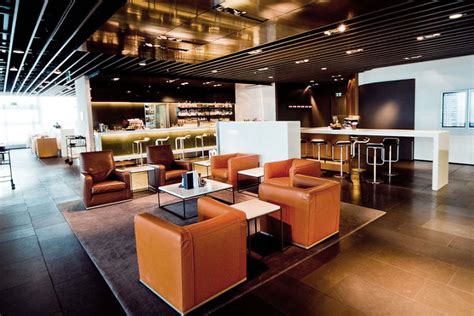
Lufthansa’s legendary First Class Terminal in Frankfurt represents one of the clearest examples of how airlines redefine luxury through separation. Rather than entering the main terminal, first class passengers access a dedicated standalone building with private immigration processing, à la carte dining, sleeping rooms, cigar lounges, bathtubs, and individualized service staff.
The experience feels less like an airport and more like a private members club attached to an aviation operation.
The climax arrives during boarding. Instead of walking through crowded gate areas or standing in jet bridge queues, passengers are often chauffeured directly across the tarmac in luxury vehicles to the aircraft stairs.
That seamless transition matters psychologically. Stress never meaningfully enters the experience.
Why Many Airlines Are Abandoning First Class
Despite its glamour, first class faces harsh economic realities.
Modern business cabins generate far greater revenue density per square foot. Airlines discovered that many corporate travelers would not pay exponentially higher fares for first class once business class seats became fully flat and highly private.
As a result, several carriers have eliminated international first class entirely.
American Airlines has shifted focus toward premium business products. United Airlines abandoned traditional long-haul first class years ago. Other carriers increasingly view business class as the optimal balance between luxury and profitability.
The economics are difficult to ignore.
A single first class suite occupies enormous floor space that could otherwise fit multiple business seats. On highly competitive routes, airlines must justify sacrificing that revenue potential for a relatively small group of ultra-wealthy travelers.
This is why first class has become heavily concentrated among specific global regions and airlines. Middle Eastern giants like Emirates, Qatar Airways, and Etihad continue investing heavily in prestige cabins because luxury branding remains central to their identities. Asian carriers such as Singapore Airlines, ANA, and Japan Airlines view first class as an extension of national hospitality standards.
European legacy airlines like Lufthansa, Air France, and British Airways maintain first class selectively on flagship routes where elite demand remains strong.
Meanwhile, countless international routes now operate exclusively with business class as the highest available cabin.
Ultra-Long-Haul Flights Magnify Every Difference
On shorter flights, the gap between business and first class can feel surprisingly small. A six-hour daytime journey simply does not provide enough time for premium distinctions to fully unfold.
Ultra-long-haul routes are different.
A 16-hour flight amplifies every aspect of the onboard experience: noise levels, sleep interruptions, service pacing, privacy, storage space, lavatory cleanliness, passenger movement, lighting conditions, and crew responsiveness.
Small frustrations become psychologically magnified after ten consecutive hours onboard.
In business class, passengers still share cabin rhythms with dozens of others. Lights turn on collectively. Meal services create movement and noise. Crew attention remains divided among large passenger counts. Even excellent products retain a sense of organized scale.
First class minimizes these variables aggressively.
Passengers can often remain inside a controlled personal environment for nearly the entire journey. Crew interactions become discreet and individualized. Sleep occurs without mass disruptions. Dining becomes flexible instead of scheduled.
This explains why ultra-high-net-worth travelers continue supporting first class despite enormous ticket prices.
For them, the product is not about indulgence alone. It is about preserving energy, concentration, privacy, and routine during exhausting international travel.

The Price Difference Is Absolutely Massive
The financial gap between business and first class remains staggering.
On routes like New York to Dubai, Singapore to Los Angeles, or London to Tokyo, business class fares frequently range between $6,000 and $8,000 round-trip during peak periods. First class tickets on identical flights can easily exceed $15,000 or even $20,000.
That pricing structure raises an unavoidable question: is first class actually worth it?
For most travelers, the answer is probably no.
Modern business class already provides the overwhelming majority of practical benefits needed for comfortable ultra-long-haul travel. Passengers receive flat beds, privacy, premium food, airport lounges, priority handling, and strong onboard service.
The remaining upgrades delivered by first class exist within the realm of diminishing returns.
Travelers pay enormous premiums for quieter cabins, additional personal space, exclusive ground services, flexible dining schedules, luxury alcohol programs, and enhanced personalization.
From a purely rational perspective, business class represents the better value proposition.
But luxury markets rarely operate according to strict rationality.
For billionaires, celebrities, heads of state, and senior executives whose schedules demand immediate productivity after landing, the incremental improvements of first class may justify the price entirely.
The Future Of First Class Will Become Even More Exclusive
Contrary to repeated predictions of extinction, first class is unlikely to disappear completely. Instead, it is evolving into something even more specialized.
Future cabins will probably shrink dramatically while becoming significantly more extravagant. Airlines increasingly envision ultra-premium sections containing only two to four oversized suites instead of traditional multi-row first class cabins.
The arrival of aircraft like the Boeing 777X may accelerate this trend. Airlines can reduce cabin weight and maximize fuel efficiency while still offering extraordinarily profitable luxury products for elite travelers.
The future first class passenger will not simply purchase transportation. They will purchase insulation from the modern travel ecosystem itself.
That distinction matters because airports and airplanes continue becoming more crowded every year. Business class, despite its sophistication, still functions within large-scale commercial operations. First class increasingly attempts to create an entirely parallel world adjacent to those operations.
As ultra-long-haul flying expands further, airlines understand that certain travelers will continue paying immense sums for total control over their environment. Privacy, silence, flexibility, and exclusivity remain powerful currencies at 40,000 feet.
Business class may now deliver astonishing comfort compared to previous generations, but first class continues moving further upward into a category defined less by seating hardware and more by complete environmental mastery.
And on a 16-hour journey across oceans and continents, that difference can feel enormous.