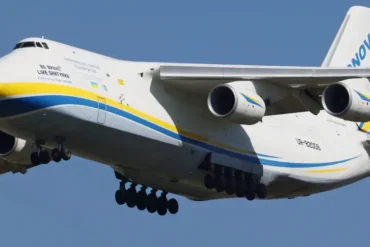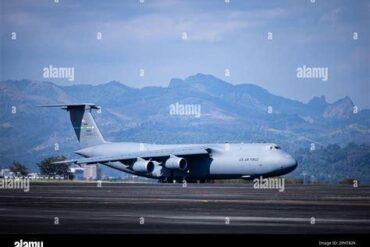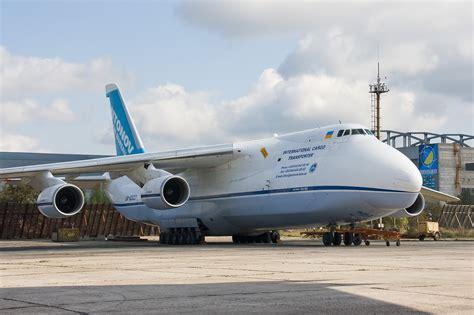
In the rarefied world of strategic airlift, size is not bragging rights—it is operational power. The ability to move outsized, overweight, and mission-critical cargo across continents in a single sortie defines military logistics, disaster relief, and global industry. Two aircraft dominate this conversation like tectonic plates colliding in the sky: the Antonov An-124 Ruslan and the Lockheed Martin C-5 Galaxy, specifically the C-5M Super Galaxy.
At first glance, the debate seems simple. Both aircraft are enormous, four-engine, high-wing transports with nose and rear loading, designed during the Cold War when logistics was as much about deterrence as delivery. Yet “bigger” in aviation is a slippery concept. It can mean longer, wider, heavier, more voluminous, or more operationally dominant. Each metric tells a different story, and together they reveal why this question refuses to die.
By examining external dimensions, internal cargo geometry, payload and weight limits, and real-world operational impact, the answer becomes clearer—and more interesting. One aircraft occupies more physical space. The other projects its reach farther across the globe. Size, it turns out, is multidimensional.
Cold War Origins That Shaped Two Giants
Both aircraft emerged from the same strategic anxiety: how to move armies and infrastructure faster than any adversary thought possible. The C-5 Galaxy first flew in 1968, designed to airlift American armored divisions across oceans without relying on seaports. The Soviet response arrived later but heavier. The An-124 Ruslan, which entered service in the 1980s, was engineered with a singular obsession: out-lifting and out-sizing the Galaxy wherever possible.
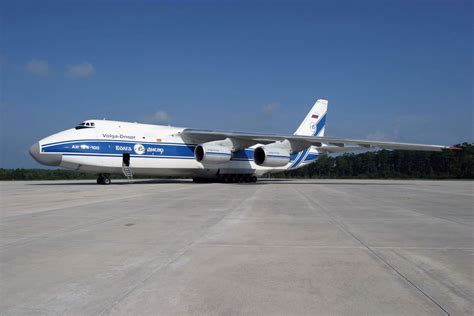
That intent matters. The An-124 was not simply a transport aircraft; it was a statement of industrial capacity, built to haul ballistic missile components, power-station turbines, and armored vehicles that were never meant to fly. The C-5, by contrast, prioritized global reach, flexibility, and military tempo, even if that meant conceding raw payload supremacy.
External Dimensions: Width Versus Length
If size is judged by sheer physical footprint, the An-124 begins to pull ahead quickly. Its wingspan measures 73.3 meters (240 feet 6 inches), dwarfing the C-5M’s 67.9 meters (222 feet 9 inches). On crowded aprons, this difference is immediately obvious. The Antonov simply occupies more lateral space, a direct consequence of its wing design and lift requirements for heavier loads.
The fuselage tells a similar story. The An-124 is shorter overall, measuring 69.1 meters, while the C-5M stretches out to 75.3 meters (247 feet 1 inch), making the American aircraft roughly 20 feet longer from nose to tail. Length, however, is only one axis of size, and in heavy-lift aviation, width and volume often matter more than linear measurement.
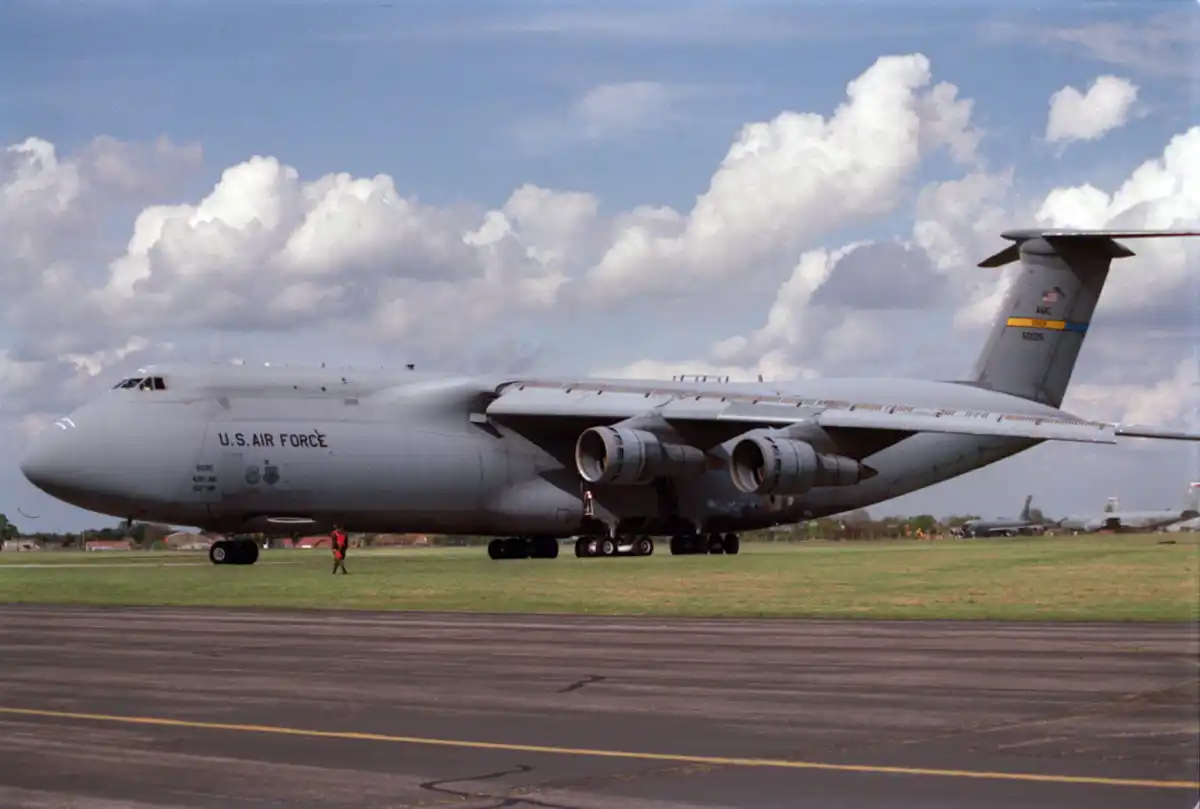
The result is a paradox that fuels endless debate. The C-5M is longer, but the An-124 is wider, broader, and physically bulkier. One looks stretched; the other looks massive.
Internal Cargo Volume: Where Size Becomes Practical
External dimensions impress spectators. Internal cargo dimensions decide contracts.
The An-124’s cargo hold is a masterclass in volumetric dominance. With an internal width of 6.4 meters and a height of 4.4 meters, it comfortably accommodates loads that simply will not fit inside a C-5 without disassembly. Industrial generators, wide satellite containers, and oversized construction equipment often default to the Ruslan because nothing else can swallow them whole.
The C-5M counters with length. Its cargo floor extends to 43.8 meters, significantly longer than the An-124’s usable deck. This makes the Galaxy ideal for transporting multiple vehicles in sequence, long missile systems, or extended infrastructure components that benefit from uninterrupted floor space rather than extra width.
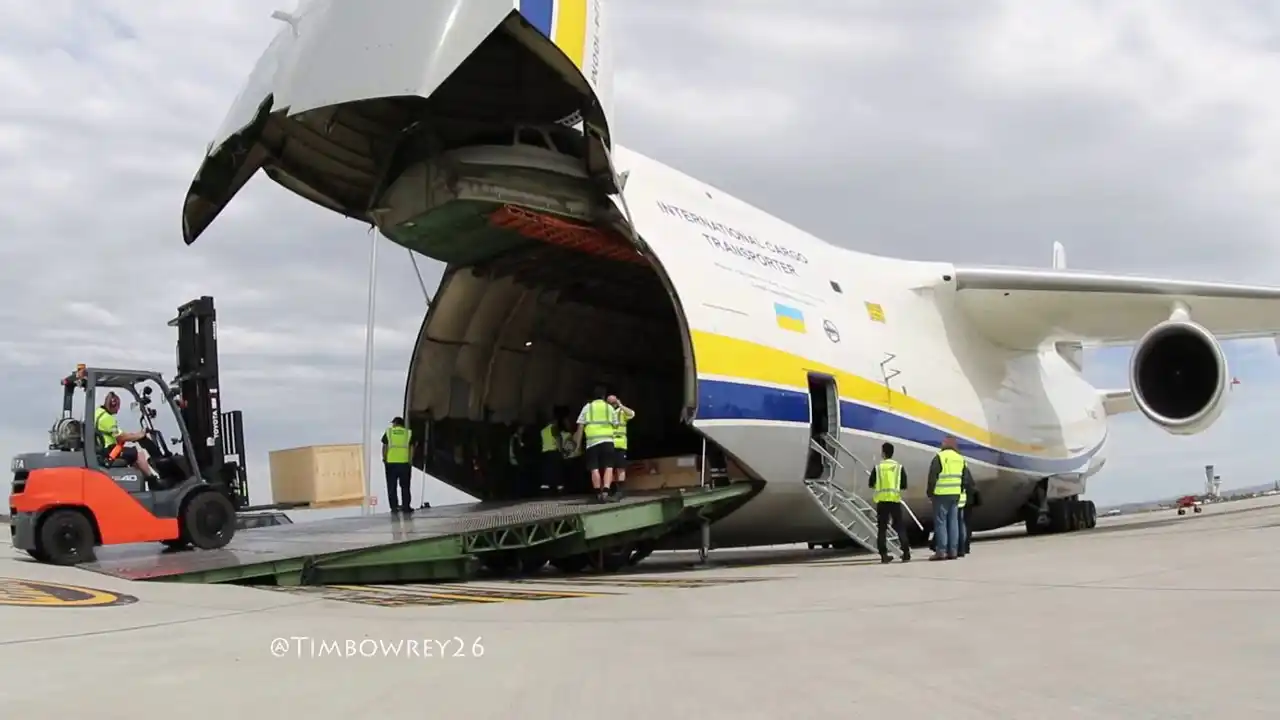
From an operator’s perspective, the An-124 feels like a flying warehouse, while the C-5 feels like a flying railcar. Both are enormous, but the An-124 encloses more usable volume, which is why it is often described as “bigger” by commercial heavy-lift specialists.
Payload and Weight: The Numbers That End Arguments
When the conversation turns to mass, the debate largely ends. The An-124-100M-150 boasts a maximum payload of 150,000 kilograms, roughly 17 percent more than the C-5M’s 127,460 kilograms. Its maximum takeoff weight reaches approximately 402,000 kilograms, exceeding the C-5M’s already staggering 381,018 kilograms.
This difference is not academic. It means the An-124 can lift heavier single items, not just more items. A fully assembled locomotive section, a massive transformer, or armored vehicles with minimal weight reduction all fall within the Ruslan’s comfort zone.
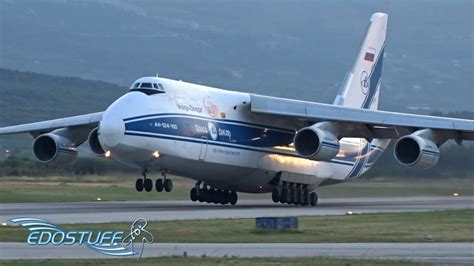
The C-5M remains formidable, but in pure lifting contests, the Antonov is the heavyweight champion. If size is defined by how much mass an aircraft can move in one flight, the An-124 is unequivocally bigger.
Engines, Wings, and the Cost of Being Massive
Bigness has consequences. The An-124’s immense payload comes at the cost of runway hunger. At maximum takeoff weight, it requires nearly 9,800 feet of runway, restricting operations to large, well-prepared airports. Its Progress D-18T engines deliver enormous thrust, but physics remains unimpressed by ambition.
The C-5M, powered by GE CF6 engines and benefiting from an optimized high-lift wing, needs only about 5,400 feet to launch at comparable weight. This difference fundamentally alters operational flexibility. The Galaxy can operate from more airfields, including forward bases where the An-124 simply cannot go when fully loaded.
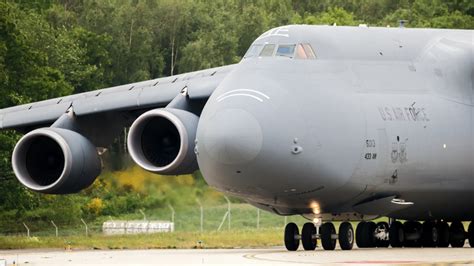
In this sense, the An-124 is bigger but less agile. The C-5M is slightly smaller but more forgiving of geography.
Loading Philosophy: Industrial Muscle Versus Military Tempo
Size is not only about space; it is about how that space is used. The An-124 includes two internal bridge cranes, each capable of lifting 30,000 kilograms. This allows it to load cargo at austere airports with minimal ground support. For commercial operators moving equipment into developing regions, this feature alone can decide contracts.
The C-5M emphasizes speed and flow. Its true drive-through capability, enabled by opening both the nose and rear ramp simultaneously, allows vehicles to enter from one end and exit the other. In combat logistics, where minutes matter and congestion kills efficiency, this design choice amplifies the Galaxy’s operational presence.
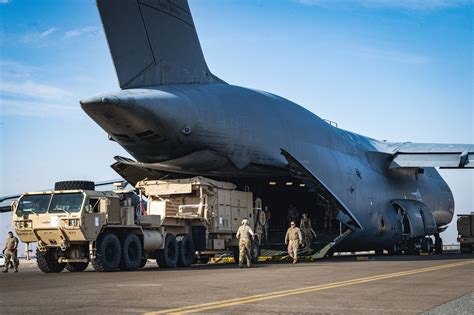
The An-124 feels bigger because it is self-sufficient and cavernous. The C-5M feels faster because it is optimized for sustained military tempo.
Range and Aerial Refueling: Operational Size Versus Physical Size
Here, the Galaxy flips the narrative. The C-5M is capable of aerial refueling, granting it effectively unlimited range. It can deliver heavy payloads across oceans without landing, bypassing diplomatic constraints and refueling stops.
The An-124 lacks this capability. Long intercontinental flights require multiple fuel stops, each one a negotiation, a delay, and a vulnerability. In geopolitical terms, this makes the C-5M operationally larger, even if it is physically smaller in some dimensions.
An aircraft that can reach anywhere without landing projects a bigger shadow than one that must pause along the way. Size, again, depends on how it is measured.
Comparison With Other Heavy Lifters
Context sharpens perspective. The Boeing 747-8F is actually longer than both aircraft at 76.3 meters, yet its nose-only loading and narrower cargo floor limit its ability to carry ultra-wide loads. The Airbus BelugaXL and Boeing Dreamlifter boast enormous fuselage diameters but are weight-limited, designed for aircraft parts rather than dense machinery.
Above them all once flew the Antonov An-225 Mriya, a six-engine colossus that rendered the An-124 and C-5 modest by comparison. With its destruction in 2022, the An-124 reclaimed the title of largest operational production freighter in the world.
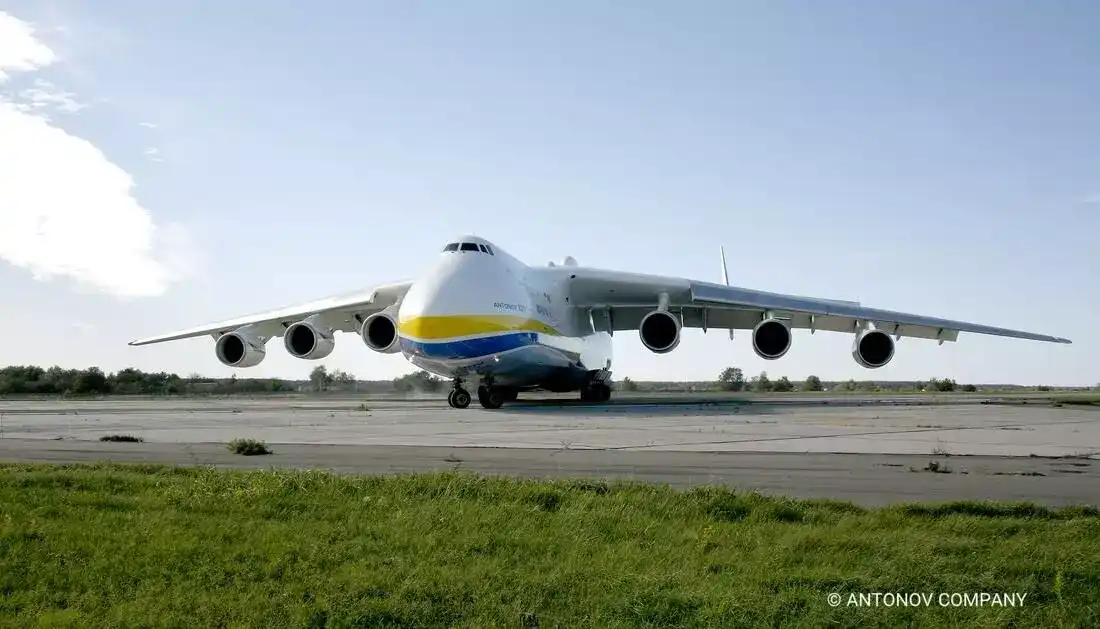
In today’s skies, the An-124 stands as the physical giant, while the C-5M remains the most globally agile strategic lifter.
Reliability, Availability, and the Reality of Scale
Bigness means nothing if it cannot fly. The An-124 fleet is aging and increasingly constrained by parts availability and geopolitics. Maintenance challenges often sideline aircraft for extended periods. The C-5M, following its modernization program, offers improved avionics and engines, though reliability gains have been more modest than once promised.
For operators, a slightly smaller aircraft that is consistently available can outweigh a larger one grounded by logistics. Scale without sustainability becomes theoretical.
So, Is the An-124 Bigger Than the C-5 Galaxy?
By physical volume, wingspan, payload capacity, and internal width, the Antonov An-124 Ruslan is bigger. It carries more weight, encloses more cargo, and dominates the commercial heavy-lift market for outsized loads.
By length, runway flexibility, and global reach, the C-5M Super Galaxy asserts a different kind of size, one measured in operational influence rather than cubic meters.
In aviation, the most honest answer is this: the An-124 is the larger machine, while the C-5M casts the longer shadow. Each defines size on its own terms, and together they represent the outer limits of what humans have dared to lift into the air.