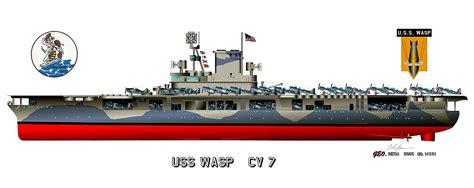
The U.S. Navy’s decision to extend the operational life of the USS Wasp (LHD-1) is about far more than preserving another aging warship. It is a clear sign that America’s naval modernization timeline is slipping under mounting industrial, logistical, and strategic pressure. While headlines recently focused on the delayed retirement of the legendary USS Nimitz, another massive “flattop” quietly received its own reprieve — and the implications are significant for the future of U.S. maritime power.
The USS Wasp, the lead ship of the Wasp-class amphibious assault fleet, was originally expected to approach retirement near the end of this decade. Instead, the vessel is now projected to remain in active service until 2034, extending its lifespan well beyond the traditional 40-year benchmark for ships of its class. The move reflects the Navy’s growing concern over replacement delays and the urgent need to maintain force projection capability in increasingly contested regions.
Although officially classified as an amphibious assault ship, the USS Wasp often resembles a conventional aircraft carrier at first glance. Its enormous flat flight deck stretches across 844 feet, supporting a wide range of aircraft including F-35B Lightning II stealth fighters, MV-22 Osprey tiltrotors, helicopters, and unmanned systems. With a displacement of approximately 41,000 tons, the ship carries enough aviation power to operate as a compact strike platform during high-intensity operations.
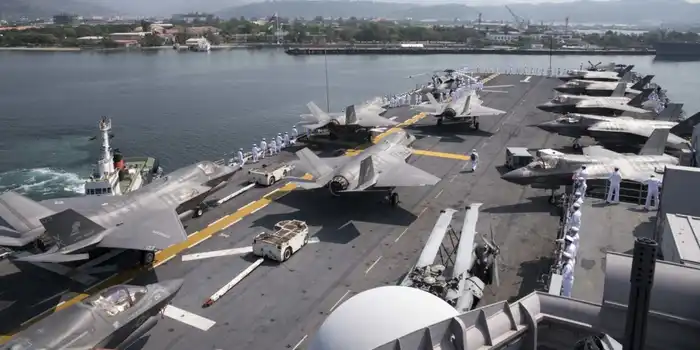
The vessel also serves as a floating Marine expeditionary base. More than 1,200 sailors operate the ship, while roughly 1,000 Marines and support personnel can embark during combat deployments. This dual-purpose role has become increasingly valuable as the Pentagon shifts toward flexible, fast-moving naval formations capable of operating across the Pacific theater.
The Navy’s decision to keep the Wasp active follows a major modernization effort completed only a few years ago. The ship underwent an extensive refurbishment beginning in 2019 before returning to operational status in 2022. Those upgrades improved combat systems, aviation support infrastructure, and long-term survivability, effectively preparing the vessel for another decade at sea.
Yet the real reason behind the extension lies in the troubled pace of replacement programs. The Navy originally planned for the newer America-class amphibious assault ships to gradually take over the missions currently handled by the Wasp-class fleet. That transition has moved far slower than expected.
Only two America-class vessels — USS America (LHA-6) and USS Tripoli (LHA-7) — are currently operational despite long-standing plans for an 11-ship program. Additional ships remain under construction with timelines continuing to slide. The USS Bougainville (LHA-8) is not expected to enter service until after 2027, while the USS Fallujah (LHA-9) may not arrive until the early 2030s.
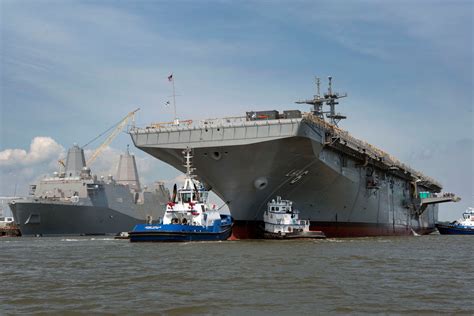
Those delays have created a dangerous capability gap. The retirement of the USS Bonhomme Richard following its catastrophic 2020 fire already reduced the operational Wasp-class fleet from eight ships to seven. Removing additional vessels before replacements are ready would significantly weaken the Navy’s ability to support Marine expeditionary operations, crisis response missions, and distributed aviation warfare.
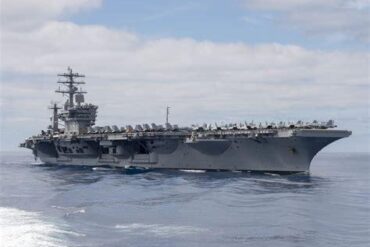
The broader picture reveals a Navy increasingly forced to stretch the lives of legacy vessels because next-generation platforms are arriving too slowly. The same issue affecting the USS Wasp also explains why the USS Nimitz remains in service longer than planned while the delayed USS John F. Kennedy (CVN-79) completes sea trials.
For Washington, extending the service life of proven flattops may be the only realistic short-term solution. Building modern warships has become vastly more expensive and technologically demanding, while global tensions continue rising across the Indo-Pacific, Middle East, and Arctic regions. Retiring capable ships too early is no longer an option.
The USS Wasp’s extended future therefore represents more than a maintenance decision. It is a reflection of the U.S. Navy’s struggle to balance modernization ambitions with operational reality — and a reminder that even aging warships remain indispensable in an increasingly unstable world.