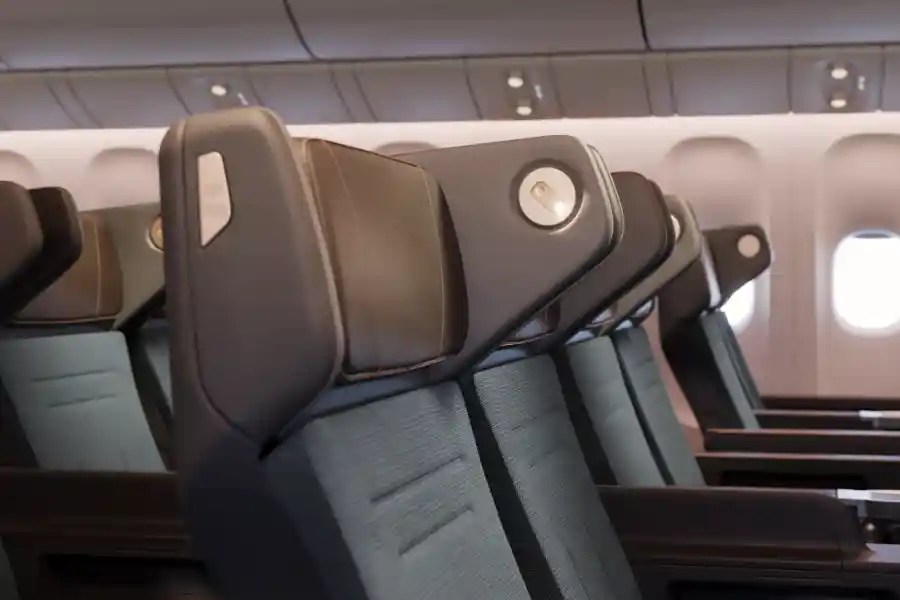
Premium economy has moved from an afterthought to a core part of long-haul strategy, and the Boeing 777-300ER is one of the aircraft most closely associated with that shift. Its wide cabin gives airlines room to wedge a genuinely separate premium economy section between business class and economy, complete with its own seats, service rituals, and price point. But the product is anything except standardized. Seat width, pitch, recline, screen size, dining, and even the presence of a dedicated lavatory change from carrier to carrier and, in several cases, from aircraft to aircraft within the same fleet.
American Airlines, United Airlines, Cathay Pacific, Emirates, and Singapore Airlines all sell the cabin on at least some of their 777-300ER airframes, and together they demonstrate how differently five carriers can answer the same commercial question. One has just rolled out a fully redesigned seat, another treats premium economy as a compact 24-seat enclave, and a third folds airport benefits into the fare. The details below refer to the specific 777-300ER configurations each airline operates, not to every route or aircraft those carriers fly.
American Airlines: A Redesigned Premium Economy Cabin on the 777-300ER
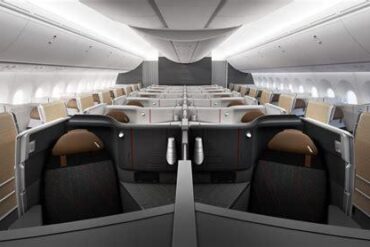
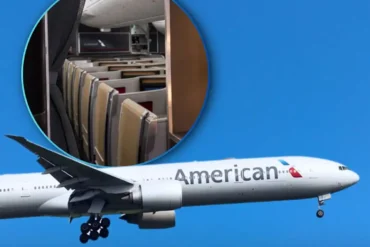
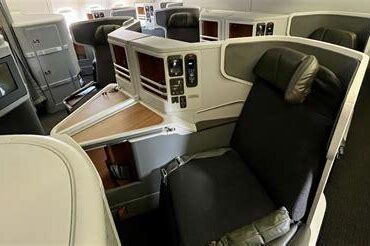
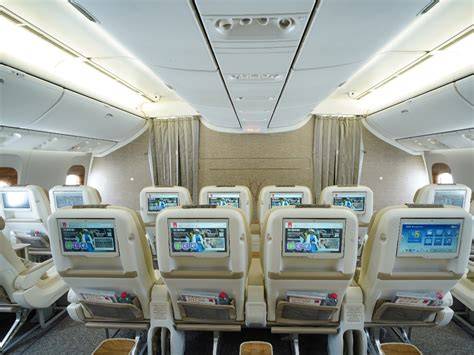
American Airlines has made premium economy a far more visible feature of its Boeing 777-300ER through a sweeping interior redesign. The refreshed aircraft carry 44 premium economy seats slotted between the Flagship Suite business-class cabin and the main economy section, part of a deliberate effort to expand the number of premium seats available on long-haul routes. In the updated layout the aircraft holds 330 seats overall, including 70 Flagship Suites and 30 Main Cabin Extra seats. That last figure matters: Main Cabin Extra remains an extra-legroom zone inside economy rather than a distinct cabin class, whereas the 44-seat premium economy section is a clearly walled-off space rather than a scattering of preferred seats.
The redesigned seat itself is built around long, overnight flying. It features sculpted headrests, adjustable calf and footrests, and additional personal storage—small touches that matter when a passenger wants to shift position or settle in for several hours without rummaging through the cabin. Wireless charging is also built into the seating environment, cutting the need to keep a device tethered to a cable throughout the flight. The overall effect is a clearer step up from standard economy in both physical support and practical technology, while preserving a substantial gap in fare and service between premium economy and Flagship Suite.
The refurbishment also rebalances the aircraft’s premium inventory, giving American more seats in its upper cabins while retaining a large economy section. The airline has been introducing the updated 777-300ERs progressively, so travelers should check the specific aircraft assigned to a flight rather than assuming every 777-300ER carries the new interior. American’s first commercial flight with the redesigned aircraft was scheduled from New York John F. Kennedy International Airport to Buenos Aires on September 2, 2026, with the program continuing as further aircraft receive the cabin. Aircraft assignments can change at short notice, so the refreshed interior should be verified before travel.
United Airlines: Premium Plus on a Dedicated 777-300ER Cabin
United Airlines positions its Premium Plus product on the 777-300ER directly between Polaris business class and economy. In one representative 350-seat configuration, the aircraft carries 60 Polaris seats, 24 Premium Plus seats, and 266 economy seats. The 24-seat section is arranged in a 2-4-2 layout, offering pairs of seats along each window and a four-seat block in the center. That geometry appeals to couples and solo travelers who would rather not sit in a broad economy bank, though the small size of the cabin makes seat selection more consequential for groups traveling together.
The compact footprint creates a more contained atmosphere, with fewer rows and less foot traffic than the main economy cabin. Passengers receive a wider seat with additional recline and leg support, alongside upgraded dining and amenities. Because exact onboard service and seat features can vary by aircraft and route, travelers should review the details attached to their specific flight when choosing a fare. The distinction becomes most obvious on overnight sectors, where reclining and resting are worth more than a few extra inches of legroom.
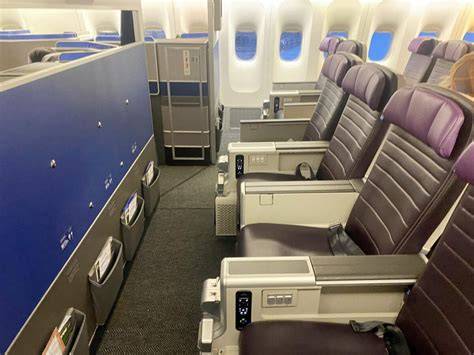
United’s seat maps also separate Premium Plus from Economy Plus, the airline’s extra-legroom option within the economy cabin. In the cited 350-seat layout, 62 economy seats are designated as extra-legroom seats, but they do not form a separate cabin class and do not deliver the same seat or service as Premium Plus. Economy Plus primarily adds legroom, while Premium Plus is a distinct cabin with a different seat and additional amenities. Because United’s 777-300ER layouts can differ, the seat map for the booked flight is the most reliable reference, and fare comparisons should weigh the full Premium Plus product rather than treating the seat map as a legroom chart.
Cathay Pacific: A Refreshed Premium Economy on the 777-300ER
Cathay Pacific has folded its 777-300ER premium economy cabin into a wider investment in refreshing the aircraft’s long-haul interior. The airline has been introducing redesigned cabins across its 777-300ER fleet, with updated business class, premium economy, and economy sections. The new premium economy product sits between the Aria Suite business-class cabin and economy, giving passengers an intermediate option on selected long-haul services. Cathay has framed the work as a major cabin refresh rather than a change limited to seat covers or cosmetic details, aimed at updating the passenger experience throughout the aircraft.
The most visible feature of the refreshed premium economy cabin is its 15.6-inch 4K widescreen entertainment display. The system supports Bluetooth audio pairing, letting passengers connect compatible personal headphones instead of relying solely on a wired connection. Cathay has also highlighted updated seating, improved privacy, and more considered cabin lighting and fixtures. These changes are designed to make the cabin feel more comfortable across a long flight while delivering a more modern entertainment experience, and the airline has added dedicated premium economy lavatories on the refreshed aircraft—a detail frequent flyers notice quickly on a 12-hour sector.
Bluetooth pairing is particularly useful for travelers who already carry wireless headphones and would rather not hunt for an adapter. Cathay Pacific’s refurbishment program covers 30 Boeing 777-300ER aircraft, with the updated interiors returning to service progressively, so the new premium economy experience is not guaranteed on every 777-300ER flight. Passengers should check the aircraft and seat map attached to their itinerary, especially when selecting a specific seat or paying a premium for the refreshed product. Notably, Cathay’s newer 777 cabin also departs from some competitors at the top end: the announced configuration includes business class, premium economy, and economy without a separate first-class cabin, which makes premium economy a distinct pillar of the redesigned long-haul offering rather than a stepping stone below first.
Emirates: Wider Seats and Dedicated Leg Supports on Retrofitted 777s
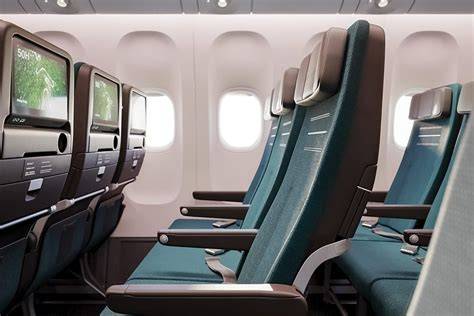
Emirates introduced premium economy on selected Boeing 777-300ER aircraft as part of its broader cabin-refurbishment program. The 777 version has a dedicated 24-seat premium economy cabin arranged in a 2-4-2 layout, positioned between business class and economy at the front of the economy area. Because the cabin is available only on aircraft that have received the relevant interior, it should not be assumed to appear on every Emirates 777-300ER service. The layout creates a genuinely separate section while keeping the seat count relatively intimate for an aircraft of this size.
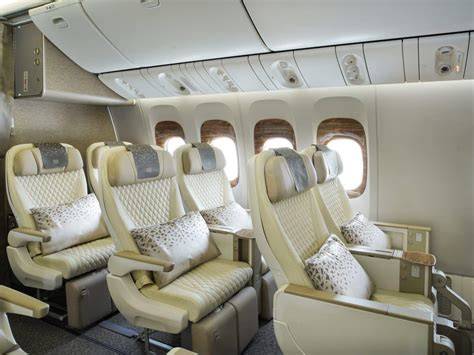
Emirates’ premium economy seat is upholstered in cream-colored leather and built with a six-way adjustable headrest, calf rest, and footrest. The 777 seat offers 38-inch pitch and is 19.5 inches wide, providing more room than a standard economy seat. It reclines by up to eight inches, and an in-seat charging point keeps personal devices powered during the journey. A wooden dining table and a separate side cocktail table add usable surfaces, giving passengers more flexibility when eating, working, or using a laptop.
The combination of seat width and pitch is especially relevant on long sectors, where small differences affect how easily a passenger settles in. Emirates’ onboard entertainment system is another part of the product, with a 13.3-inch screen in premium economy. The cabin is designed to deliver a more substantial upgrade than simply selecting an extra-legroom economy seat, pairing a wider recliner with dedicated foot support and a separate cabin environment. Emirates has installed the product on selected refurbished aircraft, and its wider retrofit program means the fleet is changing over time. Travelers should confirm that premium economy is offered on their particular flight before booking around the cabin’s features or paying a higher fare.
Singapore Airlines: Compact Premium Economy With Airport Perks
Singapore Airlines offers premium economy on its Boeing 777-300ER, with a 28-seat section in the airline’s 264-seat four-class configuration. The cabin is arranged in a 2-4-2 layout between business class and economy, giving passengers paired window seats or center-section seats while keeping the section separate from the larger economy area. The same configuration includes four first-class seats and 48 business-class seats, making premium economy one part of a cabin arrangement that serves several long-haul fare categories simultaneously. Its location between business and economy makes the product easy to distinguish from the standard economy offering.
The smaller premium economy section gives the cabin a more defined atmosphere than the main economy area, while the seat itself is designed to offer additional personal space and recline. Singapore Airlines’ premium economy service also extends beyond the physical seat, with priority check-in and boarding, an increased baggage allowance, and access to its Book the Cook meal-preordering service on eligible flights. Those benefits appeal to passengers who value a smoother airport experience and more choice over their onboard meal, as well as to those simply looking for more room during the flight. Availability of individual benefits can vary by route, so passengers should review the conditions attached to their booking.
As with the other carriers on this list, the exact aircraft configuration matters when booking Singapore Airlines premium economy. The 28-seat layout is specific to the cited 264-seat 777-300ER configuration, and the airline operates different aircraft types and cabin arrangements across its network. Passengers should use the seat map for their individual flight to confirm that the aircraft includes premium economy and to see which seats are available. For travelers on a route served by the relevant 777-300ER, Singapore Airlines offers a relatively compact premium economy cabin backed by a defined set of airport and onboard benefits—an important point when comparing premium economy across airlines, since the fare name alone does not describe every benefit.
How the Five 777-300ER Premium Economy Products Differ
Set side by side, the five cabins reveal how much room the 777-300ER gives airlines to shape the same proposition. American Airlines leads with 44 seats and a fully redesigned shell featuring wireless charging and adjustable calf and footrests. Cathay Pacific matches it in ambition with 48 seats, 19-inch width, 40-inch pitch, and a 15.6-inch 4K screen. Emirates counters with up to 19.5-inch width, 40-inch pitch, and dedicated calf and footrests. United Airlines keeps things tight with 24 seats in a dedicated Premium Plus cabin, and Singapore Airlines offers 18.5-inch width, 38-inch pitch, and a 13.3-inch screen across 28 seats. Seat count, then, is no proxy for comfort: the smallest cabins can deliver the widest seats, while the largest cabins can deliver the most technology.
The through-line is the separate cabin. In every case, premium economy is a defined section between business class and economy, not a preferred-seat bundle inside coach. That distinction separates these fares from Main Cabin Extra and Economy Plus, which add legroom without a different seat or service. The secondary through-line is fleet variance. American, Cathay Pacific, and Emirates are all mid-retrofit, so the same aircraft type can deliver two different premium economy experiences depending on which airframe shows up. Only the seat map for the specific flight resolves that uncertainty.
Booking the Right 777-300ER Premium Economy Seat
The practical lesson across all five airlines is that the aircraft type alone cannot confirm the product. American Airlines is rolling out its redesigned 777-300ER progressively, Cathay Pacific is refreshing 30 aircraft, and Emirates limits its cabin to selected retrofitted jets—so travelers who care about wireless charging, a dedicated lavatory, or a 4K screen should verify the assigned airframe before paying the premium. On United and Singapore Airlines, where configurations also vary, the seat map remains the single most useful tool for confirming that premium economy exists on the flight and for choosing a window pair or center block.
Fare positioning deserves equal scrutiny. Premium economy buys a wider seat, greater recline, upgraded dining, and, on some carriers, airport privileges such as priority boarding and larger baggage allowances. It does not buy the Flagship Suite, Polaris, Aria Suite, or first-class experience at the top of the aircraft. For overnight transoceanic flying, that middle ground—more space and better rest without a business-class ticket—is exactly why the cabin has become so important on the Boeing 777-300ER, and why five very different airlines keep investing in it.