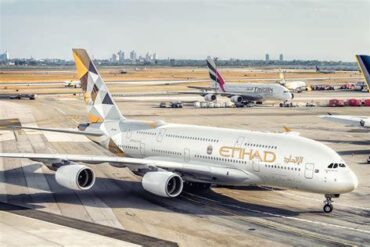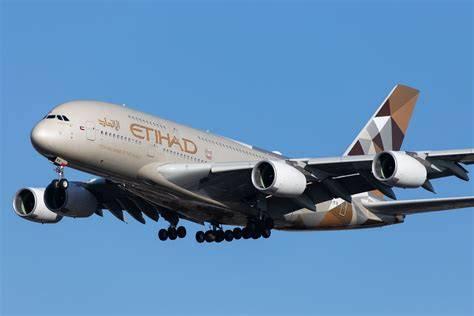
Etihad Airways has quietly ended one of the most closely watched experiments in its recent history. The Abu Dhabi-based carrier will fly its Airbus A380 to Toronto for the final time on January 18, 2027, making Canada and the entire North American market a superjumbo-free zone for Etihad. The final double-decker departure closes a chapter that lasted barely eighteen months and confirms that the airline’s premium flagship is now reserved almost exclusively for high-yield European and Asian gateways.
The daily rotation currently linking Abu Dhabi International Airport with Toronto Pearson International Airport departs the UAE capital as EY21 at 3:20 AM and lands at 8:50 AM, a block time of 14 hours and 30 minutes. The return leg, EY22, leaves Toronto at 2:25 PM and touches down in Abu Dhabi at 12:20 PM the following day after 12 hours and 55 minutes in the air. Those schedules were built around one crucial flow: connecting traffic to and from India, which forms the commercial backbone of the route far more than local point-to-point demand.
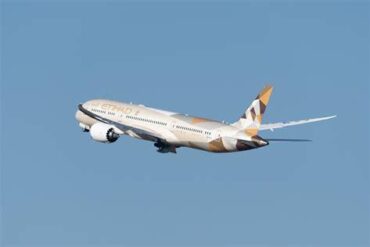
From January 19, the A350-1000 takes over. The equipment swap is not a like-for-like replacement. The A380 carries 486 seats, while Etihad’s A350 layout offers 371, a reduction of 24% per departure. The shift also removes The Residence and first class from Toronto entirely, cuts business class from 70 to 44 seats, a 37% decline, and trims economy by 78 seats, or 19%. Premium capacity falls from 17% of the total cabin on the superjumbo to just 11% on the A350, a deliberate tilt toward the lower-yielding transit passengers who fill the back of the aircraft.
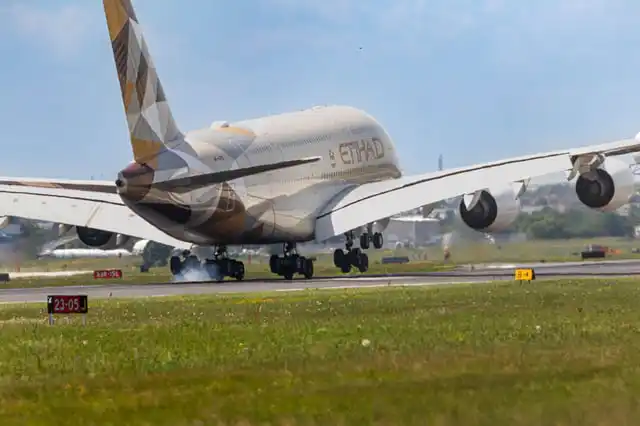
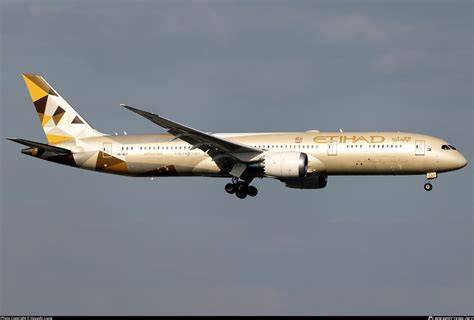
That logic explains why the change is less drastic than it first appears. Almost all of Etihad’s United States and Canada flying now relies on the A350 or the Boeing 787-9, and nearly every one of those routes has no first class at all. Bringing Toronto into line with New York JFK, Chicago, Washington Dulles and other North American destinations simplifies fleet planning and reduces the risk of flying premium cabins that Indian and European connecting passengers rarely pay for. For an airline whose hub strategy depends on funneling sixth-freedom traffic through Abu Dhabi, the smaller, more efficient jet is arguably the more honest aircraft for the mission.
The A380 first arrived in Toronto in June 2025, a debut that generated unusually loud coverage. The aircraft was redeployed from New York JFK, which meant Toronto suddenly hosted two regular superjumbo operators for the first time, with Etihad joining Emirates, which has flown the type into Pearson since 2009. It also gave Canada two double-decker operators simultaneously for the first time since British Airways withdrew the A380 from Vancouver in 2022. Barely a year and a half later, the Canadian superjumbo renaissance is down to a single carrier again.
Singapore Loses Its A380 After a Brief Christmas Return
Singapore followed a slightly different trajectory. The A380 debuted on the Abu Dhabi-Singapore route in February 2025 and flew daily until early April 2026, when the Boeing 787-9, with 226 seats, took over. The superjumbo returned briefly in June, then departed once more. The plan called for a daily reintroduction from December 15, and that return will still happen, but only until January 10, capturing Christmas and New Year demand before the Dreamliner resumes on January 11.
The current daily pattern has EY498 leaving Abu Dhabi at 10:05 PM and landing in Singapore at 9:35 AM the next morning, with EY499 departing Changi at 7:25 PM and arriving at 11:00 PM. Unlike Toronto, Singapore’s traffic mix centers on connections to and from Europe, and the A380’s premium density suits that flow better, which makes its eventual exit a closer call commercially. The wider Changi picture is also shifting: Qatar Airways pulled the A380 from Doha-Singapore in March 2026, the same month Qantas stopped flying it from Melbourne, while British Airways introduced the type from London Heathrow six months later. Emirates continues to grow, and will operate roughly three daily A380 services into Changi next year.
The Remaining A380 Network Shrinks to Four Routes
By January 19, Etihad’s superjumbo map will consist of four cities. Bangkok stays daily through the end of March 2027, London Heathrow retains two daily services, and both Paris CDG and Tokyo Narita return at the end of March 2027 on a daily basis. It is a compact network that concentrates the double-decker where premium demand is thickest and where slot constraints at constrained airports make extra seats genuinely valuable.
Timing matters here. The cuts land roughly a month after Etihad reactivated its final A380, and Ch-aviation data shows the carrier holding nine superjumbos, with a tenth airframe scrapped. Whether the freed aircraft are parked or redeployed remains open, because the list of routes that can absorb a 486-seat jet without wrecking yields is short. The A380 is a superb asset on a handful of trunk routes and an expensive liability everywhere else.
The changes also follow the departure of Etihad’s Chief Revenue and Commercial Officer, Arik De, whose tenure coincided with rapid network growth and some divisive additions, including Luxembourg and Calgary. Speaking anonymously on November 6, an Etihad employee claimed that the A380 was being shifted between destinations with “absolutely nothing to do with strategy.” That allegation, unverified though it is, captures the frustration inside a commercial team watching an aircraft chase capacity rather than profit.
For travelers, the practical impact is clear. Toronto loses its most premium widebody, and anyone holding an A380 booking beyond January 18 should expect an aircraft change, a cabin downgrade, or a reaccommodation onto the A350. First class passengers heading to Canada will need to route through Europe or the Gulf on another carrier, and the prospect of Etihad first class in North America disappears entirely. For plane spotters, Pearson’s double-decker lineup narrows to Emirates, and the question now is whether Bangkok or Tokyo becomes the next destination to lose its superjumbo. On current evidence, the Etihad A380 is becoming a European and Asian specialist, and North America is simply no longer part of the plan.